Universe Today
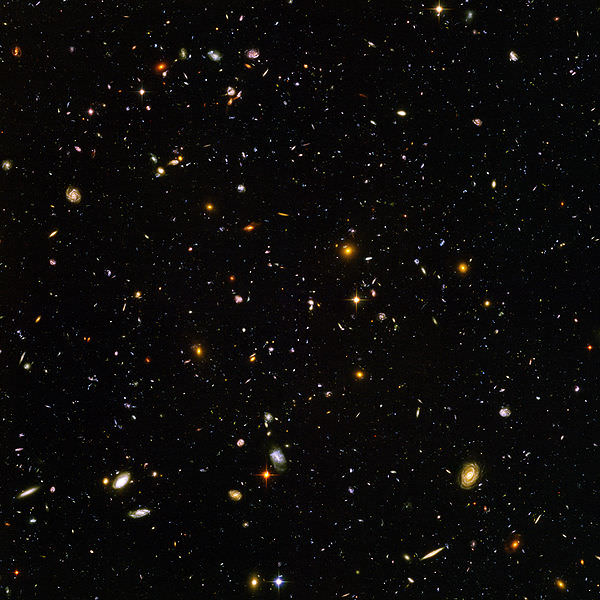
Astronomers think that there are hundreds of billions galaxies in the universe, however the exact number is not known. But astronomers should know how many galaxies we've actually seen and discovered, right? Well, not necessarily. “We don’t know,” says Ed Churchwell, professor of astronomy at the University of Wisconsin-Madison. “We know it’s a very large number.” In just one image for example, the Hubble Ultra Deep Field, above, there are about 10,000 galaxies visible.
In our own galaxy, There are between 4 billion 100-300 billion stars in the Milky Way. At most, 8,479 of them are visible from Earth. Roughly 2,500 stars are available to the unaided eye in ideal conditions from a single spot at a given time.
But the number of galaxies will keep growing as our telescopes get better and can look out and back farther in time.
“To count them all, you have to be able to look far enough back in time or deep enough in space to see when galaxies were formed,” Churchwell says. “We haven’t reached that point yet. It’s not a well-determined number, but at some point we’re going to reach it.”
The estimate of how many galaxies there are in the universe is done by counting how many galaxies we can see in a small area of the sky. This number is then used to guess how many galaxies there are in the entire sky.
For the time being, the hundreds of billions in the tally are extrapolated from the Hubble Ultra Deep Field, taken over a time period in 2003 and 2004. Pointed at a single piece of space for several months — a spot covering less than one-tenth of one-millionth of the sky — Hubble returned an image of galaxies 13 billion light years away.
“You look at that and say, ‘How many galaxies can I see?’” Churchwell explains. “And that turns out to be a very large number.”
“Then you take that number of galaxies from that postage-stamp-sized piece of the sky and multiply it by the number of postage-stamp-sized pieces of sky,” Churchwell says. “And that turns out to be a much larger number.”
In the first Hubble Deep Field image, taken in 1995, there are about 3,000 galaxies visible in the image.
Source: UW-M