Universe Today
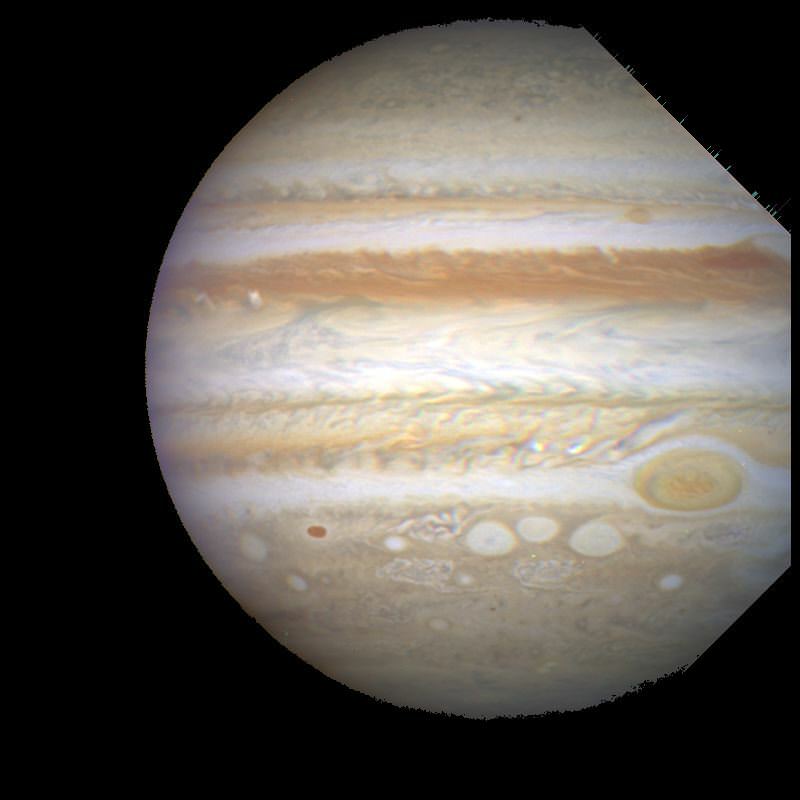
I'm sure you've heard that Jupiter is the largest planet in the Solar System, but just how big is Jupiter?
In terms of size, Jupiter is 142,984 km (88,846 miles) in diameter across its equator. If you just compare that to Earth, it's 11.2 times the diameter of Earth. But then, it's only 10% the diameter of the Sun.
The volume of Jupiter is 1.43128x10¹⁵ km3. That's enough to fit inside 1321 planets the size of Earth, and still have room left over.
The surface area of Jupiter is 6.21796x10¹⁰ km2. And just for comparison, that's 122 times more surface area than Earth.
And finally, the mass of Jupiter is 1.8986x1027 kg. That's enough mass for 318 Earths. In fact, Jupiter is 2.5 times more than the mass of all the other planets in the Solar System. But then, the Sun accounts for 99.9% of the mass of the Solar System.
Jupiter's big, no question, but don't worry about the possibility that Jupiter might become a star. It would need another 80 times its own mass to be able to ignite solar fusion.
We've written several articles about Jupiter for Universe Today. Here's an article about an impact that recently happened on Jupiter, and here's an article about how Jupiter might protect us in the Solar System.
If you'd like more information on Jupiter, check out Hubblesite's News Releases about Jupiter, and here's a link to NASA's Solar System Exploration Guide to Jupiter.
We've also recorded a whole episode of Astronomy Cast just about Jupiter. Listen here, Episode 56: Jupiter.