Universe Today
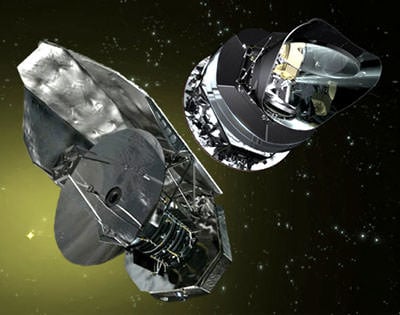
The European Space Agency announced today that the Herschel and Planck spacecraft will now launch on May 14. Liftoff had been delayed to allow time for additional checks on the Ariane 5 ECA launch vehicle. The two spacecraft are launching together in what was originally a cost saving move, but the complexity of preparing two spacecraft at once has caused frequent delays and cost overruns. However, now that the launch is near, hopefully the cutting-edge technologies included in both spacecraft will soon pay off in new discoveries astronomy and cosmology.
The Herschel Space Observatory's primary mirror is the largest single mirror ever built for a space telescope. At 3.5-meters in diameter the mirror will collect long-wavelength radiation from some of the coldest and most distant objects in the Universe. The mirror is also a technological wonder: it uses 12 silicon carbide petals fused together into a single piece. Herschel will be the only space observatory to cover a spectral range from the far infrared to sub-millimeter.
Planck is designed to image the anisotropies of the Cosmic Background Radiation Field over the whole sky, with unprecedented sensitivity and angular resolution. It will provide a major source of information relevant to several cosmological and astrophysical issues, such as testing theories of the early universe and the origin of cosmic structure.
The two satellites are being prepared for launch and recently were both fueled with hydrazine. Planck’s three-stage active cryogenic cooler, needed to keep the instruments at extremely cold temperatures, has been filled with helium-3 and helium-4. Herschel's cryogenic tanks are also being filled with superfluid helium. Herschel and Planck will liftoff from Europe's Spaceport in Kourou, French Guiana
Source: ESA