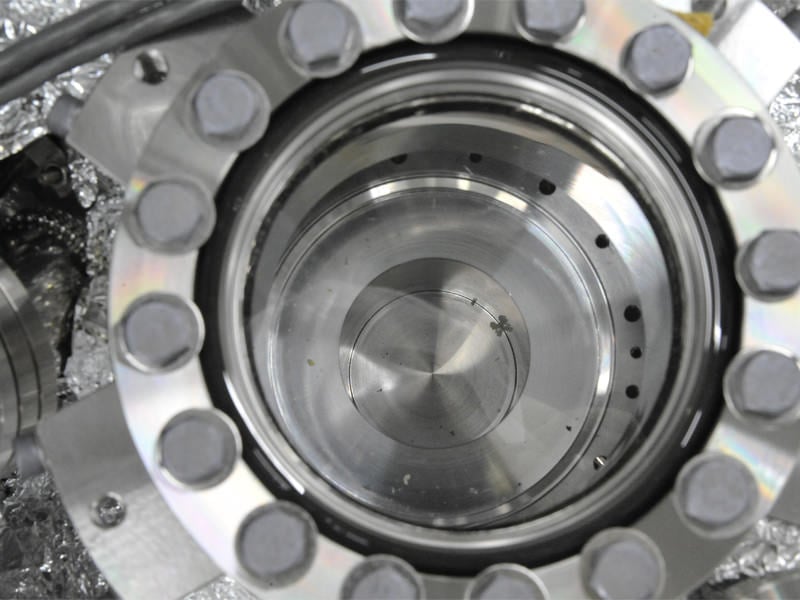
Hayabusa Sample Return Canister Opened, Contains Material

[/caption]

The sample return canister from the Hayabusa spacecraft has been opened, and does contain a small amount of dust particles, according to the

JAXA website.

This is very encouraging news! However, it is not yet known if the dust is from the asteroid Itokawa, where Hayabusa briefly touched down, or if it could be from Earth -- left in the container from before launch, or it possibly could have made its way in there during the landing/post landing handling. "Material on the planet or asteroid or particulate matter is at this stage is unknown, we will consider in detail," is the Google translate version of the JAXA press release. According to Emily Lakdawalla at the Planetary Society, the dust grains are extremely small, about 0.01-millimeter in size, and there are about a dozen of them inside the container. This image was taken on June 28, 2010, and below is a magnified view of one of the particles.

[caption id="attachment_67805" align="aligncenter" width="580" caption="Magnified view of a dust particle in the Hayabusa canister. Credit: JAXA"]

[/caption]

This magnified view was taken on June 29, and shows a magnified view of one very small particle being picked up by a quartz manipulator, which appears as a stripe on the image. It likely will take several weeks to confirm whether the particles are from the asteroid, but if so, would be the first-ever asteroid sample return.

Below is an image of Earth that Hayabusa took as it approached the home planet.

[caption id="attachment_67806" align="aligncenter" width="466" caption="Earth seen by the returning Hayabusa. Credit: JAXA"]

[/caption]

Sources:

JAXA,

The Planetary Society

,

BBC

Nancy Atkinson

Nancy Atkinson

Nancy Atkinson is a space journalist and author with a passion for telling the stories of people involved in space exploration and astronomy. She is currently retired from daily writing, but worked at Universe Today for 20 years as a writer and editor. She also contributed articles to The Planetary Society, Ad Astra (National Space Society), New Scientist and many other online outlets.

Her 2019 book, "Eight Years to the Moon: The History of the Apollo Missions,” shares the untold stories of engineers and scientists who worked behind the scenes to make the Apollo program so successful, despite the daunting odds against it. Her first book “Incredible Stories From Space: A Behind-the-Scenes Look at the Missions Changing Our View of the Cosmos” (2016) tells the stories of 37 scientists and engineers that work on several current NASA robotic missions to explore the solar system and beyond.

Nancy is also a NASA/JPL Solar System Ambassador, and through this program, she has the opportunity to share her passion of space and astronomy with children and adults through presentations and programs. Nancy's personal website is nancyatkinson.com