Universe Today
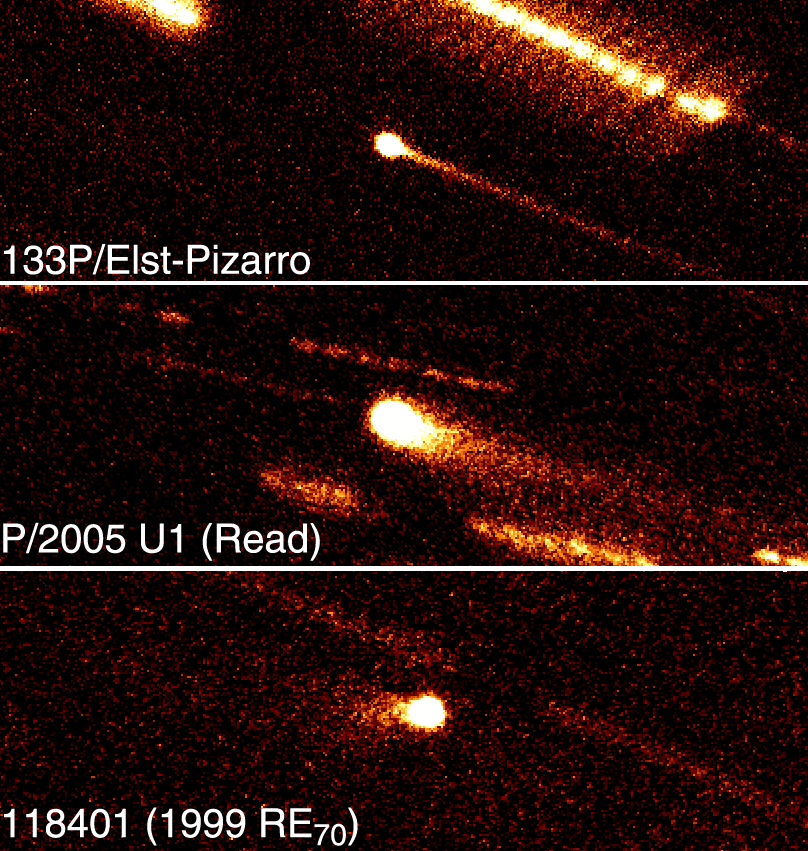
Back in 1996, astronomers discovered a strange object in the asteroid belt. They decided it was either a "lost" comet or an icy asteroid, as it ejected dust like a comet but had an orbit like an asteroid. No one had ever seen anything like the object, called 133P. Ever since it was found, astronomers have wondered if it was just an oddity -- one of a kind. We now know it is not, and the discovery of more of these half asteroids/half comets means there is a new class of objects in our solar system.
One of these new objecst, 176P/LINEAR is also emitting dust as it orbits in the asteroid belt. It was found by Henry Hsieh at Queen's University, Belfast in Northern Ireland. Hsieh has been working to figure out the unusual behavior of 133P. He hypothesized that either one of two things could explain the existence of the comet-asteroid: "(1.) 133P is a classical comet from the outer solar system that has evolved onto a main-belt orbit, or (2.) 133P is a dynamically ordinary main-belt asteroid on which subsurface ice has recently been exposed," Hsieh wrote in his paper. "If (1) is correct, the expected rarity of a dynamical transition onto an asteroidal orbit implies that 133P could be alone in the main belt. In contrast, if (2) is correct, other icy main-belt objects should exist and could also exhibit cometary activity."
Hsieh thought it was unlikely a comet could have been kicked around enough to end up in orbit in the asteroid belt, so he followed the assumption that 133P was a dynamically ordinary, yet icy main-belt asteroid. He set out to prove the hypothesis that 133P-like objects should be common and could be found by an well-designed observational survey.
Hsieh made 657 observations of 599 asteroids in the asteroid belt and found 176P/LINEAR. He also determined the asteroid is partially made of ice, which is being ejected following a collision with another object, thus the comet-like attributes.
Additionally, since there is evidence for past and even present water in main-belt asteroids, Hsieh says statistically there should be around 100 currently active Main Belt Comets (MBCs) as these objects are called, among the kilometer-scale, low-inclination, outer belt asteroid population.
The Technology Review blog offered suggestions for what to name these new objects that are half comet and half asteroid: "Comsteroids? Asteromets? Hsiehroids?"
Hseih's paper, Hseih's website on MBCs Sources: Technology Review Blog, arXiv