Universe Today
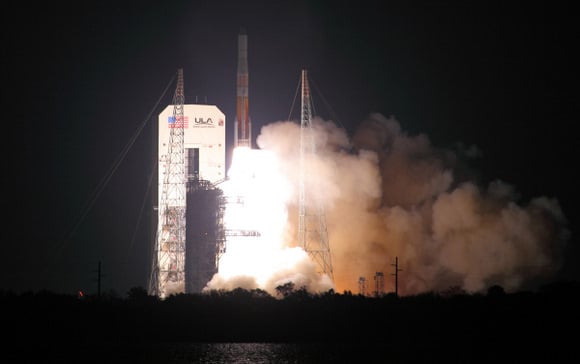
A Delta IV rocket rumbled and roared off launch pad 37B at Cape Canaveral Air Force Station in Florida Thursday evening, sending the GOES-P satellite soaring into a crisp and clear night sky. With liftoff at 6:57 p.m. EST, the rocket could be seen for several minutes after launch, and booster separation was clearly visible to observers on the NASA Causeway. The Geostationary Operational Environmental Satellite-P, or GOES-P, is the latest in a series of meteorological satellites designed to watch for storm development and weather conditions on Earth as well as detect hazards with its emergency beacon support and Search and Rescue Transponder. It will take ten days for the satellite to maneuver to its geostationary equatorial orbit at 35,888 km (22,300 miles). Once there, GOES-P will get a new name: GOES-15.
It will take five months for all the instruments on board to be tested and calibrated. After that, GOES-15 will be a back-up satellite, stored on-orbit and ready for activation should one of the operational GOES satellites degrade or exhaust their fuel.
The satellite is a cooperative effort between NASA and NOAA, the National Oceanic and Atmospheric Administration.
NOAA has two operational GOES satellites: GOES-12 in the east and GOES-11 in the west. Each provides continuous observations of environmental conditions in North, Central and South America and the surrounding oceans. GOES-13 is being moved to replace GOES-12, which will be positioned to provide coverage for South America as part of the Global Earth Observing System of Systems, or GEOSS.
Thanks to Alan Walters for great images of the launch.
On a personal note, I've now seen three different launches - each with a different launch vehicle -- in just four weeks here at Kennedy Space Center (space shuttle Endeavour, SDO on Atlas and now GOES-P on the Delta IV.) KSC is a busy spaceport, indeed!