Universe Today
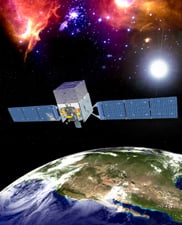
The GLAST (Gamma-ray Large Area Space Telescope) spacecraft blasted off on June 11, 2008, and after acclimating to the cold reaches of space, the instruments on board are now powering up and have sent back signals to Earth indicating that all systems are operational. Meanwhile back on Earth, several bases of operations for the telescope are gearing up for processing data from the various instruments.
The Large Area Telescope (LAT), one of two instruments aboard GLAST has sent back data to Stanford Linear Accelerator Center's Instrument Science Operations Center (ISOC) where it will be monitored, processed, and distributed to the rest of the science team worldwide. The observatory is commanded from the Mission Operations Center (MOC) at NASA Goddard Space Flight Center, and during the present initial on-orbit commissioning phase is staffed by a team from across the mission.
Manager Rob Cameron said, "Powering up the LAT has been even smoother than we had hoped. Everything has worked well-in fact, it's going great. We're already receiving high-quality data that we can use to get the instrument ready for the best science return."
Peter Michelson, of Stanford University, spokesperson and principal investigator for the LAT collaboration, said, "We're off to a great start and we're looking forward to a new view of our universe once science operations begin."
GLAST will explore the most extreme, high energy environments in the universe, and seek answers to questions about dark matter, supermassive black hole systems, pulsars, and the origin of cosmic rays. It also will study the mystery of gamma-ray bursts.
VIDEO
of GLAST and gamma rays from pulsars
After the 60-day checkout and initial calibration period, the project will begin science operations in earnest. The LAT will perform a full-sky survey for the first year of the mission and will rapidly respond to gamma-ray bursts detected by both GLAST instruments.
NASA's GLAST mission has been developed in collaboration with the U.S. Department of Energy, along with important contributions from academic institutions and partners in France, Germany, Italy, Japan, Sweden, and the U.S.
Original News Source:
NASA's GLAST Site