Universe Today
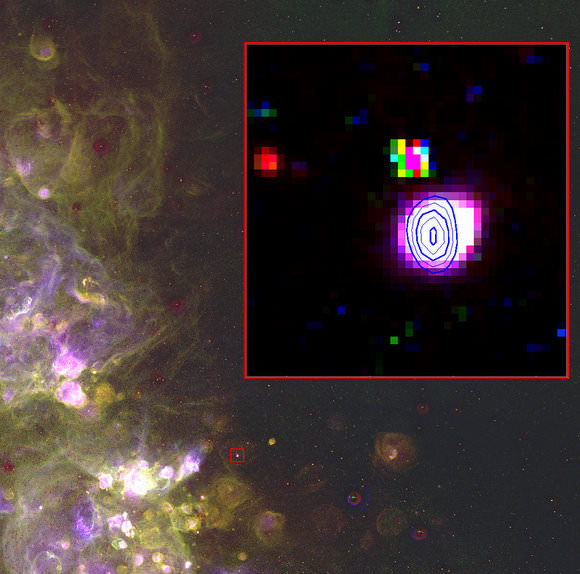
Planetary nebula – the glowing gaseous shells thrown off by stars during the latter stages of their evolution – were thought to only form around stars the size of our Sun or smaller. Although astronomers had predicted these shells should form around "heavier" stars, none had ever been detected. Until now. An international team of scientists have discovered a new class of object which they call “Super Planetary Nebulae,” found around stars up to 8 times the mass of the Sun.
“This came as a shock to us,” said Miroslav Filipovic from the University of Western Sydney “as no one expected to detect these object at radio wavelengths and with the present generation of radio telescopes. We have been holding up our findings for some 3 years until we were 100% sure that they are indeed Planetary Nebulae”.
The team surveyed the Magellanic Clouds, the two companion galaxies to the Milky Way, with radio telescopes of the Commonwealth Scientific and Industrial Research Organisation (CSIRO) Australia Telescope National Facility. They noticed that 15 radio objects in the Clouds match with well known planetary nebulae observed by optical telescopes. The new class of objects are unusually strong radio sources and are associated with larger original stars (progenitors), up to 8 times the mass of the Sun. The nebular material around each star may have as much as 2.6 times the mass of the Sun.
Filipovic's team argues that the detections of these new objects may help to solve the so called “missing mass problem” – the absence of planetary nebulae around central stars that were originally 1 to 8 times the mass of the Sun. Up to now most known planetary nebulae have central stars and surrounding nebulae with respectively only about 0.6 and 0.3 times the mass of the Sun but none have been detected around more massive stars.
Some of the 15 newly discovered planetary nebulae in the Magellanic Clouds are 3 times more luminous than any of their Milky Way cousins. But to see them in greater detail astronomers will need the power of a coming radio telescope – the Square Kilometre Array planned for the deserts of Western Australia.
The scientist's paper appears in the journal Monthly Notices of the Royal Astronomical Society.
Lead image caption: An optical image from the 0.6-m University of Michigan/CTIO Curtis Schmidt telescope of the brightest Radio Planetary Nebula in the Small Magellanic Cloud, JD 04. The inset box shows a portion of this image overlaid with radio contours from the Australia Telescope Compact Array. The planetary nebula is a glowing record of the final death throes of the star. (Optical images are courtesy of the Magellanic Cloud Emission Line Survey (MCELS) team).
Source: RAS