Universe Today
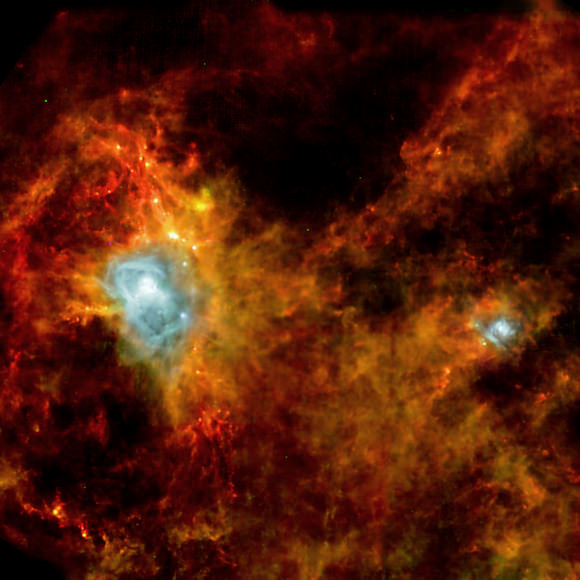
Herschel looks deep inside the heart of a dark cloud located 1000 light years away in the constellation Aquila, the Eagle.Credit: ESA and the SPIRE and PACS consortia
The science teams from the Herchel telescope are meeting this week to discuss their first results from the intial months of observations by the newest infrared space telescope, which was launched in May. While details of the scientific findings won't be released until Friday after everyone at the meetings has had a chance to share their results, ESA released a few stunning new pictures to give everyone a sample of what is to come. In addition to the images shown here, hints of other upcoming images include the most distant known quasar, a dwarf planet, and water sublimating from a comet's surface. Some of the images have been described as among the most important images obtained from space for decades.
Above, Herschel peered deep inside an unseen stellar nursery in located 1000 light years away in the constellation Aquila, the Eagle, revealing a surprising amounts of activity. Some 700 newly-forming stars are estimated to be crowded into filaments of dust stretching through the image. The image is the first new release of ‘OSHI’, ESA’s Online Showcase of Herschel Images.
Another images release of the Southern Cross shows that even the darkest patches of sky can shine brightly to Herschel. Usually, this region looks like a bland cloud of dust, but Herschel shows it to be a place of intense star formation with filaments and condensations of dust cocooning newly forming stars. The dust forms into clumps along magnetic lines - like pearls on a necklace. Each clump is a very early star - at its embryonic stage.
The third image is of the spiral galaxy M51, also known as the Whirlpool Galaxy, showing off its spectacular infrared colors. Two huge waves of star formation encircle its central nucleus, making beautiful spiral arms. Each one shines brightly with its dust being warmed by the young stars.
Source: OSHI