Universe Today
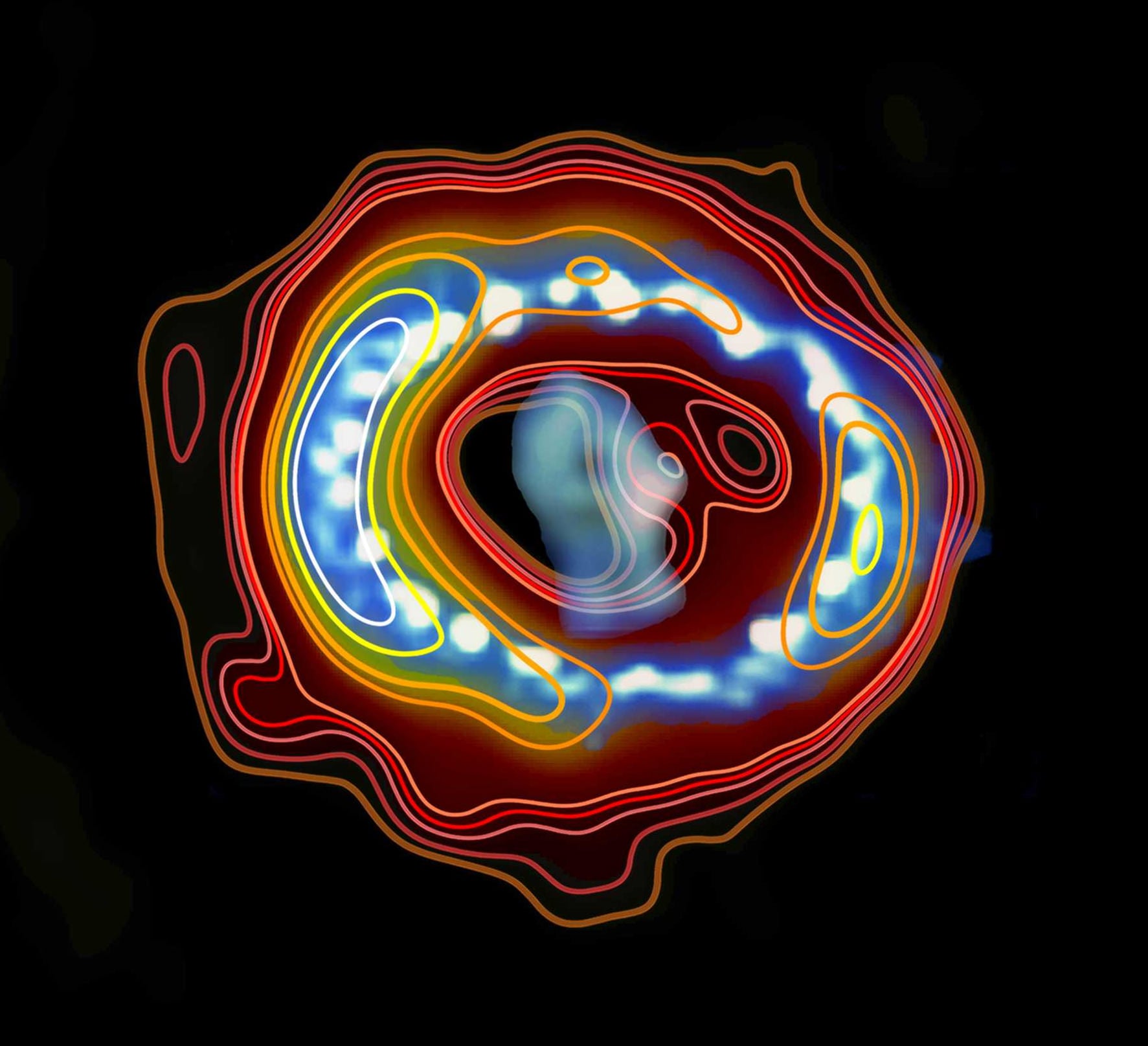
On February 23, 1987, the brightest extragalactic supernova in history was seen from Earth. Now 26 years later, astronomers have taken the highest resolution radio images ever of the expanding supernova remnant at extremely precise millimeter wavelengths. Using the Australia Telescope Compact Array radio telescope in New South Wales, Australia, Supernova 1987A has been now observed in unprecedented detail. The new data provide some unique imagery that takes a look at the different regions of the supernova remnant.
“Not only have we been able to analyze the morphology of Supernova 1987A through our high resolution imaging, we have compared it to X-ray and optical data in order to model its likely history,” said Bryan Gaensler, Director of CAASTRO (Centre for All-sky Astrophysics) at the University of Sydney.
SN 1987A has been on one of the most-studied astronomical objects, as its “close” proximity in the Large Magellanic Cloud allows it to be a focus for researchers around the world. Astronomers says it has provided a wealth of information about one of the Universe’s most extreme events.
“Imaging distant astronomical objects like this at wavelengths less than 1 centimetre demands the most stable atmospheric conditions,” said lead author, Giovanna Zanardo of ICRAR, the International Center for Radio Astronomy Research. “For this telescope these are usually only possible during cooler winter conditions but even then, the humidity and low elevation of the site makes things very challenging,”
Unlike optical telescopes, a radio telescope can operate in the daytime and can peer through gas and dust allowing astronomers to see the inner workings of objects like supernova remnants, radio galaxies and black holes.
“Supernova remnants are like natural particle accelerators, the radio emission we observe comes from electrons spiraling along the magnetic field lines and emitting photons every time they turn. The higher the resolution of the images the more we can learn about the structure of this object,” said Professor Lister Staveley-Smith, Deputy Director of ICRAR and CAASTRO.
Scientists study the evolution of supernovae into supernova remnants to gain an insight into the dynamics of these massive explosions and the interaction of the blast wave with the surrounding medium.
The team suspects a compact source or pulsar wind nebula to be sitting in the centre of the radio emission, implying that the supernova explosion did not make the star collapse into a black hole. They will now attempt to observe further into the core and see what’s there.
Their paper was published in the Astrophysical Journal.
Source: ICRAR