Universe Today
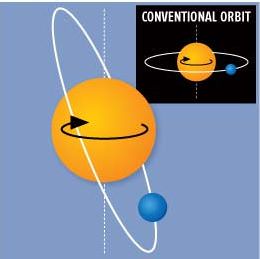
In what might be a evidence of planetary billiards, astronomers have found an exoplanet with an extremely odd orbit. The question is, was this planet the cue ball or the object ball? While most planets orbit around a star's mid-section, this one – called XO-3b -- is tilted about 37 degrees from the star's equator. It's also a massive planet, about 10 times the size of Jupiter. Such a misalignment must have occurred as a result of a disturbance, such as a collision with another object, sometime after the planet's formation. But astronomers say they don't yet know what caused the unusual orbit of XO-3b.
Detecting this oddball orbit required a combination of good luck, advanced technology and ingenious methodology. The planet was discovered back in 2007 using the transit method by measuring how the star is dimmed by the planet passing in through the line-of-sight between Earth and the star.
Using the Keck I telescope, detecting the planet itself was relatively easy, as it dimmed the star's light by about 1 percent. But to go one step further and measure the angle of its orbit, meant that "we have to be sneaky about it," said MIT physicist Joshua Winn, who led the team that measured the planet's tilted orbit. It turns out that if a planet crosses the star's disk at an angle to the star's own rotation, it causes a distinctive pattern of change in the overall color of the star, as measured by a highly sensitive spectrograph, because of the Doppler shifts caused by the star's rotation.
Hints of such a spectral signature were seen last year by another team, but that team acknowledged that they could not be confident of their result. The new observations, carried out by Winn and his team in February at the Keck I Observatory in Hawaii, provided a clear, solid measurement of the planet's distinctive tilt, determining the angle of the orbit to be about 37 degrees from the star's equator. The results are reported in a paper in the Astrophysical Journal, which was recently posted online and will be published in the journal's August issue.
A majority of the exoplanet discovered so far are very large planets comparable to the gas giants in our solar system, but orbiting their stars much closer in (and thus faster). That's because the method used to detect these planets makes it much easier to detect such close-in giants than smaller or more distant ones. In the case of XO-3b, it is about 13 times as massive as Jupiter, yet orbits its star with a period, or "year," of just 3.5 days (Jupiter, by contrast, takes almost 12 years for an orbit). That size and closeness to its star are "unusual, even by the standards of exoplanets," Winn says.
Such "hot Jupiters" - so named because they resemble the solar system's largest planet, but would be much hotter because of their proximity to their parent stars - could not have formed in the places they are seen now, according to accepted planet-formation theory. They must have formed much further out from the star, then migrated inward to their present positions. Astronomers have come up with different mechanisms to account for the migration: the gravitational attraction of other planets as they passed close by, or the attraction of the disk of dust and gas from which the star and its planets formed.
Close encounters with other planets could greatly amplify a slight initial tilt, but attraction from the disk of material could not. Likely, a cataclysmic event occurred in this planet's past.
Source: MIT