Universe Today
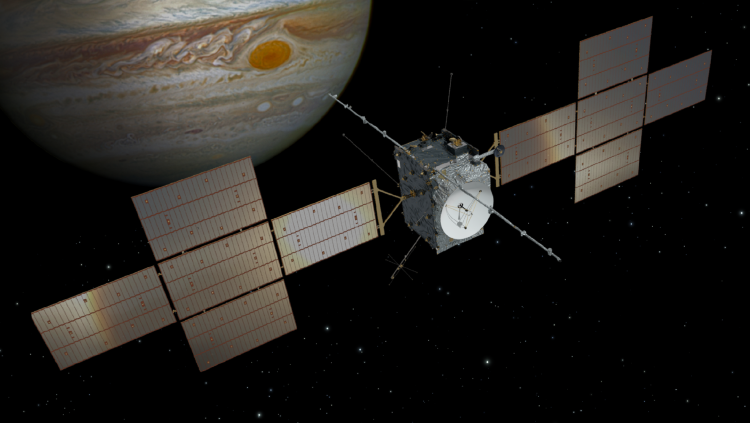
The planet Jupiter hosts more than 100 moons with the majority of attention going to the four Galilean moons, Io, Europa, Ganymede, and Callisto. This is primarily due to their active geology, including Io being the most volcanically active planetary body in the solar system and Europa having a vast subsurface liquid water ocean beneath its icy crust. However, Jupiter’s smaller and lesser-known moons could provide astronomers key insights into the history of the solar system since they’ve remained largely unchanged, unlike the Galilean moons.
Now, an international team of researchers could shed light on one of Jupiter’s smallest moons, Kallichore, whose average diameter is 3.8 kilometers (2.4 miles), but is known as an irregular moon due to its extremely non-circular orbit. For context, the smallest Galilean moon, Europa, has a diameter of about 3,122 kilometers (1,940 miles). The primary motivation behind the study, whose findings were recently published in Nature, was to use a variety of space- and ground-based telescopes to gain new insight into Kallichore in preparation for a planned flyby of the small moon by the European Space Agency’s Jupiter Icy Moons Explorer (JUICE) spacecraft, which is slated to arrive at the Jupiter system in April 2031.
To accomplish this, the researchers obtained data from NASA’s Hubble Space Telescope and the Gran Telescopio de Canarias, which is a multinational- and multi-institutional-operated telescope located on the island of La Palma off the coast of west Africa. In the end, the researchers found that Kallichore’s area-equivalent diameter, which is its diameter is its irregular shape was a perfect sphere, was about 3.8 kilometers (2.4 miles), and its geometric albedo (brightness) calculated at about (0.037) 3.7 percent, meaning the tiny moon is incredibly dark. For context, albedo is measured dark to bright from 0 to 1.
Finally, the researchers put tighter constraints on Kallichore’s orbit, enabling JUICE mission planners to better estimate a flyby trajectory. Before the study, the estimated location of Kallichore upon JUICE’s planned arrival had a margin of error of about 272 kilometers (169 miles). However, these new measurements close this error margin by about 80 percent, with JUICE needing a margin of error of about 30 kilometers (19 miles) to substantially increase its chances of a flyby of Kallichore in October 2031.
Irregular Moons Have Solar System Secrets
While the ultimate goal of planetary science is to find life beyond Earth, which is why Europa is a prime target for astrobiologists. However, because these larger and more geologically active moons have significantly changed since their initial formation, this enables irregular moons to provide scientists with a more pristine sample of the ancient solar system, potentially studying an object that is as old as the solar system itself.
Of the currently known 456 solar system moons, it is estimated that 396 (about 87 percent) are irregular moons. This provides scientists with a trove of scientific data regarding the formation and evolution of the solar system. However, it is largely because of their intense orbits that makes studying irregular moons extremely difficult. In the case of Kallichore, it orbits Jupiter at an average distance of 23 million kilometers (14.3 million miles) from the solar system’s largest planet, but its distance ranges between 17.7 million kilometers (11 million miles) and 30.4 million kilometers (18.9 million miles) from Jupiter.
JUICE to Unlock Jupiter Moons’ Secrets
As noted, the purpose of this study was to prepare for a potential flyby of Kallichore by ESA’s JUICE spacecraft in 2031, which was launched in April 2023 and is slated to arrive in the Jupiter system in July 2031. The primary goal of JUICE will be to study the icy Galilean moons to ascertain whether they host conditions that are habitable for life. However, JUICE is also slated to become the first spacecraft to orbit a moon aside from Earth’s Moon when it enters orbit around Ganymede, slated to occur in December 2034.
What new insights about Kallichore and other small Jovian moons will JUICE make in the coming years and decades? Only time will tell, and this is why we science!
As always, keep doing science & keep looking up!