Universe Today
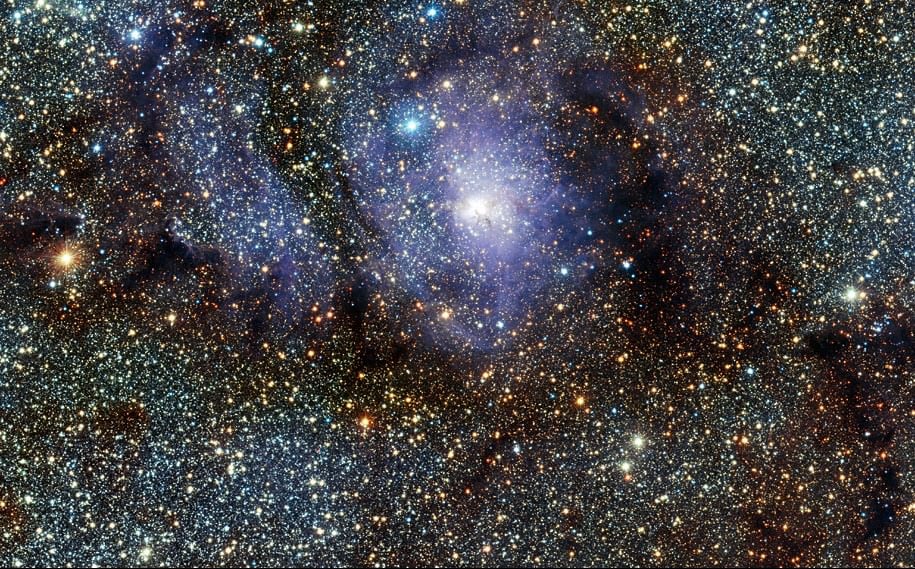
This rich and stunning new infrared view of the Lagoon Nebula shows detail never seen before. Doesn’t it make you want to dive in for a closer look? Well, you can do just in that in a video below that zooms in on all the detail. The image was captured as part of a five-year study of the Milky Way using ESO’s VISTA telescope at the Paranal Observatory in Chile. This is a small piece of a much larger image of the region surrounding the nebula, which is, in turn, only one part of a huge survey.
The survey is called VISTA Variables in the Via Lactea (VVV), and with ESO’s Visible and Infrared Survey Telescope for Astronomy (VISTA), astronomers can scour the Milky Way’s central regions for variable objects and map its structure in greater detail than ever before.
Loading player...
This image of the Lagoon Nebula (also known as Messier 8,) is part of that survey. The region which lies about 4000–5000 light-years away in the constellation of Sagittarius (the Archer).
Infrared observations allow astronomers to peer behind the veil of dust that prevents them from seeing celestial objects in visible light.
Stars typically form in large molecular clouds of gas and dust, which collapse under their own weight. The Lagoon Nebula, however, is also home to a number of much more compact regions of collapsing gas and dust, called Bok globules. These dark clouds are so dense that, even in the infrared, they can block the starlight from background stars. But the most famous dark feature in the nebula, for which it is named, is the lagoon-shaped dust lane that winds its way through the glowing cloud of gas.
Hot, young stars, which give off intense ultraviolet light, are responsible for making the nebula glow brightly. But the Lagoon Nebula is also home to much younger stellar infants. Newborn stars have been detected in the nebula that are so young that they are still surrounded by their natal accretion discs. Such new born stars occasionally eject jets of matter from their poles. When this ejected material ploughs into the surrounding gas short-lived bright streaks called Herbig–Haro objects are formed, making the new-borns easy to spot. In the last five years, several Herbig–Haro objects have been detected in the Lagoon Nebula, so the baby boom is clearly still in progress here.
Source: ESO