Universe Today
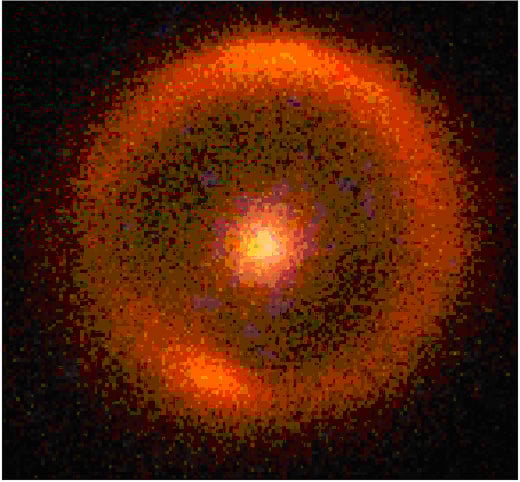
Astronomers can’t see it but they know it’s out there from the distortions caused by its gravity. That statement describes dark matter, the elusive substance which scientists have estimated makes up about 25% of our universe and doesn’t emit or absorb light. But it also describes a distant, tiny galaxy located about 10 billion light years from Earth. This galaxy can’t be seen in telescopes, but astronomers were able to detect its presence through the small distortions made in light that passes by it. This dark galaxy is the most distant and lowest-mass object ever detected, and astronomers say it could help them find similar objects and confirm or reject current cosmological theories about the structure of the Universe.
“Now we have one dark satellite [galaxy],” said Simona Vegetti, a postdoctoral researcher at the Massachusetts Institute of Technology, who led the discovery. “But suppose that we don’t find enough of them — then we will have to change the properties of dark matter. Or, we might find as many satellites as we see in the simulations, and that will tell us that dark matter has the properties we think it has.”
This dwarf galaxy is a satellite of a distant elliptical galaxy, called JVAS B1938 + 666. The team was looking for faint or dark satellites of distant galaxies using gravitational lensing, and made their observations with the Keck II telescope on Mauna Kea in Hawaii, along with the telescope’s adaptive optics to limit the distortions from our own atmosphere.
They found two galaxies aligned with each other, as viewed from Earth, and the nearer object’s gravitational field deflected the light from the more distant object (JVAS B1938 + 666) as the light passed through the dark galaxy’s gravitational field, creating a distorted image called an “Einstein Ring.”
Using data from this effect, the mass of the dark galaxy was found to be 200 million times the mass of the Sun, which is similar to the masses of the satellite galaxies found around our own Milky Way. The size, shape and brightness of the Einstein ring depends on the distribution of mass throughout the foreground lensing galaxy.
Current models suggest that the Milky Way should have about 10,000 satellite galaxies, but only 30 have been observed. “It could be that many of the satellite galaxies are made of dark matter, making them elusive to detect, or there may be a problem with the way we think galaxies form,” Vegetti said.
The dwarf galaxy is a satellite, meaning that it clings to the edges of a larger galaxy. Because it is small and most of the mass of galaxies is not made up of stars but of dark matter, distant objects such as this galaxy may be very faint or even completely dark.
“For several reasons, it didn’t manage to form many or any stars, and therefore it stayed dark,” said Vegetti.
Vegetti and her team plan to use the same method to look for more satellite galaxies in other regions of the Universe, which they hope will help them discover more information on how dark matter behaves.
Their research was published in this week's edition of Nature.
The team's paper can be found here.
Sources: Keck Observatory, UC Davis, MIT