Universe Today
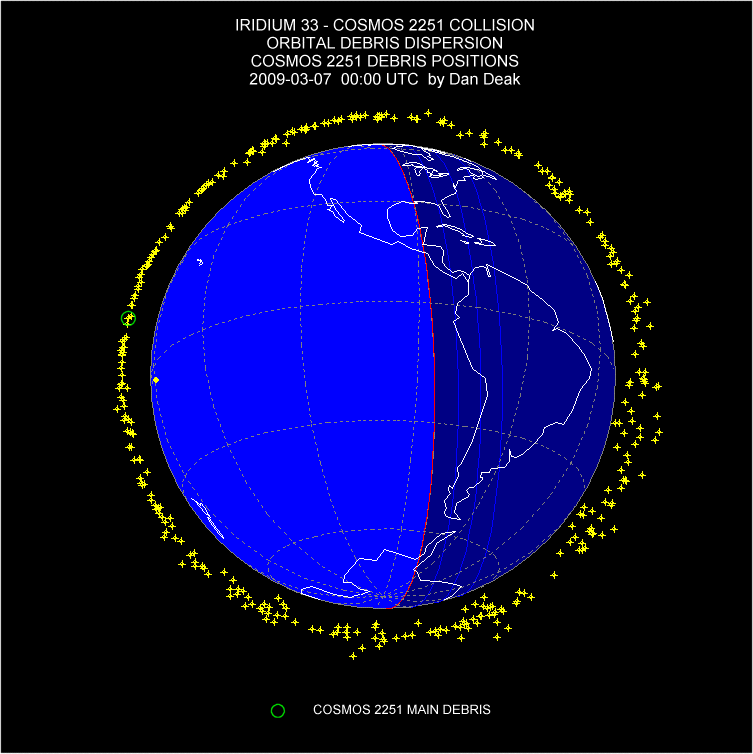
Debris from the satellite collision that occurred on February 10th will soon start entering Earth's atmosphere. 355 debris fragments from the collision between the Cosmos 2251 and the Iridium 33 satellites are being tracked by US Strategic Command, and one fragment will enter the atmosphere on March 12, followed by one on March 28th and another on March 30th. According to Spaceweather.com, these are likely centimeter-sized pieces that will disintegrate in the atmosphere, posing no threat to people on the ground. Each fragment is cataloged and tracked.
The Cosmos 2251 was bigger and possessed about one and a half times more mass than Iridium 33, and appears to have produced more than twice the number of fragments. "As of March 7th, there were 355 cataloged fragments of Cosmos 2251 and 159 fragments of Iridium 33," says Daniel Deak who prepared the above orbit-map for Spaceweather.com. "The Cosmos fragments are not only more numerous, but also more widely scattered, ranging in altitude from 198 km to 1689 km. For comparison, Iridium fragments are confined to altitudes between 582 km and 1262 km."
The extra scatter of Cosmos debris is not fully understood. Impact geometry could explain the spread, but no one knows exactly how the two complex vehicles struck one another. However, Cosmos 2251 was pressurized and might have ruptured and blown apart.
The upcoming shuttle mission is not in immediate danger from debris, although the risk of impact increased by 6%. The International Space Station also is not in danger. "NASA has recognized from the first day [of the collision] that the risks to both ISS and STS-119 have increased," says Nick Johnson, Chief Scientist for Orbital Debris at the Johnson Space Center. "However, those increases have been relatively minor in comparison to the background environment."
Source: Spaceweather.com