Universe Today
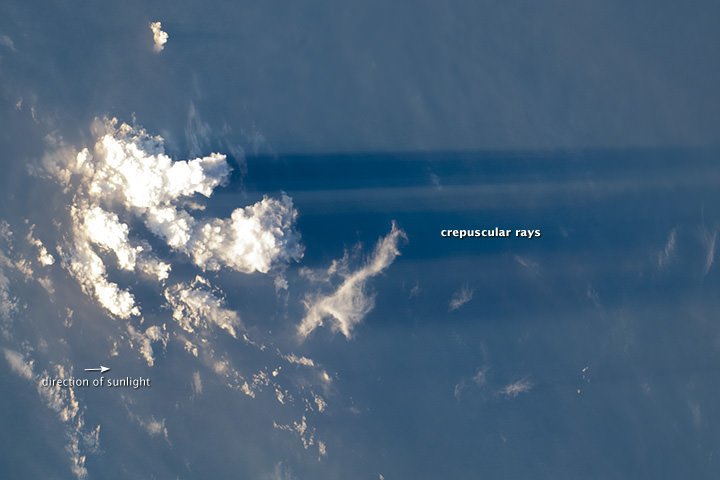
Seeing crepuscular rays on Earth is a somewhat rare event, as conditions have to be just right at either sunset or sunrise for the Sun's rays to appear as though they are diverging outward from the Sun. But seeing them from space is even more rare.
This picture taken by an astronaut on the International Space Station provides an unusual viewing perspective from above of crepuscular rays. Why are they parallel in this picture instead of radiating in an outward fashion like they appear to us on Earth? This image shows the true nature of crepuscular rays: they really are parallel!
The word crepuscular means "relating to twilight," and they occur when objects such as mountain peaks or clouds partially shadow the Sun's rays, when the Sun is low on the horizon. These rays are visible only when the atmosphere contains enough haze or dust particles so that sunlight in unshadowed areas can be scattered toward the observer.
The light rays are actually parallel, but appear to converge to the Sun due to "perspective," the same visual effect that makes parallel railroad tracks appear to converge in the distance.
In the images taken from the ISS, the sun was setting to the west (image left) on the Indian subcontinent, and cumulonimbus cloud towers provided the shadowing obstructions. The rays are being projected onto a layer of haze below the clouds.
Here's an image taken by UT reader Stephano De Rosa of crepuscular rays as seen from a more Earthly perspective:
Sources: NASA Earth Observatory, University of Illinois