Universe Today
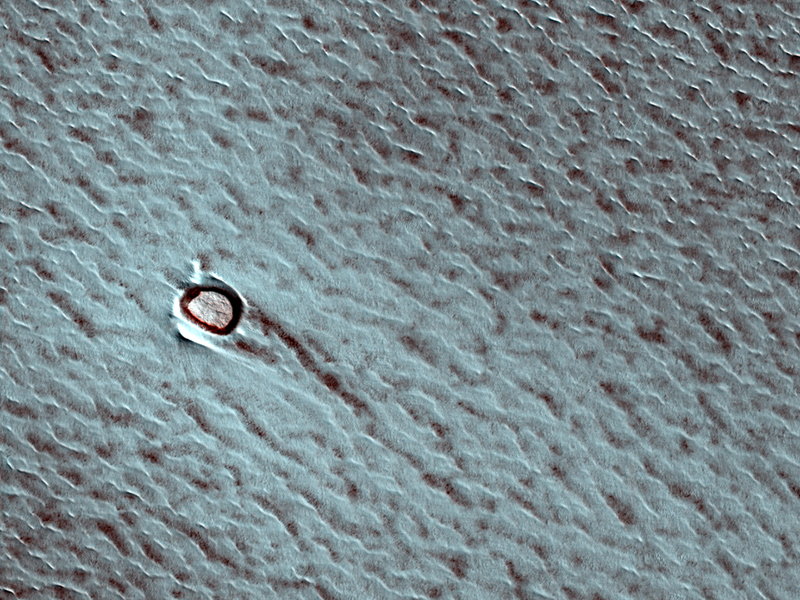
With all the different spacecraft orbiting and roving on the Red Planet, we're finding that Mars is a wonderfully diverse and dynamic planet, with some unusual landforms. Take craters, for instance, and especially a few images of craters from the Mars Reconnaissance Orbiter's HiRISE camera. The image above shows a small impact crater on the bright north polar ice cap, near where the Phoenix lander sits, now silently. The perennial, or permanent, portion of the north polar cap consists almost entirely of water ice, and so this curious-looking crater in the ice has never melted away. And its obvious how differently craters are formed in ice; ice ejecta just doesn't look the same as soil! This crater is about 66 meters (215 feet) in diameter, and scientists think the slightly elliptical shape of the crater is a result of an oblique, or a sideways impact (instead of straight down.) And if you think this crater is unusual, how about a crater that looks upside down....
Yes, this mound may actually be a buried impact crater. "The mound may be the remnant of a buried impact crater, which is now being exhumed," said HiRISE team member Shane Byrne, of the University of Arizona. Byrne said the crater formed as the north polar ice layers were being deposited. The crater itself would have been filled in by ice after it formed.
Most of these craters are buried under the Martian surface and inaccessible to scientists and their instruments. But this crater and its mound were exhumed as erosion formed a trough above and around it. "For reasons that are poorly understood right now, the ice beneath the site of the crater is more resistant to this erosion, so that as the trough is formed, ice beneath the old impact site remained, forming this isolated hill," Byrne said.
At high resolution, the HiRISE image shows that the mound is made up of polygonal blocks as big as 33 feet (10 meters) across.
Hopefully this crater rim won't take on monumental connotations and become known as the H on Mars, but, yes, that's what it looks like. It's actually just dark colored outcrops in an otherwise light colored area. You can also see gullies in the crater wall just to the left of the "H," which scientists probably find more interesting and intriguing than the H.
And finally, since I have craters on the brain, I'll call this image the Grey Matter Crater. Doesn't the texture of this region look like a brain?! Actually, these landforms in the Dueteronilus Mensae region on Mars are made up of complex alignments of small ridges and pits often called “lineated valley fill.” The cause of the texture is not well understood, but may result from patterns in ice-rich soils or ice loss due to sublimation (ice changing into water vapor).
For more HiRISE (High Resolution Imaging Science Experiment) mages, browse through the ever-interesting and ever changing HiRISE website.