Universe Today
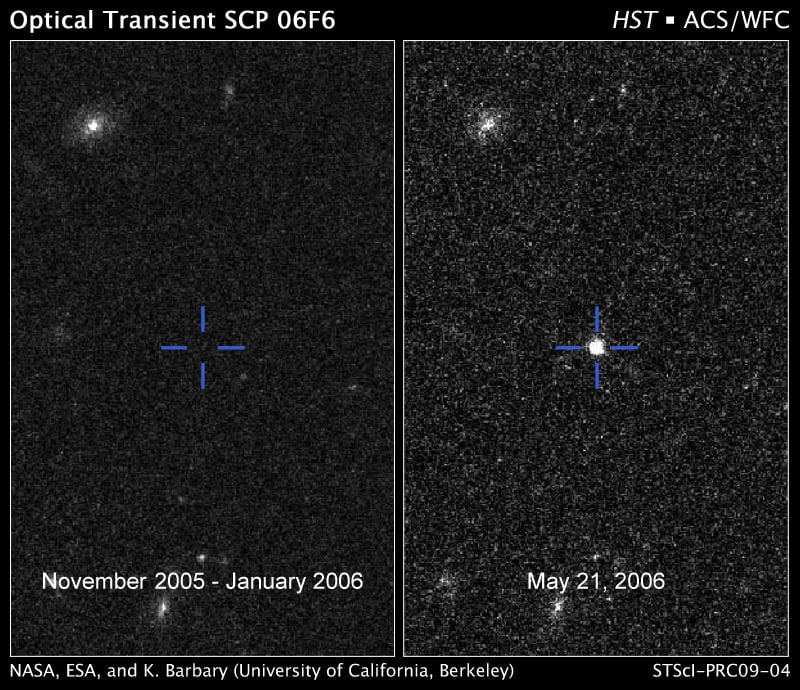
The Hubble Space Telescope serendipitously captured a mysterious burst of light on February 21, 2006. Over the next 100 days, the object, cataloged as SCP 06F6, brightened and then slowly faded. Astronomers do not know the object's distance, so it can either be in our Milky Way galaxy or at a great astronomical distance, and the light-signature of this event does not match the behavior of a supernova or any previously observed astronomical transient phenomenon in the universe. It might represent an entirely new class of stellar phenomena that has previously gone undetected in the universe, said Kyle Barbary of the Lawrence Berkeley National Laboratory (LBNL) in Berkeley, Calif.y researchers. "No one has been able to come up with a good explanation for this object" he said at a press conference at today's American Astronomical Society meeting in Long Beach, California. (Read on for an outlandish explanation one scientist proposed!)
Astronomers commonly observe intense flashes of light from a variety of stellar explosions and outbursts, such as novae and supernovae. But the rise and fall in brightness has a signature that simply has never been recorded for any other type of celestial event. Supernovae peak after no more than 70 days, and gravitational lensing events are much shorter. Therefore, this observation defies a simple explanation, said Barbary. "We have never seen anything like it."
Hubble was aimed at a cluster of galaxies 8 billion light-years away in the spring constellation Bootes. But the mystery object could be anywhere in between, even in the halo of our own Milky Way galaxy.
Papers published by other researchers since the event was reported in June 2006, have suggested a bizarre zoo of possibilities: the core collapse and explosion of a carbon rich star, a collision between a white dwarf and an asteroid, or the collision of a white dwarf with a black hole. At the press conference Barbary was asked what the most bizarre explanation of the object was: "Jokingly, someone said it was another civilization turning on their Large Hadron Collider and exploding," -- which got laughs from the audience. "Don't quote me on that!," he added.
But Barbary does not believe that any model offered so far fully explains the observations. "I don't think we really know what the discovery means until we can observe similar objects in the future."
All-sky surveys for variable phenomena, such as those to be conducted with the planned Large Synoptic Survey Telescope, may ultimately find similar transient events in the universe.
Source: HubbleSite