Universe Today
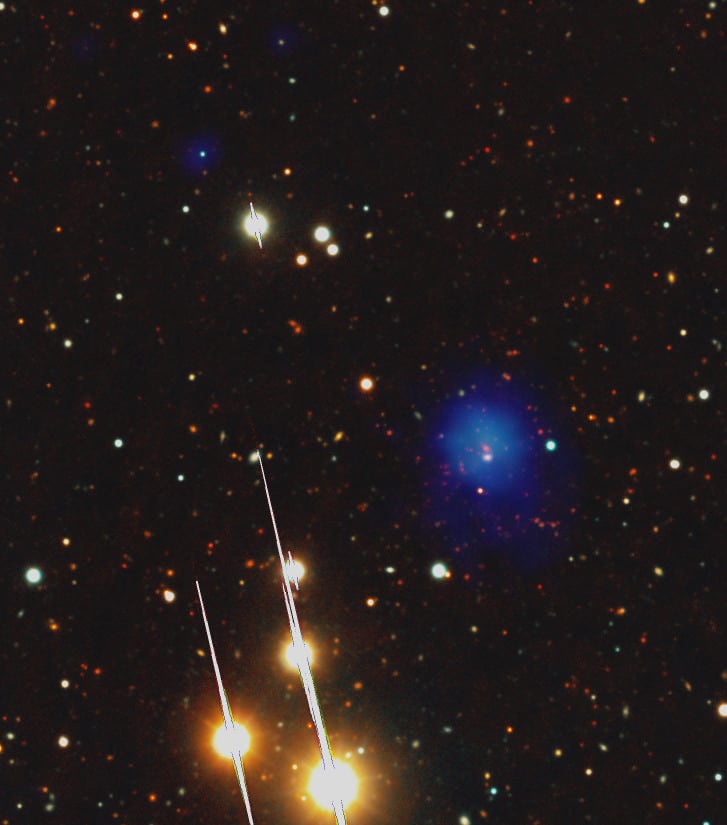
A massive cluster of galaxies seen in the distant universe by ESA’s orbiting XMM-Newton x-ray observatory is so big that astronomers believe there can only be a few of them that far away in space and time. “Such massive galaxy clusters are thought to be rare objects in the distant Universe," said Georg Lamer, Astrophysikalisches Institut in Potsdam, Germany. "They can be used to test cosmological theories. Indeed, the very presence of this cluster confirms the existence of a mysterious component of the Universe called dark energy.†The astronomers compared the rare find to a cosmic 'needle in a haystack.'
The newly-discovered monster, known by the catalogue number 2XMM J083026+524133, is 7.7 thousand million light-years distant and is estimated to contain as much mass as a thousand large galaxies. Much of it is in the form of 100-million-degree hot gas. The bright blue blob of gas was found during a systematic analysis of catalogued objects as Lamer and his team were looking for patches of X-rays that could either be nearby galaxies of distant clusters of galaxies.
Based on 3,500 observations performed with XMM-Newton's European Photon Imaging Camera (EPIC) covering about 1% of the entire sky, the catalogue contains more than 190,000 individual X-ray sources. J083026+524133 stood out because it was so bright. While checking visual images from the Sloan Digital Sky Survey, the team could not find any obvious nearby galaxy in that location. So they turned to the Large Binocular Telescope in Arizona and took a deep exposure, which found a cluster of galaxies in that location.
The astronomers were surprised to find the cluster contains a thousand times the mass of our own Milky Way Galaxy.
No one knows what dark energy is, but it is causing the expansion of the Universe to accelerate. This hampers the growth of massive galaxy clusters in more recent times, indicating that they must have formed earlier in the Universe. “The existence of the cluster can only be explained with dark energy,†says Lamer.
Yet he does not expect to find more of them in the XMM-Newton catalogue. “According to the current cosmological theories, we should only expect to find this one cluster in the 1% of sky that we have searched,†says Lamer.
Source: ESA