Universe Today
The UHF communications radio on board the Mars Reconnaissance Orbiter has switched to standby and was unable to relay instructions to the Phoenix lander for its activities for sol 2, which included unstowing its robotic arm. The problem arose at 0608 PDT on Tuesday. MRO did receive the sol 2 sequence from Earth â€" meaning the communications link between Earth and MRO continues to operate normally. But subsequently MRO reported that there had been a “problem with the handshake between MRO and Phoenix,†said Fuk Li, manager of NASA's Mars Exploration Program. A 'handshake' is the set of signals the radios on the two spacecraft send each other to establish a data-communications link.
"All this is is a one-day hiccup in being able to move the arm around, so it's no big deal," said Ed Sedivy, Phoenix program manager at Lockheed Martin Space Systems.
The next opportunity to send commands to Phoenix will occur on Wednesday morning, when Mars Odyssey, the other spacecraft used to communicate with Phoenix, passes over the landing site. At that time, the commands that failed to reach the lander today will be transmitted. We'll keep you posted.
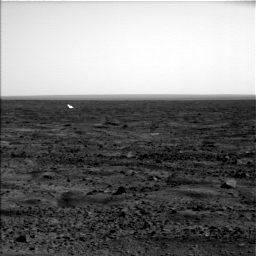
Also, we'll take this opportunity to share a couple of other tidbits about Phoenix. The image above was taken on sol 1, and shows Phoenix's backshell off in the distance.
On board Phoenix is a weather station, contributed by the Canadian Space Agency and University of Aarhus in Denmark. The weather station was activated in the first hour after landing on Mars. Measurements are being recorded continuously. Skies were clear and sunny on Sol 1 on Mars. The temperature varied between minus 112 degrees Fahrenheit in the early morning and minus 22 degrees Fahrenheit in the afternoon. The average pressure was 8.55 millibars, which is less than a 1/100th of the sea level pressure on Earth.
This image shows the spacecraft's robotic arm in its stowed configuration, with the a biobarrier, a shiny, protective film, that covers the arm on landing day, or Sol (Martian day) 0, and then the biobarrier was removed during lander's first full day on Mars, Sol 1.
The "elbow" of the arm can be seen at the top center of the picture, and the biobarrier is the shiny film seen to the left of the arm.
The biobarrier is an extra precaution to protect Mars from contamination with any bacteria from Earth. While the whole spacecraft was decontaminated through cleaning, filters and heat, the robotic arm was given additional protection because it is the only spacecraft part that will directly touch the ice below the surface of Mars. After Phoenix landed, springs were used to pop back the barrier, giving it room to deploy.
These images were taken on May 25, 2008 and May 26, 2008 by the spacecraft's Surface Stereo Imager.
News Sources:
Astrobiology Magazine,
JPL Phoenix News