Universe Today
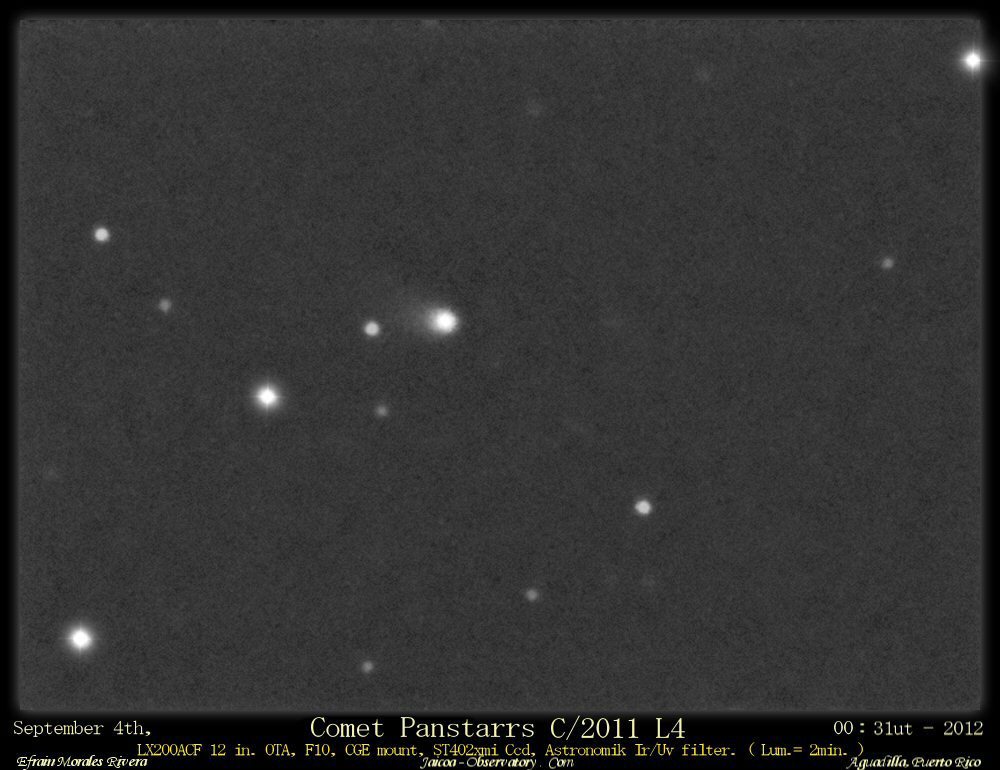
Comet PanSTARRS on September 4, 2012 as seen from Puerto Rico. Credit: Efrain Morales/
Early next year, a comet will come fairly close to Earth and the Sun -- traveling within the orbit of Mercury -- and it has the potential to be visible to the naked eye. Amateur and professional astronomers alike have been keeping watch on Comet C/2011 L4 PanSTARRS (or PanSTARRS for short), trying to ascertain just how bright this comet may become. It will come within 45 million kilometers (28 million miles) of the Sun on March 9, 2013, which is close enough for quite a bit of cometary ice to vaporize and form a bright coma and tail.
But just how bright, no one can say for sure. Comets have been known to be very unpredictable (remember the breakup of Comet Elenin?) but some estimates have said this comet could become a naked-eye object, as bright as Vega or Arcturus next March.
Right now it is at about Magnitude 12, and skywatchers in the southern hemisphere observers will have a great view as this comet gets closer and brighter, as it will remain high in the sky. But right now, skywatchers in the northern latitudes are saying farewell to Comet PANSTARRS, as it becomes low on the horizon. Astrophotographer
Efrain Morales from Puerto Rico
took the image above on September 4th, 2012 at 00:31 UTC. "It was very difficult to image due to the forest tree tops and sunset light but I was able to capture it at high magnification," Efrain told us. (He used an LX200ACF 12 inch, OTA, CGE mount, F10, ST402xmi Ccd, Astronomik Ir/UV filter at 2 minutes. )
Observers in the mid-northern latitudes won't be able to see the comet again until after its perihelion, unfortunately. And after that, we may never see Comet PanSTARRS again.
The discovery of the comet was made in June 2011 with the 1.8 meter (70.7 inch) Panoramic Survey Telescope & Rapid Response System or Pan-STARRS telescope on Mount Haleakala. PanSTARRS is looking to image the entire sky several times a month to hunt for Earth-approaching comets and asteroids that could pose a danger to our planet.
Richard Wainscoat and graduate student Marco Micheli confirmed the object was a comet using the Canada-France-Hawaii Telescope on Mauna Kea.
"The comet has an orbit that is close to parabolic," Wainscoat said, "meaning that this may be the first time it will ever come close to the Sun, and that it may never return."
Astronomers at the PanSTARRS telescope say that making brightness predictions for new comets is difficult because astronomers do not know how much ice they contain. Because sublimation of ice (conversion from solid to gas) is the source of cometary activity and a major contributor to a comet's overall eventual brightness, this means that more accurate brightness predictions will not be possible until the comet becomes more active as it approaches the sun and astronomers get a better idea of how icy it is.
It will be an adventure to follow the comet's close approach, and we hope our readers and astrophotographers in the southern hemisphere will keep us posted!
See our previous article about this comet.