Universe Today
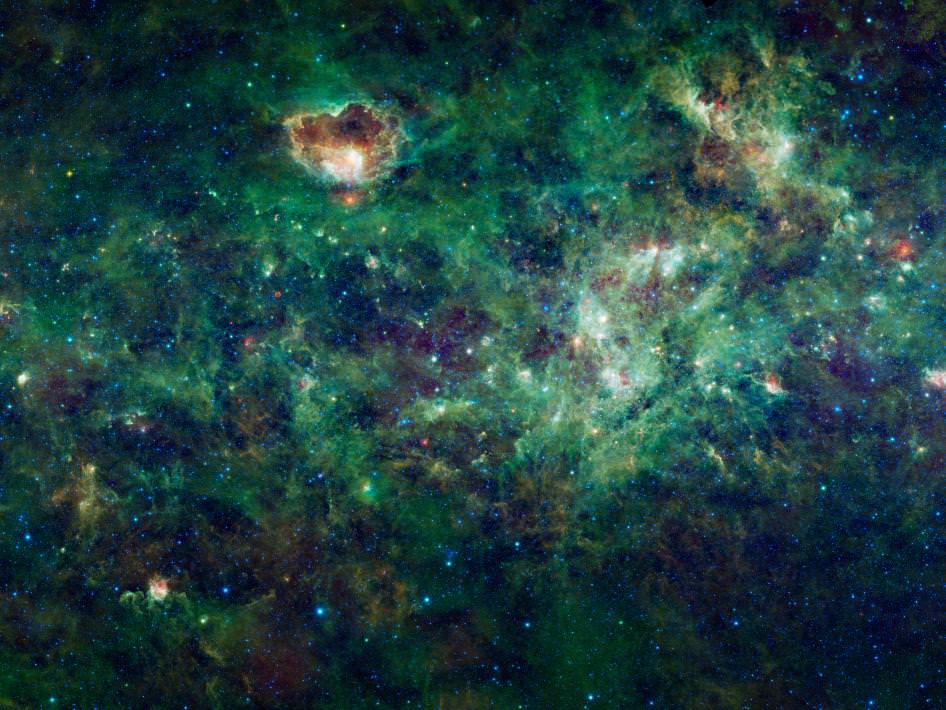
Astronomers trying to understand the formation of massive clusters of stars are getting a better idea of how the process works from the latest images and data from the WISE spacecraft. NASA's Wide-Field Infrared Survey Explorer has captured a vast stretch of nearly a dozen nebulae popping with new star birth, which is helping to narrow the field of possible star-forming scenarios.
“We are trying to understand how huge clusters of stars form at the same time from a large cloud of gas,” said Xavier Koenig from Goddard Space Flight Center, speaking at a press briefing from the American Astronomical Society meeting this week. “We have two possible pictures of how this process works and WISE is helping us piece together the chain of events."
WISE has mapped the entire sky two times in infrared light, and the astronomers selected a sample of regions to find young stars and map their distributions to try and determine how these large clusters formed. For both possible scenarios, a cluster of stars begin to form at the center of a huge cloud of gas. But what happens next? The first potential situation, called Model 1, is “collect and collapse,” Koenig said, where the stars create a hot bubble of gas which surrounds the stars. “This bubble gathers up material and after a time enough gas builds up that the next generation of stars appears.”
Model 2 is called “chain reaction,” where as bubble of gas progresses outward, stars are continually formed, and there is no gap between the births of stars.
In looking at several of the star-forming nebulae, Koenig and his colleagues noticed a pattern in the spatial arrangement of newborn stars. Some were found lining the blown-out cavities, a phenomenon that had been seen before, but other new stars were seen sprinkled throughout the cavity interiors. The results suggest that stars are born in a successive fashion, one after the other, starting from a core cluster of massive stars and moving steadily outward. This lends support to “chain reaction” star formation theory, and offers new clues about the physics of the process.
The astronomers also found evidence that the bubbles seen in the star-forming clouds can spawn new bubbles. In this scenario, a massive star blasts away surrounding material, which eventually triggers the birth of another star massive enough to carve out its own bubble. A few examples of what may be first- and second-generation bubbles can be seen in the new WISE image.
"Massive stars sweep up and destroy their natal clouds, but they continuously spark new stars to form along the way," said co-author Dave Leisawitz, the WISE Mission Scientist. "Occasionally a new, massive star forms, perpetuating the sequence of events and giving rise to the dazzling fireworks display seen in this WISE mosaic."
Since young stars are brighter in infrared, WISE is the perfect telescope to be searching for these massive star-forming regions. “WISE data is good for this kind of study because the infrared lights up right where these star-forming regions are doing their work – they pop out immediately to your eye,” said Koenig. “I can’t wait to look at more of the WISE sky coverage.”
See a larger version of the new WISE mosaic here.
Sources: JPL, AAS press briefing