Universe Today
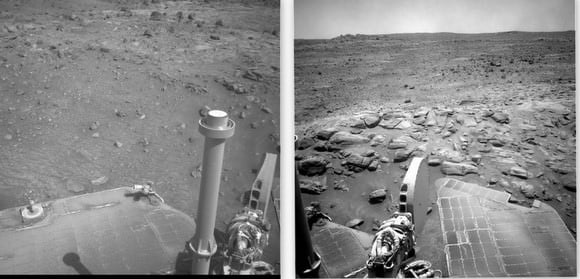
Great news about the both Mars Exploration Rovers! Spirit's dusty solar panels have been cleaned by a wind event, and Opportunity is back driving again after standing down a few days after a charged particle hit. Sprit's solar arrays have been extremely dusty ever since a huge dust storm last year enveloped much of Mars, but a dust devil or gust of wind on Sol 1812 (Feb. 6, 2009 here on Earth) has cleaned the panels just enough to make a marked difference in power available to the intrepid rover. Before the event, dust buildup on the arrays had reached the point where only 25 percent of sunlight hitting the array was getting past the dust to be used by the photovoltaic cells. Now, it is up to 28 percent. "It may not sound like a lot, but it is an important increase," said Jennifer Herman, and engineer for the MER team.
The cleaning boosts Spirit's daily energy supply by about 30 watt-hours, to about 240 watt-hours from 210 watt-hours. The rover uses about 180 watt-hours per day for basic survival and communications, so this increase roughly doubles the amount of discretionary power for activities such as driving and using instruments. Thirty watt-hours is the amount of energy used to light a 30-watt bulb for one hour.
"We will be able to use this energy to do significantly more driving," said Colette Lohr, a rover mission manager at NASA's Jet Propulsion Laboratory, Pasadena, Calif. "Our drives have been averaging about 50 minutes, and energy has usually been the limiting factor. We may be able to increase that to drives of an hour and a half."
Spirit has driven about 9 meters (about 30 feet) since getting around a rock that temporarily blocked its progress on Jan. 31. The team's goal in coming weeks is to navigate the rover over or around a low plateau called "Home Plate" to get to an area targeted for scientific studies on the other side of Home Plate in Gusev Crater.
The last prior cleaning event that was as beneficial as this one was in June 2007. Winds cleaned off more of the dust that time, but a dust storm in subsequent weeks undid much of the benefit.
Over on the other side of the planet in Meridiani Planum, Opportunity, drove 135.9 meters (446 feet) on Feb. 10. Opportunity stood down for a few sols as a result of a PMA (Panoramic Mast Assembly) error, due to a SEU (Single-Event Upset), when a charged particle whizzes through a transistor on the rover and flips a bit somewhere inside. "Fortunately, the motor controllers can detect and report these events, so that the rover can safely stop," rover driver Scott Maxwell told Universe Today on February 5. "We have good reason to hope that Opportunity's PMA is undamaged and that she'll be back on the road shortly."
And now she is back driving to her little heart's (and the rover drivers' hearts) content. Opportunity's cumulative odometry is 14.36 kilometers (8.92 miles) since landing in January 2004, including 2.58 kilometers (1.6 miles) since climbing out of Victoria Crater on Aug. 28, 2008. She is on her way to Endeavour Crater, a huge crater about about 12 kilometers (7 miles) away.
The rovers have been taking a licking, but they still keep on ticking! Over five years now for both rovers --Yippee!
Source: JPL