Universe Today
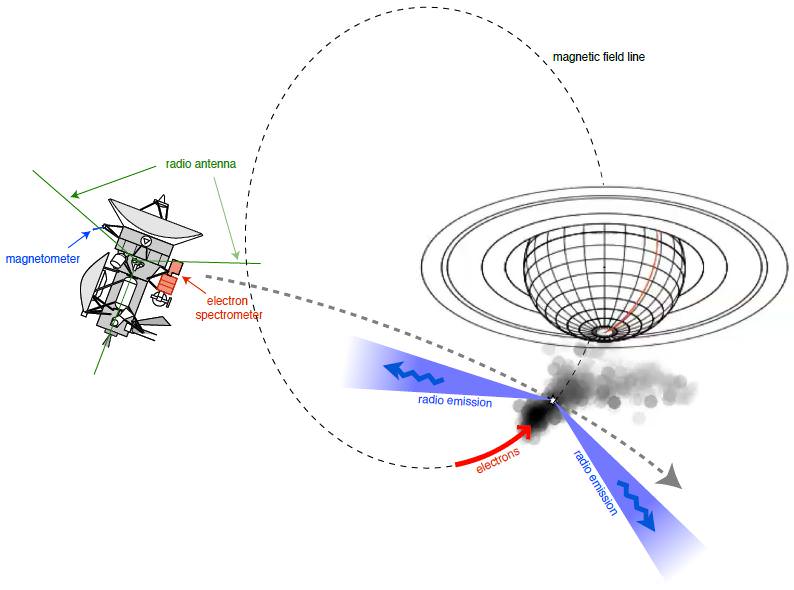
Saturn’s mysterious aurora has fascinated astronomers and space enthusiasts since it was first observed back in 1979. Now, the Cassini spacecraft has made the first observations from within the giant radio aurora of Saturn. The spacecraft flew through an active auroral region in 2008, and scientists say there are both similarities and contrasts between the radio auroral emissions generated at Saturn and those at Earth. Additionally, Cassini’s visual and infrared mapping spectrometer instrument (VIMS) took data to create a new movie (above) showing Saturn's shimmering aurora over a two-day period. All this new data are helping scientists understand what drives some of the solar system's most impressive light shows.
"So far, this is a unique event," said Dr. Laurent Lamy at the European Planetary Science Congress in Rome this week. "Whereas the source region of Earth's radio aurora has been studied by many missions, this is our first opportunity to observe the equivalent region at Saturn from the inside. From this single encounter, we have been able to build up a detailed snapshot of auroral activity using three of Cassini's instruments. This gives us a fascinating insight into the processes that are generating Saturn's radio aurora."
See an animation created from the radio instrument on Cassini at this link. On the left hand side are the radio sources as seen from Cassini. The right hand side shows the projection of the radio sources down onto the southern pole of the planet. Credit: NASA/JPL/University of Iowa/CNES/Observatoire de Paris
Separately, Tom Stallard, lead scientist on a joint VIMS and Cassini magnetometer collaboration, presented the VIMS movie at the conference.
Source: European Planetary Science Congress
In the movie, the aurora phenomenon clearly varies significantly over the course of a Saturnian day, which lasts around 10 hours 47 minutes. On the noon and midnight sides (left and right sides of the images, respectively), the aurora can be seen to brighten significantly for periods of several hours, suggesting the brightening is connected with the angle of the sun. Other features can be seen to rotate with the planet, reappearing at the same time and the same place on the second day, suggesting that these are directly controlled by the orientation of Saturn's magnetic field.
"Saturn's auroras are very complex and we are only just beginning to understand all the factors involved," Stallard said. "This study will provide a broader view of the wide variety of different auroral features that can be seen, and will allow us to better understand what controls these changes in appearance." Auroras on Saturn occur in a process similar to Earth's northern and southern lights. Particles from the solar wind are channeled by Saturn's magnetic field toward the planet's poles, where they interact with electrically charged gas (plasma) in the upper atmosphere and emit light. At Saturn, however, auroral features can also be caused by electromagnetic waves generated when the planet's moons move through the plasma that fills Saturn's magnetosphere.