Universe Today
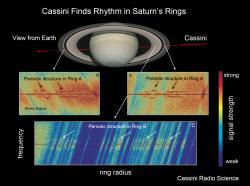
Cassini has been orbiting around Saturn for almost four years, and amazingly, the spacecraft keeps discovering new and unexpected features about this world and its system of rings and moons. Recently, in two of Saturn's rings, Cassini found orderly lines of densely grouped, boulder-size icy particles that extend outward across the rings like ripples from a rock dropped in a calm pond. Surprisingly, the distances between these ring particles stay relatively equal even though their velocities may change. This type of pattern is completely new, as normally, the distances between particles change with their velocity.
The pattern was detected when Cassini sent out three signals toward Earth. The signals crossed Saturn's rings, and the frequencies were scattered from the passing ring particles. Once the signals were captured by Earth-based antennas of NASA's Deep Space Network, Cassini scientists saw a regular pattern in the received signal frequencies.
"This particular feature is the smallest and most detailed of anything seen in Saturn's rings so far," said Cassini radio science team member Essam Marouf. "In the chaotic environment of the rings, to find such regularity in the most cramped areas is nothing short of amazing." The regular structure can only be found in locations where particles are densely packed together, such as the B ring and the innermost part of the A ring. The signals were sent to capture a complete view of the rings.
The unexpected pattern within Saturn's rings may give scientists some new ideas of what to expect from other similar planets and solar systems.
Scientists call this pattern of particles "enormously extended natural diffraction grating." A diffraction grating has parallel lines like a picket fence; when light hits this fence, it separates according to wavelength, from ultraviolet to infrared light.
"The signals showed that the particle groups were arranged in an unexpectedly regular formation that had rhythm within the rings of Saturn,'" said Marouf. "Each particle is in its own orbit, and sometimes they collide and move apart as their velocities change. As a result, you have particles bunched together into dense groups that extend across the ring in harmony with each other."
Original News Source:
Cassini Press Release