Universe Today
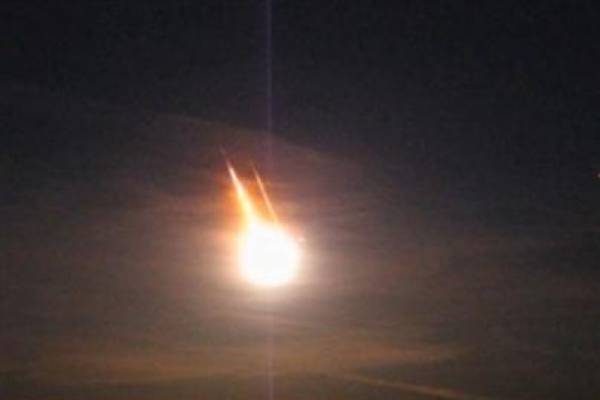
The search is on for fragments of a 10-ton rock that lit the sky over western Canada last Thursday evening. Scientists estimate that at the time it hit Earth's atmosphere, the asteroid fragment weighed approximately 10 tons and was probably about the size of a desk. It exploded with the force of 300 tons of dynamite, and hundreds of fragments of the meteorite weighing more than 50 grams (1.76 ounces) are likely strewn over a wide area. The speed of entry was relatively slow, about 14 kilometers (8.7 miles) per second, well below the average 20 kilometers (12.4 miles) per second of most meteorites, said University of Calgary researcher Alan Hildebrand. Amateur astronomers, meteorite hunters and rock hounds have been combing the prairies in western Canada for a 10-ton meteorite that lit the sky and exploded with the force of 300 tons of dynamite, according to experts from the Canadian Space Agency.
The fireball first appeared approximately 80 kilometers above and just east of the border city of Lloydminster, Alberta/Saskatchewan, and traveled SSE towards the Battle River valley fragmenting spectacularly in a series of explosions. Researchers were able to estimate it's size and energy from infrasound recordings, said Dr. Peter Brown, Canada Research Chair in Meteor Physics at the University of Western Ontario. Infrasound is very low frequency sound produced by explosions that can travel thousands of kilometers.
"At least half a dozen infrasound stations ranging from Greenland to Utah, including Canada's Lac Du Bonnett, Manitoba and Elgin Field, Ontario stations, recorded energy from the fireball's explosions. The indicated energy is approximately one third of a kiloton of TNT," Brown said.
Dr. Brown also says that a fireball this size only occurs over Canada once every five years on average. About ten fireballs of this size occur somewhere over the Earth each year.
The fireball penetrated the atmosphere at a steep angle of approximately 60 degrees from the horizontal and lasted about five seconds from 17:26:40 to 17:26:45 MST with the largest explosion at 17:26:44. The fireball was recorded on all-sky and security cameras scattered across Saskatchewan and Alberta in addition to being witnessed by tens of thousands of people who saw it streak across the sky, and may be one of the best documented meteorite falls.
But the researchers are looking for any additional information they can find.
"We are now trying to get all the transient information about the fireball before it is lost. Many motels and gas stations only keep their security recordings for one week or less, so we urge everyone to check their systems to see if they recorded the fireball or the moving shadows that it cast," Hildebrand said. "Three gas stations and motels in Lloydminster, Lashburn and Maidstone are known to have records, but dozens of other businesses in the area probably have the fireball or its shadows recorded."
If fireball images are found, he suggests immediately saving a copy and contacting him. "With the security camera footage we can compute the fireball's trajectory in the sky to calculate the prefall orbit. Meteorites have only ever been recovered from known orbits nine times previously and we want to make that ten. "
Source: PhysOrg