Universe Today
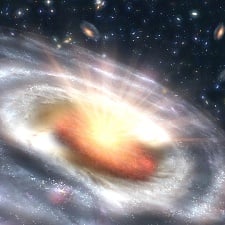
Black holes get a bad rap. Most people are afraid of them, and some think black holes might even destroy Earth. Now, scientists from the University of Leeds are blaming black holes for causing the most energetic and deadly outbursts in the universe: gamma ray bursts.
The conventional model for GRBs is that a narrow beam of intense radiation is released during a supernova event, as a rapidly rotating, high-mass star collapses to form a black hole. This involves plasma being heated by neutrinos in a disk of matter that forms around the black hole. A subclass of GRBs (the "short" bursts) appear to originate from a different process, possibly the merger of binary neutron stars.
But mathematicians at the University of Leeds have come up with a different explanation: the jets come directly from black holes, which can dive into nearby massive stars and devour them.
Their theory is based on recent observations by the Swift satellite which indicates that the central jet engine operates for up to 10,000 seconds - much longer than the neutrino model can explain.
The scientists believe that this is evidence for an electromagnetic origin of the jets, i.e. that the jets come directly from a rotating black hole, and that it is the magnetic stresses caused by the rotation that focus and accelerate the jet's flow.
For the mechanism to operate the collapsing star has to be rotating extremely rapidly. This increases the duration of the star's collapse as the gravity is opposed by strong centrifugal forces.
One particularly peculiar way of creating the right conditions involves not a collapsing star but a star invaded by its black hole companion in a binary system. The black hole acts like a parasite, diving into the normal star, spinning it with gravitational forces on its way to the star's centre, and finally eating it from the inside.
"The neutrino model cannot explain very long gamma ray bursts and the Swift observations, as the rate at which the black hole swallows the star becomes rather low quite quickly, rendering the neutrino mechanism inefficient, but the magnetic mechanism can," says Professor Komissarov from the School of Mathematics at the University of Leeds.
"Our knowledge of the amount of the matter that collects around the black hole and the rotation speed of the star allow us to calculate how long these long flashes will be – and the results correlate very well with observations from satellites," he adds.
Source: EurekAlert