Universe Today
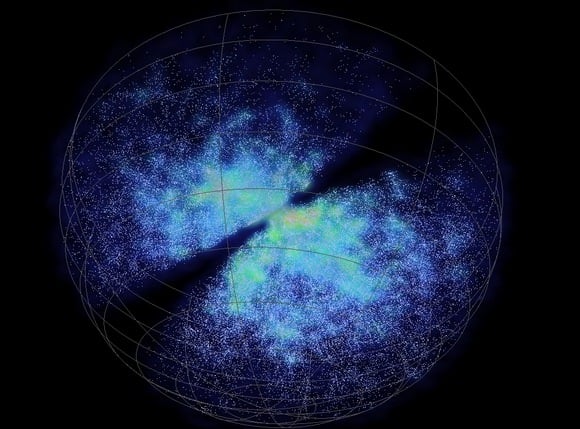
A new detailed map of the nearby Universe reveals not only where local galaxies are currently, but where they are heading, how fast and why. "It's like taking a snapshot of wildebeest on the African plain," said Dr. Heath Jones of the Anglo-Australian Observatory (AAO), lead scientist for the Six-Degree Field Galaxy Survey (6dFGS), the most detailed survey of nearby galaxies to date. "We can tell which waterholes they're heading to, and how fast they're traveling."
The project was a collaboration between astronomers from Australia, the UK and the USA. The survey was carried out with the 1.2-m UK Schmidt Telescope, which is operated by Siding Spring Observatory in New South Wales, Australia. Broader and shallower than previous comparable surveys (it covered twice as much sky as the Sloan Digital Sky Survey) it has recorded the positions of more than 110,000 galaxies over more than 80% of the Southern sky, out to about two thousand million light-years from Earth, (a redshift of 0.15).
Galaxies are tugged around by each other's gravity. By measuring the galaxies' movements, the researchers were able to map the gravitational forces at work in the local Universe, and so show how matter, both seen and unseen, is distributed.
Giant superclusters of galaxies are huge concentrations of mass, but they can't be weighed accurately by looking at their light alone.
"Light can be obscured, but you can't hide gravity," said Dr. Jones.
The survey shows strings and clusters of nearby galaxies on large scales in unprecedented detail, and has revealed more than 500 voids—"empty" areas of space with no galaxies.
The special aspect of this survey is that it will let the researchers disentangle two causes of galaxy movements.
As well as being pulled on by gravity, galaxies also ride along with the overall expansion of the Universe.
For about 10% of their galaxies, the 6dFGS researchers will tease apart these two velocity components: the one associated with the Universe's expansion, and the one representing a galaxy's individual, "peculiar", motion.
"The peculiar velocities collected as part of this survey number more than five times as many as in any previous survey," said Professor Elaine Sadler of the University of Sydney, a 6dFGS team member.
Source: Anglo-Australian Observatory