Universe Today
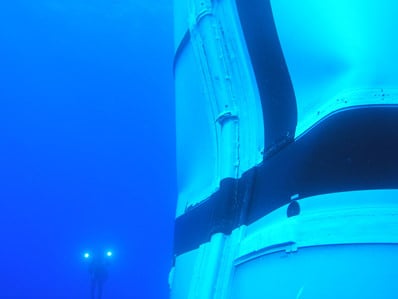
The booster rocket used in the Ares I-X test flight was found to be badly dented when divers located it in the Atlantic Ocean. The damage could have occurred as the booster hit the water. UPDATE (7:30 pm CDT): Bill Harwood from CBS news is reporting that according to NASA officials, one of the three 150-foot-wide parachutes designed to gently lower NASA's Ares I-X first stage booster to the Atlantic Ocean deflated after deployment, resulting in a harder splashdown than expected. All three main chutes deployed, but while two inflated fully, the third collapsed. "A source said the deflated parachute contacted one of the others as it whipped about in the wind, causing a partial deflation. That could not be immediately confirmed, although a splashdown in that condition might explain the buckling seen in the lower segment of the rocket's case," Harwood wrote. (end of update).
Spaceflightnow.com reported that engineers have said shuttle boosters can be damaged depending on the impact angle and how rough the ocean is. But it's not yet known whether such a "slap down" or some other issue might have caused the damage noted in the Ares I-X booster.
Parachute deploy was one of the major test objectives for the flight. The 327-foot-tall I-X rocket was equipped with a four-segment shuttle booster, a fifth segment loaded with avionics gear, a dummy upper stage and Orion crew module mockup.
The booster is being towed back to Kennedy Space Center, and should arrive late Thursday, where engineers will be able to look more closely at the damage.
Additionally, NASA is saying there was more damage to the launchpad following the Ares I-X launch than what is customarily seen after a shuttle launch. Leaks of toxic propellant at launch pad 39B forced NASA to evacuate the pad. Two separate leaks occurred at the 95-foot-level where the pad's fixed service structure and gantry-like rotating service structure meet.
Meanwhile, on the shuttle side of the program, after a Flight Readiness Review, mission managers for the STS-129 mission have cleared space shuttle Atlantis to launch on Nov. 16 at 2:28 p.m. EST. The target date depends on the planned Nov. 14 launch of an Atlas V rocket from nearby Cape Canaveral Air Force Station. The Atlas has reserved the Eastern Range on Nov. 14 and 15. If the Atlas launch is delayed to Nov. 15, the shuttle’s liftoff will move to no earlier than 2:02 p.m. on Nov. 17.
The STS-129 mission will focus on storing spare hardware on the exterior of the space station. The flight will include three spacewalks and install two platforms on the station's truss, or backbone. The platforms will hold spare parts to sustain station operations after the shuttle fleet is retired.
Also, the mission will bring up communications equipment for the SpaceX Dragon capsule and future commercial cargo missions to the ISS.
Sources: Spaceflightnow.com, NASA