Universe Today
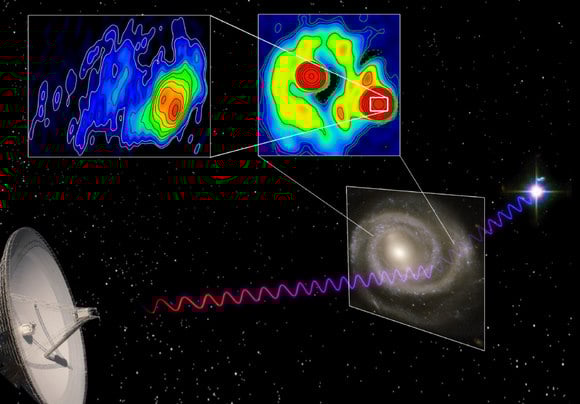
Although we haven't figured out everything in the universe by a long shot, we're getting a pretty good a handle on how things work in our world, and how the laws of nature operate here at home. One big question we have is, would laws of nature as we know them function the same at other locations in the universe? A new study says, yes. Research conducted by an international team of astronomers shows that one of the most important numbers in physics theory, the proton-electron mass ratio, is almost exactly the same in a galaxy 6 billion light years away as it is in Earth's laboratories, approximately 1836.15.
According to Michael Murphy, Swinburne astrophysicist and lead author of the study, it is an important finding, as many scientists debate whether the laws of nature may change at different times and in different places in the Universe. "We have been able to show that the laws of physics are the same in this galaxy half way across the visible Universe as they are here on Earth," he said.
The astronomers determined this by effectively looking back in time at a distant quasar, labeled B0218+367. The quasar's light, which took 7.5 billion years to reach us, was partially absorbed by ammonia gas in an intervening galaxy. Not only is ammonia useful in most bathroom cleaning products, it is also an ideal molecule to test our understanding of physics in the distant Universe. Spectroscopic observations of the ammonia molecule were performed with the Effelsberg 100m radio telescope at 2 cm wavelength (red-shifted from the original wavelength of 1.3 cm). The wavelengths at which ammonia absorbs radio energy from the quasar are sensitive to this special nuclear physics number, the proton-electron mass ratio.
"By comparing the ammonia absorption with that of other molecules, we were able to determine the value of the proton-electron mass ratio in this galaxy, and confirm that it is the same as it is on Earth," says Christian Henkel from the Max Planck Institute for Radio Astronomy in Bonn, Germany, an expert for molecular spectroscopy and co-author of the study.
Their research was published in the journal Science.
Original News Source:
Max Planck Institute