Universe Today
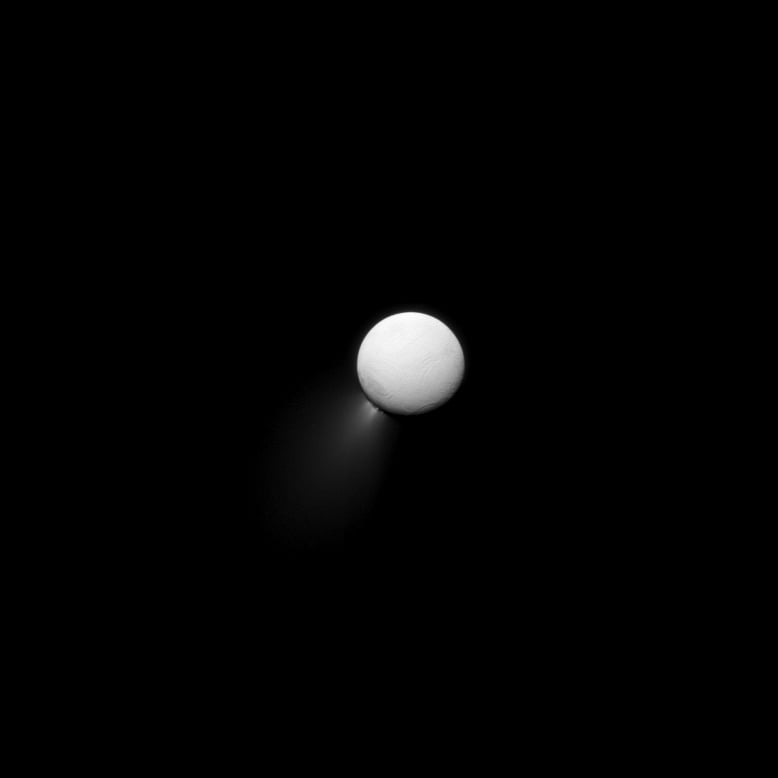
According to planetary scientist and Cassini imaging team leader Carolyn Porco, about 98 geyser jets of all sizes near Enceladus’s south pole are spraying water vapor, icy particles, and organic compounds out into space. The spray from those geysers are evident in this new image from Cassini, showing a big, beautiful plume, illuminated by light reflected off of Saturn. Look closely to see that the plume is as large as the moon itself.
Cassini first discovered the jets of water ice particles in 2005, and since then scientists have been trying to learn more about how they behave, what they are made of and – most importantly – where they are coming from. The working theory is that Enceladus has a liquid subsurface ocean, and pressure from the rock and ice layers above combined with heat from within force the water up through surface cracks near the moon’s south pole. When this water reaches the surface it instantly freezes, sending plumes of ice particles hundreds of miles into space.
Read more: Enceladus' Jets Reach All the Way to its Sea
Cassini has flown through the spray several times now, and instruments have detected that aside from water and organic material, there is salt in the icy particles. The salinity is the same as that of Earth’s oceans.
Enceladus is just 504 kilometers (313 miles) across, but it potentially could be one of the best spots in the solar system for finding life.
The top image was taken on January 18, 2013. This view looks toward the Saturn-facing side of Enceladus, and was taken when Cassini was approximately 483,000 miles (777,000 kilometers) from Enceladus. Image scale is 3 miles (5 kilometers) per pixel.
The second, face-on, color view of Enceladus was taken by the Cassini spacecraft on January 31 2011, from a distance of 81,000 km, and processed by amateur astronomer Gordan Ugarkovic.