Universe Today
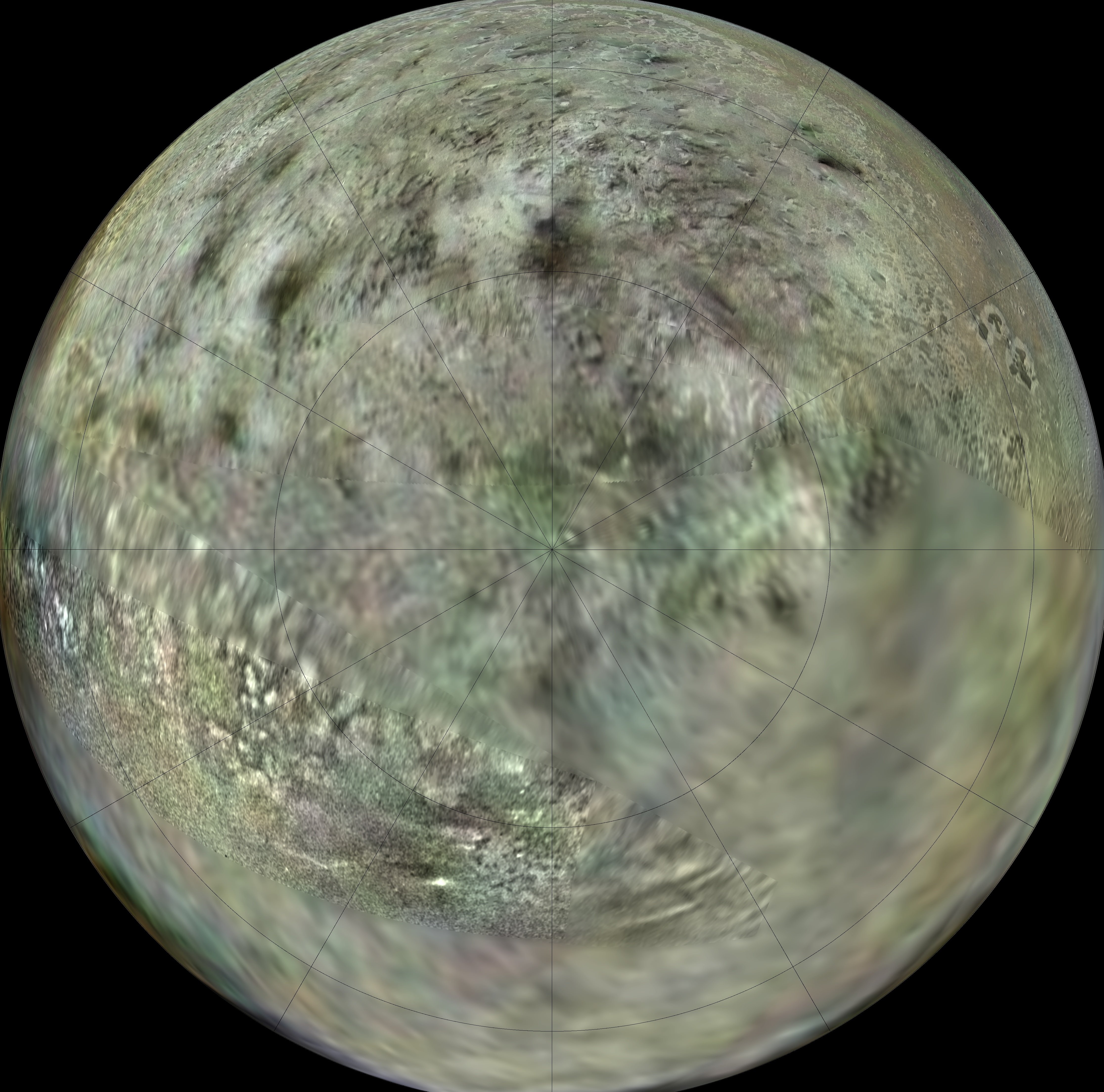
If you're planning a trip to Neptune's moon Triton, you'll want to head to the southern hemisphere where it's now just past mid-summer. Yes, distant Triton actually does have seasons, astronomers at ESO's Very Large Telescope recently determined. "We have found real evidence that the Sun still makes its presence felt on Triton, even from so far away," said astronomer Emmanuel Lellouch in an ESO press release. "This icy moon actually has seasons just as we do on Earth, but they change far more slowly." According to the first ever infrared analysis of Triton's atmosphere, the seasons last about 40 Earth years. But while summer is in full swing in Triton's southern hemisphere, there's no need to pack your bikini. The average surface temperature is about minus 235 degrees Celsius.
Oh, and you'll also want to bring along a little breathable air. The ESO team also – unexpectedly – discovered carbon monoxide in Triton's thin atmosphere, mixed in with methane and nitrogen.
The astronomer's observations revealed that Triton's thin atmosphere varies seasonally, thickening when warmed. When the distant sun's rays hits Triton at their best summer angle, a thin layer of frozen nitrogen, methane, and carbon monoxide on Triton's surface sublimates into gas, thickening the icy atmosphere as the season progresses during Neptune's 165-year orbit around the Sun. Triton passed the southern summer solstice in 2000.
So, while this action increases the thickness of the atmosphere, thus increasing the atmospheric pressure, you'll still need a pressure suit as well for your visit. Based on the amount of gas measured, Lellouch and his colleagues estimate that Triton's atmospheric pressure may have risen by a factor of four compared to the measurements made by Voyager 2 in 1989, when it was still spring on the giant moon. The Voyager data indicated the atmosphere of nitrogen and methane had a pressure of 14 microbars, 70,000 times less dense than the atmosphere on Earth. The data from ESO shows the atmospheric pressure is now between 40 and 65 microbars — 20,000 times less than on Earth.
Carbon monoxide was known to be present as ice on the surface, but Lellouch and his team discovered that Triton's upper surface layer is enriched with carbon monoxide ice by about a factor of ten compared to the deeper layers, and that it is this upper "film" that feeds the atmosphere. While the majority of Triton’s atmosphere is nitrogen (much like on Earth), the methane in the atmosphere, first detected by Voyager 2, and only now confirmed in this study from Earth, plays an important role as well.
"Climate and atmospheric models of Triton have to be revisited now, now that we have found carbon monoxide and re-measured the methane," said co-author Catherine de Bergh. The team's results are published in Astronomy & Astrophysics
If we could actually visit Triton, it would likely be a very interesting destination as we know it has geologic activity and a changing surface – plus its unique retrograde motion would offer a unique view of the solar system.
While Triton is the seventh largest moon in our solar system, its distance and position from Earth makes it difficult to observe, and ground-based observations since Voyager 2 have been limited. Observations of stellar occultations (a phenomenon that occurs when a Solar System body passes in front of a star and blocks its light) indicated that Triton’s surface pressure was increasing in the 1990's. But a new instrument on the VLT, the Cryogenic High-Resolution Infrared Echelle Spectrograph (CRIRES) has provided the chance to perform a more detailed study of Triton’s atmosphere. "We needed the sensitivity and capability of CRIRES to take very detailed spectra to look at the very tenuous atmosphere," said co-author Ulli Käufl.
These observations are just the beginning for the CRIRES instrument, which will be extremely helpful in studying other distant bodies in our solar system, such as Pluto and other Kuiper Belt Objects. Pluto is often considered a cousin of Triton with similar conditions, and in the light of the carbon monoxide discovery on Triton, astronomers are racing to find this chemical on the even more distant Pluto.
Source: ESO