Universe Today
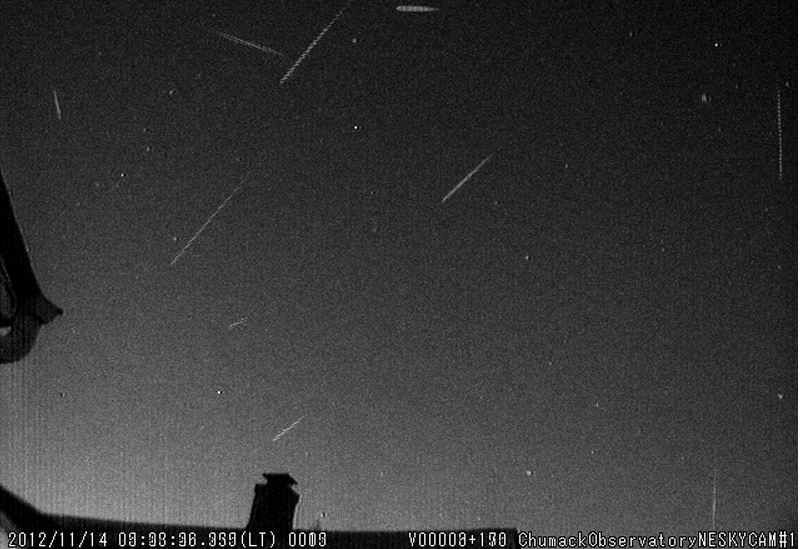
Early Leonids captured on Nov. 14, 2012 in Ohio. Credit: John Chumack
The annual Leonid Meteor Shower has already begun, according to astrophotographer John Chumack in Ohio, who said he captured a dozen or so via his night sky video cameras earlier this week. But the peak for the Leonids this year is expected to be this weekend, and the best viewing should be during the hours before dawn on November 17, according to the editors of
StarDate magazine
at the University of Texas at Austin McDonald Observatory
Every year about this time Earth passes through the debris field left by Comet Tempel-Tuttle. The tiny grains of dust enter Earth's atmosphere and burn up, sometimes leaving glowing dust trails, which we call meteors.
Graphic via StarDate magazine of the Leonid meteor shower.
If you wait until the hours before dawn this weekend, the Moon will be below the horizon, so its light will not interfere with seeing meteors. Astronomers says that with clear skies, viewers can expect to see about 15 to 20 meteors per hour, though the shower has proved highly variable in recent years.
Though the meteors will appear to originate from the constellation Leo, which will be in the eastern sky in the early morning hours, the meteors can be seen in all parts of the sky.
If you capture any images of the meteor shower, share them with Universe Today by uploading them on our
Flickr group
or send us your images by
(this means you're giving us permission to post them). Please explain what's in the picture, when you took it, the equipment you used, etc.
Here's another look at John Chumack's early Leonids.