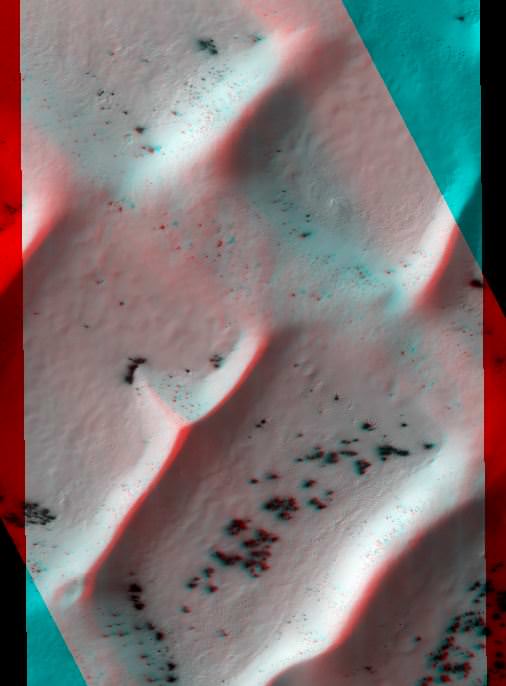
These pictures require you to grab the 3-D glasses you have handy by your desk (if you don't have a pair,
here's some great options
for buying some) and get a "you-are-there" experience from the
HiRISE camera on the Mars Reconnaissance Orbiter.
Here, you can virtually tumble down crater walls, hover over steep cliffs, and see how layered bedrock appears from above.
Our lead image is of an area referred to as "Inca City," the informal name given by Mariner 9 scientists in 1972 to a
set of intersecting, rectilinear ridges
, which some people thought looked like structures or streets. Even back then scientists thought they might be dunes, but that didn't keep people from going off the deep end about this region. But the power of HiRISE has revealed these truly are dunes, and in this image you can see some of the seasonal processes as the region goes from winter to spring. As the carbon dioxide frost and ice on the dunes warms, small areas warm and sublimate (turn from solid to gas) faster, creating a speckled surface.
Enjoy more 3-D views below. All images link directly to the HiRISE site where you can see other versions and get more info about each image.
See all the HiRISE anaglyphs that are available here.

[caption id="attachment_99902" align="aligncenter" width="497"]
Fresh 4-Kilometer Rayed Crater Northeast of Chimbote Crater. Credit: NASA/JPL/University of Arizona.[/caption]
[caption id="attachment_99903" align="aligncenter" width="502"]
Cliff with Columnar Jointing. Credit: NASA/JPL/University of Arizona.[/caption]
[caption id="attachment_99904" align="aligncenter" width="490"]
Central Uplift of a Large Impact Crater. Credit: NASA/JPL/University of Arizona.[/caption]
[caption id="attachment_99905" align="aligncenter" width="478"]
Buttes and craters: Compositional Diversity in Northern Hellas Region. Credit: NASA/JPL/University of Arizona.[/caption]
[caption id="attachment_99901" align="aligncenter" width="502"]
Well-Preserved 4-Kilometer impact Crater. Credit: NASA/JPL/University of Arizona.[/caption]
[caption id="attachment_99906" align="aligncenter" width="505"]
Flow Boundary in Elysium Planitia. Credit: NASA/JPL/University of Arizona.[/caption]
[caption id="attachment_99907" align="aligncenter" width="580"]
A fissure on Mars named Cerberus Fossae. Credit: NASA/JPL/University of Arizona.[/caption]
[caption id="attachment_99908" align="aligncenter" width="514"]
Possible Gullies in Graben. Credit: NASA/JPL/University of Arizona. [/caption]
[caption id="attachment_99909" align="aligncenter" width="580"]
Layered Bedrock on Crater Floor. Credit: NASA/JPL/University of Arizona. [/caption]
Universe Today