Universe Today
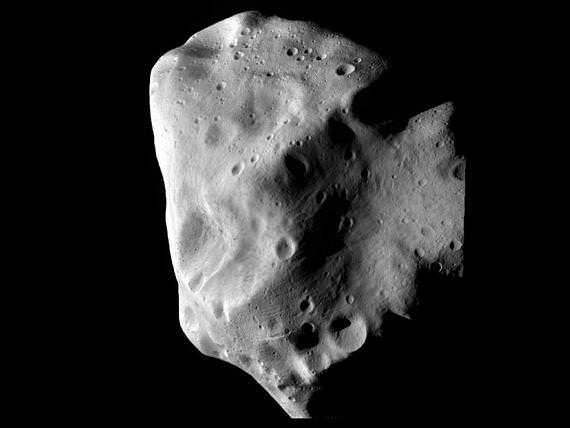
[/caption]
Over the weekend, the Rosetta spacecraft flew by
asteroid
Lutetia, returning the first close up images of this battered, cratered body. By all accounts, the flyby was a spectacular success with Rosetta performing faultlessly. Closest approach took place at 16:10 GMT on July 10, at a distance of 3,162 km (1964 miles). The images show that Lutetia has been on the receiving end of many impacts during its 4.5 billion years of existence. As Rosetta drew close, a giant bowl-shaped depression stretching across much of the asteroid rotated into view. The images confirm that Lutetia is an elongated body, with its longest side around 130 km (80 miles).
"I think this is a very old object. Tonight we have seen a remnant of the Solar System's creation," said Holger Sierks, principal investigator for the spacecraft's OSIRIS instrument, which combines a wide angle and a narrow angle camera. At closest approach, details down to a scale of 60 meters (see below) can be seen over the entire surface of Lutetia.
[caption id="attachment_68394" align="aligncenter" width="570" caption="At a distance of 36,000 kilometers (22,369 miles) the OSIRIS Narrow Angle Camera (NAC) took this image catching the planet Saturn in the background. Image credit: ESA 2010 MPS for OSIRIS Team MPS/UPD/LAM/IAA/RSSD/INTA/UPM/DASP/IDA "]
[/caption]
Rosetta raced past the asteroid at 15 km/s completing the flyby in just a minute. But the cameras and other instruments had been working for hours and in some cases days beforehand, and will continue afterwards. Shortly after closest approach, Rosetta began transmitting data to Earth for processing, and the Rosetta team will surely release more details in the coming days and weeks.
In the meantime, enjoy this wonderful poem composed by space poet laureate Stu Atkinson.
Lutetia in the Light
For all these years you were merely A smear of light through our telescopes On the clearest, coldest night; a hint Of a glint, just a few pixels wide On even your most perfectly-framed portraits. But now, now we see you! Swimming out of the dark - a great Stone shark, your star-tanned skin pitted And pocked, scarred after aeons of drifting Silently through the endless ocean of space. Here on Earth our faces lit up as we saw You clearly for the first time; eyes wide With wonder we traced the strangely familiar Grooves raked across your sides, Wondering if Rosetta had doubled back to Mars And raced past Phobos by mistake –
Then you were gone, falling back into the black, Not to be seen by human eyes again for a thousand Blue Moons or more. But we know you now, We know you; you'll never be just a speck of light again.
---Stuart Atkinson
[caption id="attachment_68396" align="aligncenter" width="570" caption="Zoom in on a possible landslide and boulders at the highest resolution. Image credit: ESA 2010 MPS for OSIRIS Team MPS/UPD/LAM/IAA/RSSD/INTA/UPM/DASP/IDA "]
[/caption]
Sources:
ESA
,
JPL
,
Rosetta Blog