Universe Today
[/caption]
Amateur astronomer
Ralf Vandebergh
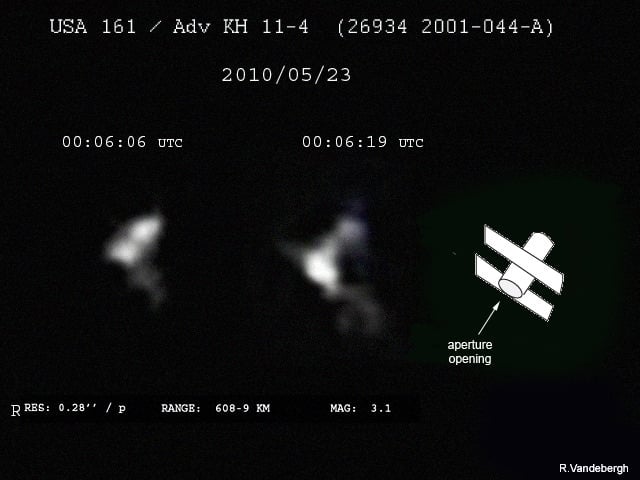
from the Netherlands is becoming well-known for his ability to capture images of the space shuttle, space station and other satellites in low Earth orbit. Recently, he tried his hand at something a little more distant: The Keyhole 11-4 satellite, which orbits at about 600 km (360 miles) above the Earth. The KH-11 series of satellites was the first American spy satellite to utilize optical digital imaging, and create a real-time optical observation capability for reconnaissance of other countries. There were about 10 of these satellites, launched by the American National Reconnaissance Office between December 1976 and 1990. These satellites are about same shape as the Hubble Space Telescope – a cylinder with solar arrays on each side, but a little bigger: according to
Wikipedia
, the KH 11's are thought to be about 19.5 meters (63 feet) long, while Hubble is 13.1 meters (43.5 ft) long. Hubble's orbit is similar, at about 353 miles (569 kilometers), but a big difference is that while Hubble is pointed out towards space, the KH 11's are pointed back at Earth, looking at the happenings of humans.
Ralf emailed me with this newest image, and said, "Although we are too high in latitude in the Netherlands to see the known Hubble telescope, I did the following comparable observation," adding that he was surprised to have captured clearly the body with some detail and signs of solar panels.
"'High res' images may sound questionable, but realize that we speak of a category object in range 600 km altitude, and you will understand that the recorded resolution is less than the images obtained on objects as the Space Shuttle and the ISS in almost halfway its orbital altitude," Ralf said.
Ralf's observations of the KH 11 satellite were obtained "in steady air in the night of May 23, 2010."
Not much else is known about the KH 11 satellites, but only a couple of them are still operational. A US CIA employee went to prison for selling the technical manuals on these satellites to the Soviet Union.
Although no 'official' info is out there about the KH 11's, they are believed to resemble the Hubble Space Telescope in size and shape because the satellites were shipped in similar containers. Also, a NASA history of the Hubble said that one of the main reasons for switching Hubble from a 3-meter main mirror to a 2.4-meter design "would lessen fabrication costs by using manufacturing technologies developed for military spy satellites."
Just what can these satellites see on the ground? Assuming a 2.4-meter mirror, the theoretical ground resolution with no atmospheric degradation and 50%
Modulation Transfer Function
would be roughly 15 cm (6 inches), but actual resolution would be worse due to effects of the atmosphere.
So, Ralf was spying on the spies!
Check out his
webpage on the KH 11 observation,
which includes a "movie" of a KH 11 flare.
Thanks again to Ralf Vandebergh for sharing his very unique images!