Universe Today
[/caption]
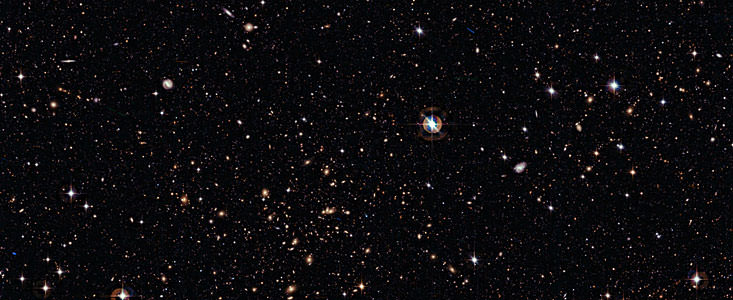
In an image akin to the Hubble Deep Field, ESO's La Silla Observatory in Chile stared at a patch of sky about as big as a full Moon and observed thousands of distant galaxies. The Wide Field Imager on ESO's 2.2 meter telescope zeroed in on a large group of galaxies that are part of the massive galaxy cluster known as Abell 315. But there's more in this image—including relatively close asteroids that show up as blue, green or red trails, which lie in the main asteroid belt, located between the orbits of Mars and Jupiter. Also, invisible dark matter is revealed in this image through its gravitational effects, noticeably visible on this galaxy cluster.
Of course, not all the galaxies seen here are the same distance from us. Some are relatively close, as it is possible to distinguish their spiral arms or elliptical halos if you
zoom in on this larger image,
especially in the upper part of the image. The more distant galaxies appear just like faint of blobs — their light has traveled through the Universe for eight billion years or more before reaching Earth.
The concentration of about a hundred yellowish galaxies is the Abell 315 galaxy cluster. The cluster is located in the constellation of Cetus (the Whale).
The galaxies in these clusters contribute to only ten percent of the mass, with hot gas in between galaxies accounting for another ten percent. The remaining 80 percent is made of dark matter that lies in between the galaxies.
We know the dark matter is there because of its effects: the enormous mass of a galaxy cluster acts on the light from galaxies behind the cluster like a cosmic magnifying glass, bending the trajectory of the light and thus making the galaxies appear slightly distorted. By observing and analyzing the twisted shapes of these background galaxies, astronomers can infer the total mass of the cluster responsible for the distortion, even when this mass is mostly invisible. However, this effect is usually tiny, and it is necessary to measure it over a huge number of galaxies to obtain significant results. In the case of Abell 315, the shapes of almost 10,000 faint galaxies in this image were studied in order to estimate the total mass of the cluster, which amounts to over a hundred thousand billion times the mass of our Sun.
For more information see the
ESO release and additional images.