Universe Today
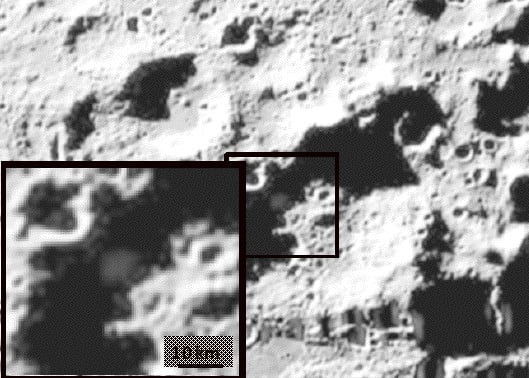
The LCROSS team announced today the mission successfully uncovered water during the Oct. 9, 2009 impacts into the permanently shadowed region of Cabeus cater near the moon's south pole. "Indeed yes, we found water. We didn't find just a little bit we found a significant amount," said Tony Colaprete, principal investigator for LCROSS at a press conference. The team was not able to put a concentration of how much water is held in the lunar regolith, but in a fraction of the 20-30 meter crater the impact made, they were able to observe about 25 gallons (95 liters) of water with spectroscopic data. Colaprete held up a 2-gallon (7 liter) bucket, to demonstrate how much they found.
[caption id="attachment_44961" align="aligncenter" width="580" caption="Data from the down-looking near-infrared spectrometer. The red curve shows how the spectra would look for a "grey" or "colorless" warm (230 C) dust cloud. The yellow areas indicate the water absorption bands. Credit: NASA"]
[/caption] Asked if the team had "eureka" moment of when they found the water signature, Colaprete said, "It's been a 'holy cow!' moment every day since impact. About two weeks ago we meet as a team and went through the entire data set. That's when we came to the conclusion that we definitively found water."
Colaprete said they also found signatures of other compounds as well, including sodium and carbon dioxide, which they are still analyzing.
While earlier findings this year of water on the Moon with the Moon Mineralogy Mapper on the Chandrayaan-1 spacecraft compared the lunar regolith to being drier than deserts on Earth, at Cabeus crater, there appears to be more.
"If you were standing on the 20 meter 'beach,' of the crater we created from the impact, it is wetter than some deserts on Earth," Colaprete said.
Since the impacts, the LCROSS science team has been working almost nonstop analyzing the huge amount of data the spacecraft collected. The team concentrated on data from the satellite's spectrometers, which provide the most definitive information about the presence of water. A spectrometer examines light emitted or absorbed by materials that helps identify their composition. [caption id="attachment_44966" align="aligncenter" width="580" caption="Data from the ultraviolet/visible spectrometer taken shortly after impact showing emission lines (indicated by arrows). These emission lines are diagnostic of compounds in the vapor/debris cloud. Credit: NASA"]
[/caption]
The 95 liters was the amount of what was in the field of view of the spectrometers. To find out how much total water is inside the crater will take a "reconstruction" of the crater by the team. "We need to take the amount of ejecta, along with the size of crater and reconstruct the event to understand how it all fits back in the ground to understand everything in its entirety," said Colaprete. "We know it was important to the public for us to come out with the results, and to provide some sort of quantifiable amount but we still have a lot of work to do to see the total picture."
The impact created by the LCROSS Centaur upper stage rocket created a two-part plume of material from the bottom of the crater. The first part was a high angle plume about 10-12 meters across of vapor and fine dust and the second a lower angle ejecta curtain of heavier material. This material has not seen sunlight in billions of years.
Colaprete said the crater floor is normally about -230 C, but the impact heated things up to about 1000 K, or 700 C, which is cold for an impact, but what was expected for the low density Centaur rocket that slammed into the Cabeus Crater.
Where the water came from is yet to be determined, whether it was delivered there by comets and meteorite hits or if some process within the Moon or on the surface is creating the water.
Mike Wargo, NASA's chief lunar scientist, said the cold traps in the permanently shadowed craters of the Moon are like the dusty attics or junk drawers of the solar system. "They collect stuff from the whole evolution of the solar system, at least form the past few billion years. We're only just begun to tap into our understanding."
"This has really turned our understanding of lunar water on its head," said Greg Delory. We should keep our minds open of what this is telling us. It's not Apollo's Moon, its our Moon."
Source: NASA press conference
For more information see NASA's press release