Universe Today
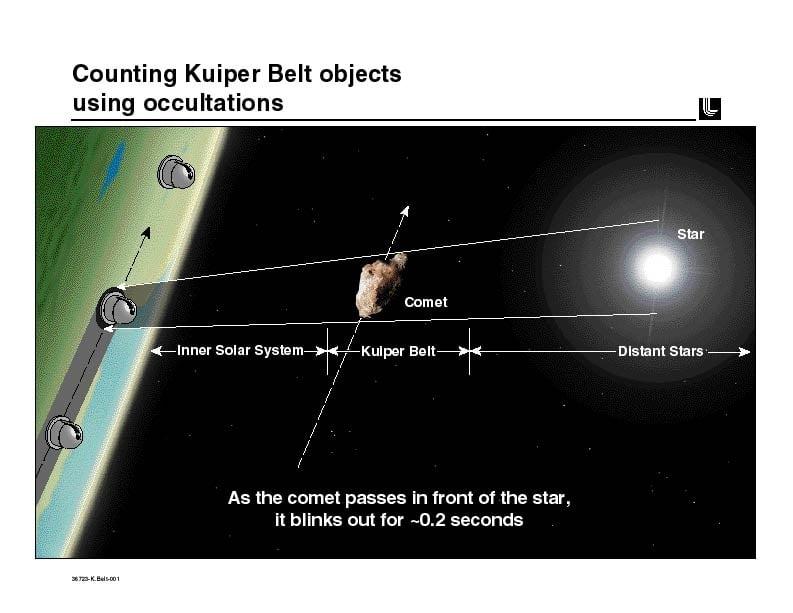
[/caption] A group of astronomers spent two years photographing portions of the sky to look for small chunks of rock and ice orbiting beyond Neptune, in the Kuiper Belt region of our Solar System. The survey targeted Kuiper Belt objects (KBOs) with sizes between 2 miles (3 km) and 17 miles (28 km). The researchers are surprised, as well as a little disappointed with the results. They came up empty. Nada. Not a single KBO within those parameters was spotted. But these researchers from the Taiwanese-American Occultation Survey (TAOS) are 'glass-half-full' types, and say that defeat can provide as much information as a successful search, so they are making the most of their data. What this means is that there are less KBOs out there than previously thought.
Since the KBO's this group searched for are too small to see directly, the survey watched for stars to dim as KBOs passed in front of and occulted them. After accumulating more than 200 hours of data watching for stellar flickers lasting a second or less, TAOS did not spot any occultations.
Here's a movie that illustrates their search.
The Kuiper Belt contains objects in a range of sizes: a few very large ones (like the dwarf planets Pluto, Eris, Makemake and Haumea) and many more smaller ones. The commonness of a given size tells us information about the history of planet formation and dynamics. In particular, the size distribution of KBOs reflects a history of agglomeration, in which colliding objects tended to stick together, followed by destructive collisions, where collisional velocities were high enough to shatter the rocks involved.
Astronomers questioned whether they would find more and more objects as sizes decreased further, or whether the distribution leveled out. The fact that no occultations were seen sets a stringent upper limit on the number density of KBOs between 2 and 17 miles in diameter. The outer solar system, therefore, appears not as crowded as some theories suggest, perhaps because small KBOs have already stuck together to form larger bodies or frequent collisions have ground down small KBOs into even smaller bits below the threshold of the survey.
The paper announcing this result, co-authored by CfA director Charles Alcock, was published in the October 1 issue of the Astrophysical Journal Letters.
Sources:
TAOS
,
CfA