Mercury

50 Years Ago Today: The Flight of Aurora 7

May 24, 2012

Fifty years ago today, May 24, 1962 astronaut Scott Carpenter launched in his Aurora 7 capsule. This was the fourth manned mission and the second orbital flight of the Mercury program. This video celebrates the Aurora 7 flight, which successfully made three Earth orbits. But a targeting mishap during reentry took the spacecraft about 400 [...]

Read the full article →

Spacecraft Captures Mercury-Jupiter Conjunction

May 22, 2012

Here’s a great shot from the Solar and Heliospheric Observatory (SOHO) spacecraft of Mercury (top planet) and Jupiter snuggling up together, along with the Pleiades cluster, all close to Sun, as seen from SOHO’s LASCO C3 instrument (Large Angle and Spectrometric Coronagraph). SOHO has been in space since 1995, and is a workhorse of solar [...]

Read the full article →

Warhol Crater Gets Its 15 Minutes of Fame

May 14, 2012

As pop art icon Andy Warhol said, “In the future everyone will be famous for fifteen minutes,”  and so here’s an image of the crater on Mercury that now bears his name, set up in the style of one of his multicolored silkscreens. Warhol is one of 23 craters on Mercury to be recently approved [...]

Read the full article →

The View From Freedom 7

May 5, 2012

51 years ago today, on May 5, 1961, NASA launched the Mercury-Redstone 3 rocket carrying Alan B. Shepard, Jr. aboard the Freedom 7 capsule. Shepard successfully became America’s first man in space, making a brief but historic suborbital test flight that propelled American astronauts into the space race of the 1960s. The video above is [...]

Read the full article →

MESSENGER Reveals Mercury’s Colors

April 20, 2012

The subtle yet surprisingly varied colors of Mercury are revealed in the latest images from NASA’s MESSENGER spacecraft, now in its extended mission and second year in orbit.

Read the full article →

Thin Skinned and Wrinkled, Mercury is Full of Surprises

April 13, 2012

Until relatively recently, Mercury was one of the most poorly understood planets in the inner solar system. The MESSENGER mission to Mercury, is changing all of the that. New results from the Mercury Laser Altimeter (MLA) and gravity measurements are showing us that the planet closest to our sun is thin skinned and wrinkled, which [...]

Read the full article →

Watch Mercury Get Smacked By CMEs

April 9, 2012

The bright object in the center of this video sequence is the planet Mercury, seen by NASA’s STEREO-B spacecraft as it was pummeled by wave after wave of solar material ejected from the Sun during the week of March 25 – April 2, 2012. The video above was released by NASA’s Goddard Space Flight Center [...]

Read the full article →

MESSENGER Gets It Donne

April 7, 2012

Named after the 17th-century metaphysical poet, Mercury’s Donne crater was captured in this image by NASA’s MESSENGER spacecraft. The 53-mile (83-km) -wide crater features a large, rounded central peak and numerous lobate scarps lining its floor.

Read the full article →

Characteristics of Mercury

April 1, 2012

Quick Mercury Stats Mass: 0.3302 x 1024 kg Volume: 6.083 x 10¹⁰ km3 Average radius: 2439.7 km Average diameter: 4879.4 km Density: 5.427 g/cm3 Escape velocity: 4.3 km/s Surface gravity: 3.7 m/s2 Visual magnitude: -0.42 Natural satellites: 0 Rings? – No Semimajor axis: 57,910,000 km Orbit period: 87.969 days Perihelion: 46,000,000 km Aphelion: 69,820,000 km [...]

Read the full article →

A Peek at a Pitch-Black Pit

March 19, 2012

MESSENGER captured this high-resolution image of an elongated pit crater within the floor of the 355-km (220-mile) -wide crater Tolstoj on Mercury on Jan. 11, 2012. The low angle of sun illumination puts the interior of the pit crater into deep shadow, making it appear bottomless.

Read the full article →

Who Discovered Mercury?

March 13, 2012

Mercury is one of the 5 planets visible with the unaided eye. Even thousands of years ago, ancient astronomers knew that the 5 wanderers were different from the other stars in the sky. The 5 planets visible with the unaided eye are Mercury, Venus, Mars, Jupiter and Saturn. They gave them distinct names, and charted [...]

Read the full article →

Symbol for Mercury

March 13, 2012

Astronomers have traditionally used this symbol for the planet Mercury. It is also the medieval alchemy sign for the element Mercury. The planet Mercury symbol contains the sign for female, but then it’s also topped with “horns” or a crescent. These are to symbolize the winged hat that the Greek god Hermes wore in legend. [...]

Read the full article →

How Many Moons Does Mercury Have?

March 13, 2012

Since the Earth has a moon, and Saturn has more than 60, here’s a good question: does Mercury have moons? Unfortunately, the answer is no, Mercury has no moons. But if moons are so common in the Solar System, and even Pluto, which is smaller than Mercury has moons, why doesn’t Mercury have moons? The [...]

Read the full article →

Atmosphere of Mercury

March 12, 2012

When you look at an image of Mercury, it looks like a dry, airless world. But you might be surprised to know that Mercury does have an atmosphere. Not the kind of atmosphere that we have here on Earth, or even the thin atmosphere that surrounds Mars. But Mercury’s atmosphere is currently being studied by [...]

Read the full article →

Mercury

March 12, 2012

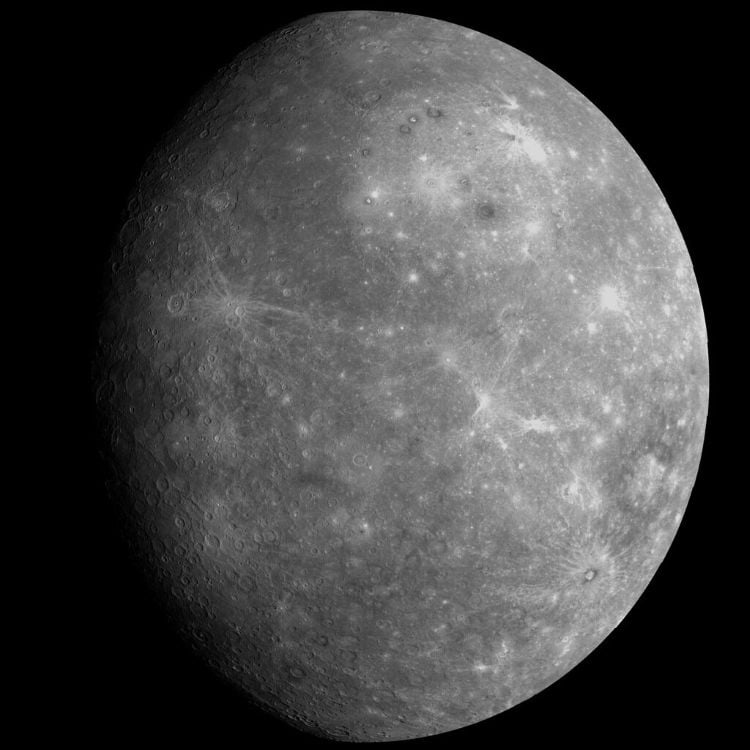
Mercury is the closest planet to orbit the Sun in the Solar System; orbiting at a distance of only 58 million km (just for comparison, Earth orbits at 150 million km). Like all of the planets, Mercury is named after a Roman god; in this case, Mercury was the Roman god of commerce – the [...]

Read the full article →

Night Sky Guide: March 2012

March 2, 2012

Special thanks to Ninian Boyle astronomyknowhow.com for information in parts of this guide. March brings us some wonderful sights to see in the night skies for those who are armed with binoculars, telescopes or just their eyes. The brightest object in the night sky this month (apart from the Moon) is the Planet Venus. Venus [...]

Read the full article →

Mercury Down Under

February 24, 2012

NASA’s MESSENGER spacecraft, about to wrap up its first full year in orbit around Mercury, captured this view of the planet’s heavily-cratered southern hemisphere on August 28, 2011. Because of its orbit, MESSENGER gets particularly good panoramic views of Mercury’s underside. Here’s why…

Read the full article →

Degas: a Crater Painted Blue

February 21, 2012

This image, acquired by NASA’s MESSENGER spacecraft on December 12, 2011, reveals the blue coloration of the 32-mile (52-km) -wide Degas crater located in Mercury’s Sobkou Planitia region. Degas’ bright central peaks are highly reflective in this view, and may be surrounded by hollows — patches of sunken, eroded ground first identified by MESSENGER last [...]

Read the full article →

Bright Peaks, Dark Shadows

February 19, 2012

The 68-mile (109-km) -wide Amaral crater on Mercury reveals its brightly-tipped central peaks in this image, acquired by NASA’s MESSENGER spacecraft on Feb. 4, 2012. Long shadows are cast by the crater’s peaks and rugged rim (north is to the left.) The image was acquired as a high-resolution targeted observation with MESSENGER’s Narrow-Angle Camera (NAC) on [...]

Read the full article →

Kuiper’s Color Close-Up

February 14, 2012

The pale-orange coloration around the 39-mile (62-km) -wide Kuiper crater on Mercury is evident in this image, a color composition made from targeted images acquired by NASA’s MESSENGER spacecraft on September 2, 2011. The color may be due to compositional differences in the material that was ejected during the impact that formed the crater.

Read the full article →