Anne Minard

New Studies: Planetary Rings Harbor Records of Past Smash-Ups

March 31, 2011

Planetary rings are more than just astronomical marvels — they’re also a sort of archive, chronicling histories of impacts for decades. A pair of studies were published online in Science today by two different teams that noticed odd characteristics in the rings of Saturn and Jupiter — and followed them to this promising conclusion. In the [...]

Read the full article →

New Technique Separates the Modest Red Giants From the … Giant Red Giants

March 30, 2011

Based on results from the first year of the Kepler mission, researchers have learned a way to distinguish two different groups of red giant stars: the giants, and the truly giant giants. The findings appear this week in Nature.

Read the full article →

New Image: Rosy Glow of Starbirth, Just in Time for Spring

March 30, 2011

Just in time for the start of spring, the ESO’s Very Large Telescope has captured this stunning new image of a region of glowing hydrogen surrounding the star cluster NGC 371. Regions of ionized hydrogen like this one — known as HII regions — are exploding with the births of new stars. NGC 371 lies [...]

Read the full article →

Perseus Cluster Thicker Around the Middle Than Thought

March 24, 2011

The Japanese Suzaku X-ray telescope has just taken a close look at the Perseus galaxy cluster, and revealed it’s got a bit of a spare tire. Suzaku explored faint X-ray emission of hot gas across two swaths of the Perseus Galaxy Cluster. The resulting images, which record X-rays with energies between 700 and 7,000 electron [...]

Read the full article →

Famous Binary Cygnus-X1 Displays First-Ever Polarized Emissions

March 24, 2011

Using the IBIS telescope onboard the European Space Agency’s INTEGRAL satellite, researchers have reported the first measurements of polarization from a black hole binary system, which comprises a black hole and a normal star orbiting around a common center of mass. The new observations reveal that the chaotic region is threaded by magnetic fields, and [...]

Read the full article →

Probing the Moho Boundary – Earth’s Own Unexplored Frontier

March 23, 2011

The boundary where Earth’s crust gives way to the unexplored mantle was first detected in 1909, because of a change in the travel of seismic waves. Named the Moho boundary for Andrija Mohorovicic, who listened to those seismic waves, the crust-mantle boundary is a frontier that remains elusive and compelling — harboring tantalizing clues as to [...]

Read the full article →

Coolest Brown Dwarf Spotted by Earth-bound Telescopes

March 23, 2011

Astronomers have found the coldest known star — a brown dwarf in a double system about as hot as a cup of tea. The discovery blurs the line between small cold stars and large hot planets. The star, CFBDSIR 1458+10B, is the dimmer member of the binary system, about 75 light-years from Earth.

Read the full article →

Success! MESSENGER First Spacecraft to Orbit Mercury

March 17, 2011

After more than a dozen laps through the inner solar system, NASA’s MESSENGER spacecraft appears to have moved into orbit around Mercury tonight. Although Mariner in the 1970s and MESSENGER in the past several years have done flybys, MESSENGER is the first spacecraft to orbit the innermost planet in our solar system. NASA is stopping short of [...]

Read the full article →

Titan’s Spring Showers Bring Torrents of Methane, Maintain ‘Dry’ Gullies

March 17, 2011

Titan’s skies dump methane rain on the bizarre moon a quarter of the year, which collects in northern methane lakes and maintains gullies and washes once presumed to have been sculpted in a wetter age. Elizabeth Turtle from the Johns Hopkins University Applied Physics Laboratory (APL) is lead author on the new Science paper reporting [...]

Read the full article →

NASA: Happy St. Paddy’s Day!

March 17, 2011

With the luck o’ the Irish, NASA’s Aqua satellite was fortunate to capture mostly clear views of the Emerald Isle in these near-infrared/visible, infrared and microwave light views acquired by Aqua’s Atmospheric Infrared Sounder (AIRS) instrument. And with holiday flair, the agency has arranged the images into a clover and released them as a St. [...]

Read the full article →

New Image: VLT Captures Tumult of Starbirth

March 16, 2011

Newborn stars spew material into the surrounding gas and dust, creating a surreal landscape of glowing arcs, blobs and streaks — and ESO’s Very Large Telescope (VLT) has caught some of them on candid camera. This new image, released today, hails from NGC 6729, a nearby star-forming region in the constellation Corona Australis.

Read the full article →

Touching the Tarantula: Hubble Gets in Close

March 15, 2011

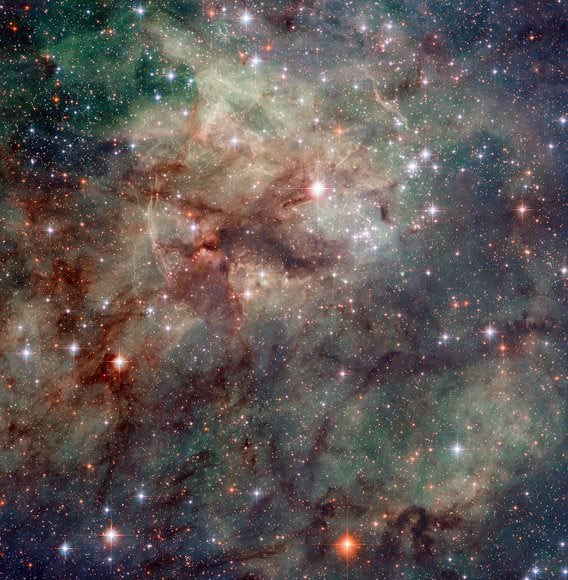
Hubble has edged in close to the Tarantula Nebula, peering into its bright center of ionized gases, dust and still-forming stars. The Tarantula is already a go-to celestial marvel, because its hydrogen-fueled young stars shine with such intense ultraviolet light that they ionize and redden the surrounding gas — making the nebula visible without a telescope for [...]

Read the full article →

Bullseye: MESSENGER Gears Up For First-Ever Mercury Orbit

March 14, 2011

When MESSENGER streaked into the early morning sky over Cape Canaveral on Aug. 3, 2004, very little was known about Mercury. That could soon change. This week, MESSENGER — which stands for MErcury Surface, Space ENvironment, GEochemistry and Ranging — will make history when it becomes the first spacecraft to orbit Mercury. At 8:45 p.m. [...]

Read the full article →

Did Mars’ Missing Carbon Go Underground in a Wetter Age?

March 11, 2011

A close look at the Wisconsin-sized Huygens Crater, above, in Mars’ southern highlands gave NASA and Arizona State University scientists some clues to announce this week as to a possible source of the carbon that’s mysteriously missing from the red planet’s thin atmosphere. It might be buried underground. The impact that formed the crater lifted material [...]

Read the full article →

Grieving Glory — And Will The Taurus XL Fly Again?

March 11, 2011

Last week’s loss of the $420 million Glory satellite has sent NASA into an intensive investigation to find out why two climate change missions in a row — flying aboard the same type of rocket — crashed due to what apparently was a similar technical glitch. Orbital Sciences out of Dulles, Va. is the company that designed [...]

Read the full article →

‘Armada of Telescopes’ Captures Most Distant Galaxy Cluster Ever Seen

March 9, 2011

The galaxies above are among the oldest objects astronomers have ever laid eyes — er, telescopes — on, formed when the Universe was less than a quarter of its current age. In a new study out in the journal Astronomy & Astrophysics, a team of researchers has announced that they’ve used a fleet of the world’s most [...]

Read the full article →

New Look at Messier 82 Reveals Superwind Source, Young Star Clusters

March 7, 2011

Messier 82′s galactic windstorms emanate from many young star clusters, rather than any single source, say astronomers who released this new image today. The international team of scientists, led by Poshak Gandhi of the Japan Aerospace Exporation Agency (JAXA), has used the Subaru Telescope to produce a new view of M 82 at infrared wavelengths [...]

Read the full article →

‘Climate Change Satellite’ Fails to Reach Orbit, Crashes in Ocean

March 4, 2011

NASA’s Glory mission launched from Vandenberg Air Force Base in California Friday at 5:09:45 a.m. EST failed to reach orbit. Telemetry indicated the fairing, the protective shell atop the Taurus XL rocket, did not separate as expected about three minutes after launch. The failure represents a $420 million loss for NASA, and the loss of two [...]

Read the full article →

Solar System’s Story Revealed in a Pea

March 3, 2011

Feast your eyes on some of the solar system’s earliest materials: the pink core comprises melilite, spinel and perovskite. The multi-colored rim contains hibonite, perovskite, spinel, melilite/sodalite, pyroxene, and olivine. This close-up reveals part of a pea-sized chunk of meteorite, a calcium-aluminum rich inclusion, formed when the planets in our solar system were still dust grains swirling around [...]

Read the full article →

New Study: Sun’s Deep Physics Explain Sunspot-Free Days

March 2, 2011

The long lull in sunspots at the end of Solar Cycle 23 wasn’t just fodder for global cooling predictions — it gave solar physicists plenty to study. And a new computer analysis may have come up with a fairly simple explanation for the sun’s odd quiet. Lead author Dibyendu Nandy, of the Indian Institute of [...]

Read the full article →