Universe Today
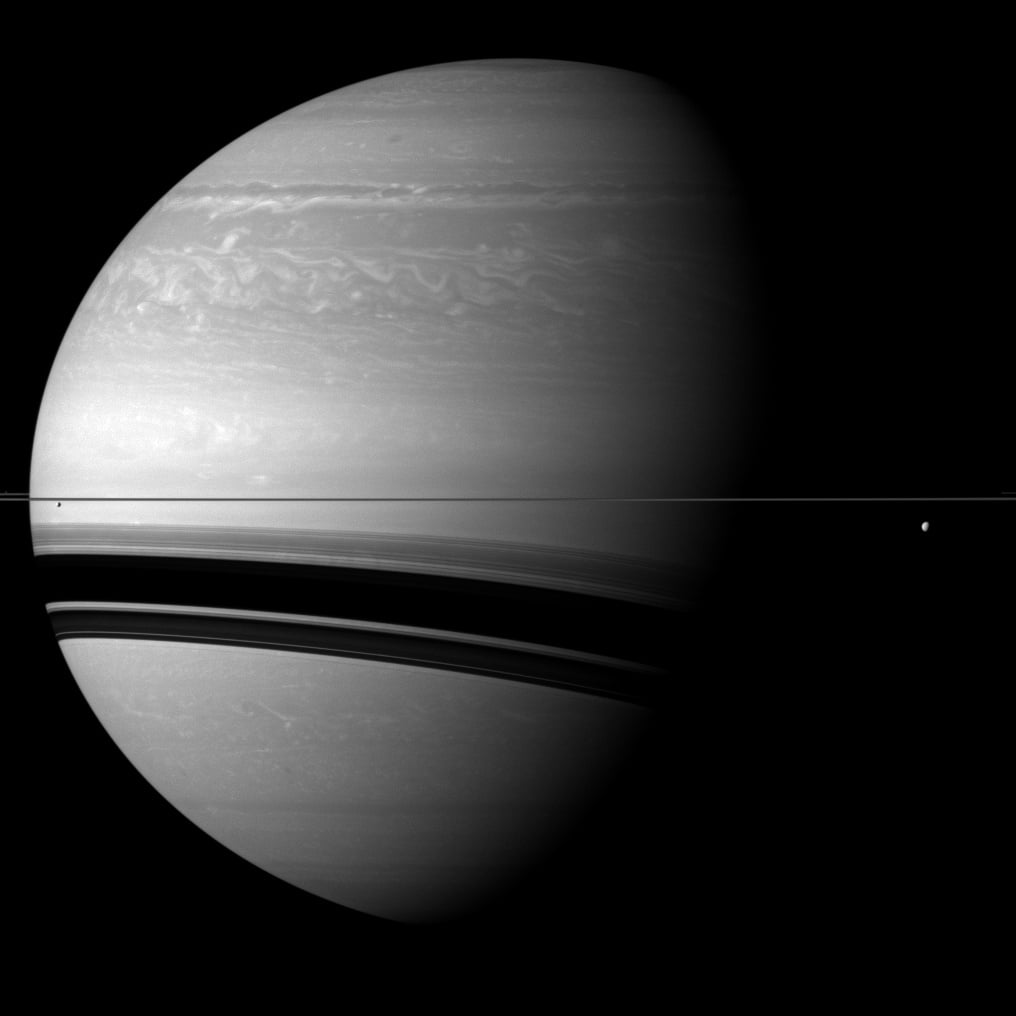
It's just one extreme to another in this image from the Cassini spacecraft. Of course, you can't miss the ginormous Saturn. But do you see three of what appear to be eentsy, tiny moons of the ringed planet?
Tethys (660 miles, or 1,062 kilometers across) is on the right of the image, below the rings. Smaller Enceladus (313 miles, or 504 kilometers across) is on the left of the view, below the rings. Pandora (50 miles, or 81 kilometers across) is also present in this view but is barely visible. It appears as a small grey speck above the rings on the extreme left edge of the image. Pandora has been slightly brightened by the imaging team by a factor 1.2 relative to the rest of the image.
The image was taken with the Cassini spacecraft wide-angle camera on Dec. 7, 2011 using a spectral filter sensitive to wavelengths of near-infrared light centered at 752 nanometers. The view was obtained at a distance of approximately 1.3 million miles (2.1 million kilometers) from Saturn. Image scale is about 77 miles (124 kilometers) per pixel.
Image caption: Saturn and three small moons. Credit: NASA/JPL-Caltech/Space Science Institute
Source:
CICLOPS