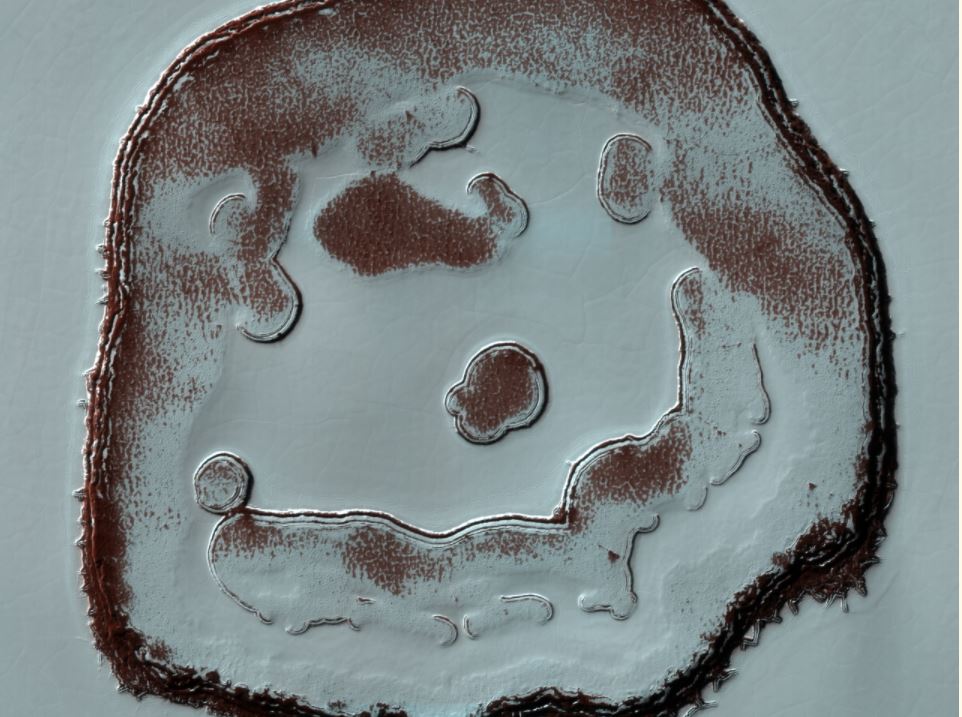
Asteroid’s Unusual Light and Dark Crater

by Jason Major on January 26, 2012

Want to stay on top of all the space news? Follow @universetoday on Twitter

A 5-km-wide crater on Vesta displays light and dark material.

Light and dark material spreads outward from a 5-km-wide crater on Vesta in this image from NASA’s Dawn spacecraft, acquired on October 22, 2011. While craters with differently-toned materials have been previously seen on the asteroid, it is unusual to find one with such a large amount of ejecta of different albedos.

This is a crop of a larger version which was released today on the Dawn website.

This brightness image was taken through the clear filter of Dawn’s framing camera. The distance to the surface of Vesta is 700 kilometers (435 miles) and the image has a resolution of about 70 meters (230 feet) per pixel.

Orbit map: Where is Dawn now?

Vesta resides in the main asteroid belt between the orbits of Mars and Jupiter and is thought to be the source of many of the meteorites that fall to Earth. The Dawn spacecraft successfully entered orbit around Vesta on July 16, 2011.

After its investigation of Vesta, Dawn will leave orbit and move on to Ceres. It will become the first spacecraft to orbit two different worlds.

Image Credit: NASA/ JPL-Caltech/ UCLA/ MPS/ DLR/ IDA

About

A graphic designer living in Providence, RI, Jason writes about astronomy and space exploration on his blog Lights In The Dark, Discovery News and here on Universe Today.

  • panwhale narjathawal

    cosmic anus?

  • Torbjörn Larsson

    [Ivan] Apollo 8 – 17 and other crafts have orbited two different worlds before Dawn. [/Ivan]

    It is a funny misconception as it is repeated over and over again, on UT and elsewhere. I wonder if it was an early boast from the project that somehow got misconstrued?

    Also a good reflection on the stupendous early achievement of Apollo and the near repeat by the similarly advanced Russian Moon program.

    • IVAN3MAN_AT_LARGE

      The term “two different worlds” means any two worlds other than the Earth.

  • Anonymous

    It is quite obvious that this is a blast crater from a liftoff from the tau cetian’s observation post for earth, we just got a little to close.

Previous post:

Next post: