Universe Today
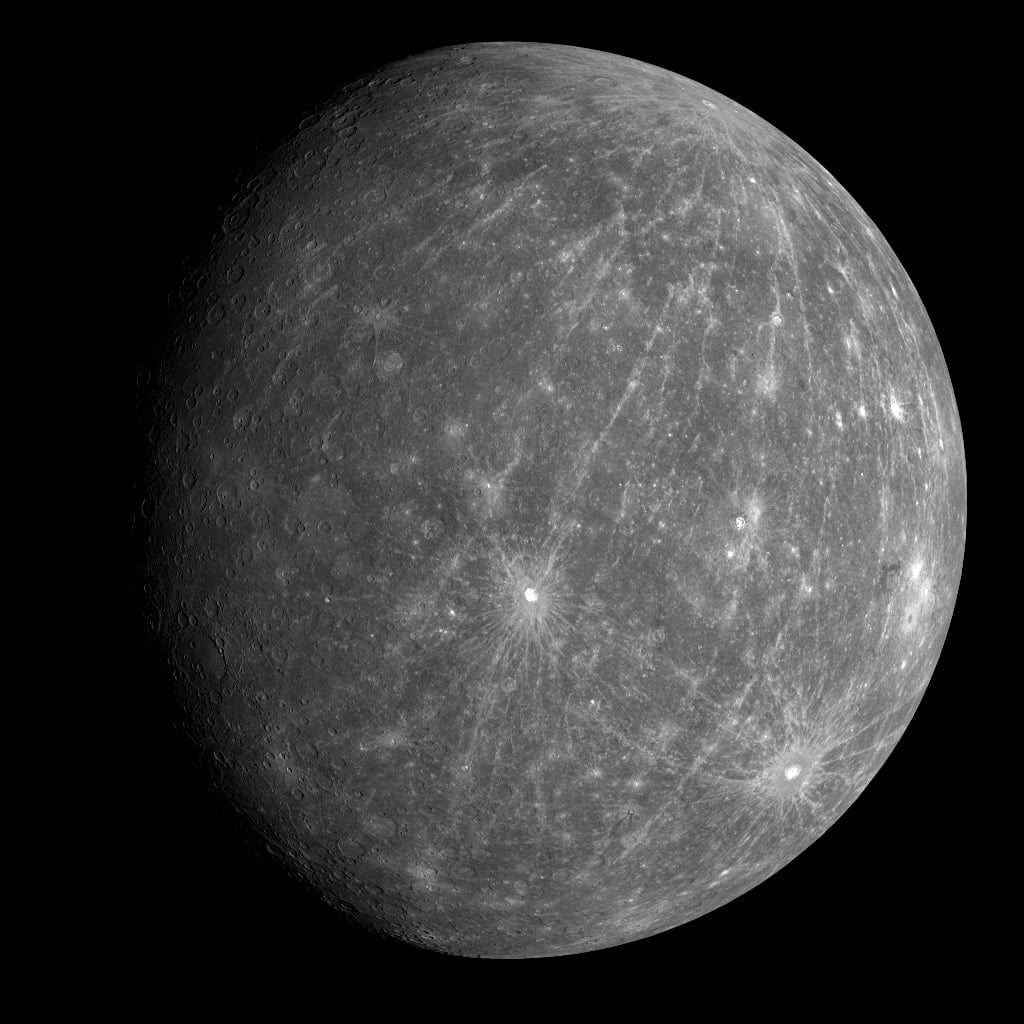
With the dawning of the Space Age in the 1950s, human beings were no longer confined to studying the Solar planets and other astronomical bodies with Earth-based instruments alone. Instead crewed missions have gone into orbit and to the Moon while robotic missions have traveled to every corner of the Solar System. And in the process, we have learned some interesting things about the planets, planetoids, and asteroids in our Solar neighborhood.
For example, we have learned that all the Solar planets have their own particular patterns and cycles. For instance, even though Mercury is an airless body, it does have a tenuous exosphere and experiences seasons of a sort. And while it is known for being extremely hot, it also experiences extremes of cold, to the point that ice can exist on its surface. While it is by no means what we are used to here on Earth, Mercury still experiences a kind of "weather".
Mercury's Atmosphere:
As noted, Mercury has no atmosphere to speak of, owing to its small size and extremes in temperature. However, it does have a tenuous and variable exosphere that is made up of hydrogen, helium, oxygen, sodium, calcium, potassium and water vapor, with a combined pressure level of about 10-14 bar (one-quadrillionth of Earth’s atmospheric pressure).
It is believed this exosphere was formed from particles captured from the Sun (i.e solar wind) as well as volcanic outgassing and debris kicked into orbit by micrometeorite impacts. In any case, Mercury's lack of a viable atmosphere is the reason why it is unable to retain heat from the Sun, which leads to extreme variations between night and day for the rocky planet.
Orbital Resonance:
Mercury's temperature variations are also attributed to its orbital eccentricity of 0.2056, which is the most extreme of any planet in the Solar System. Essentially, its distance from the Sun ranges from 46 million km (29 million mi) at its closest (perihelion) to 70 million km (43 million mi) at its farthest (aphelion). As a result, the side facing the Sun reaches temperatures of up to 700 K (427° C), the side in shadow dips down to 100 K (-173° C).
With an average rotational speed of 10.892 km/h (6.768 mph), Mercury also takes 58.646 days to complete a single rotation. This means that Mercury has a spin-orbit resonance of 3:2, where it completes three rotations on its axis for every two rotations completed around the Sun. This does not, however, mean that three days last the same as two years on Mercury.
In fact, its high eccentricity and slow rotation mean that it takes 176 Earth days for the Sun to return to the same place in the sky (aka. a solar day). In short, a single day on Mercury is twice as long as a single year! Mercury also has the lowest axial tilt of any planet in the Solar System – approximately 0.027 degrees compared to Jupiter’s 3.1 degrees (the second smallest).
Polar Ice:
This low tilt means that the polar regions are constantly in shadow, which leads to another interesting feature about Mercury. Yes, despite how hot its Sun-facing side can become, the existence of water ice and even organic molecules have been confirmed on Mercury’s surface. But this only true at the poles, where the floors of deep craters are never exposed to direct sunlight, and temperatures within them therefore remain below the planetary average.
These icy regions are believed to contain about 1014–1015 kg (1 to 10 billion metric tons, 1.1 to 11 billion US tons) of frozen water, and may be covered by a layer of regolith that inhibits sublimation. The origin of the ice on Mercury is not yet known, but the two most likely sources are from outgassing of water from the planet’s interior or deposition by the impacts of comets.
When one talks about the "weather" on Mercury, they are generally confined to talking about variations between the Sun-facing side and the night side. Over the course of two years, that weather will remain scorching hot or freezing cold. In that respect, we could say that a single season on Mercury lasts a full four years, and includes a "Midnight Sun" that lasts two years, and a "Polar Night" that lasts the same.
Between its rapid and very eccentric orbit, its slow rotation, and its strange diurnal and annual patterns, Mercury is a very extreme planet with a very extreme environment. It only makes sense that its weather would be similarly extreme. Hey, there's a reason nobody lives there, at least not yet...
We have written many interesting articles about the weather on other planets here at Universe Today. Here's What is the Weather like on Venus?, What is the Weather Like on Mars?, What is the Weather Like on Jupiter?, What is the Weather Like on Saturn?, What is the Weather Like on Uranus?, and What is the Weather Like on Neptune?
If you'd like more information on Mercury, check out NASA's Solar System Exploration Guide, and here's a link to NASA's MESSENGER Misson Page.
We've also recorded an entire episode of Astronomy Cast all about Mercury. Listen here, Episode 49: Mercury.
Sources: