Missing Milky Way Dark Matter

by Jon Voisey on November 8, 2010

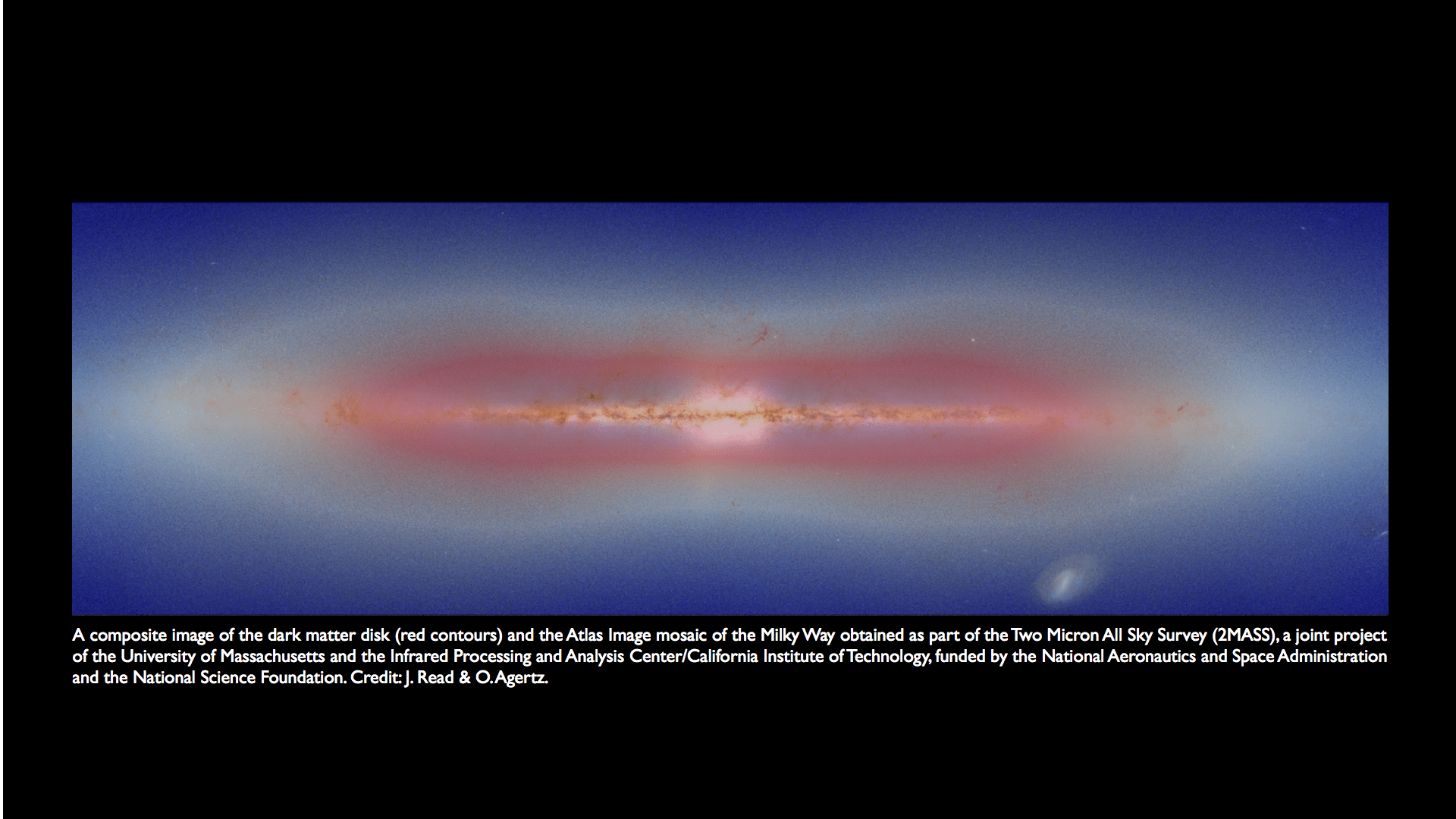
A composite image shows a dark matter disk in red. From images in the Two Micron All Sky Survey. Credit: Credit: J. Read & O. Agertz.

Although dark matter is inherently difficult to observe, an understanding of its properties (even if not its nature) allows astronomers to predict where its effects should be felt. The current understanding is that dark matter helped form the first galaxies by providing gravitational scaffolding in the early universe. These galaxies were small and collapsed to form the larger galaxies we see today. As galaxies grew large enough to shred incoming satellites and their dark matter, much of the dark matter should have been deposited in a flat structure in spiral galaxies which would allow such galaxies to form dark components similar to the disk and halo. However, a new study aimed at detecting the Milky Way’s dark disk have come up empty.


The study concentrated on detecting the dark matter by studying the luminous matter embedded in it in much the same way dark matter was originally discovered. By studying the kinematics of the matter, it would allow astronomers to determine the overall mass present that would dictate the movement. That observed mass could then be compared to the amount of mass predicted of both baryonic matter as well as the dark matter component.

The team, led by C. Moni Bidin used ~300 red giant stars in the Milky Way’s thick disk to map the mass distribution of the region. To eliminate any contamination from the thin disc component, the team limited their selections to stars over 2 kiloparsecs from the galactic midplane and velocities characteristic of such stars to avoid contamination from halo stars. Once stars were selected, the team analyzed the overall velocity of the stars as a function of distance from the galactic center which would give an understanding of the mass interior to their orbits.

Using estimations on the mass from the visible stars and the interstellar medium, the team compared this visible mass to the solution for mass from the observations of the kinematics to search for a discrepancy indicative of dark matter. When the comparison was made, the team discovered that, “[t]he agreement between the visible mass and our dynamical solution is striking, and there is no need to invoke any dark component.”

While this finding doesn’t rule out the presence of dark matter, it does place constraints on it distribution and, if confirmed in other galaxies, may challenge the understanding of how dark matter serves to form galaxies. If dark matter is still present, this study has demonstrated that it is more diffuse than previously recognized or perhaps the disc component is flatter than previously expected and limited to the thin disc. Further observations and modeling will undoubtedly be necessary.

Yet while the research may show a lack of our understanding of dark matter, the team also notes that it is even more devastating for dark matter’s largest rival. While dark matter may yet hide within the error bars in this study, the findings directly contradict the predictions of Modified Newtonian Dynamics (MOND). This hypothesis predicts the apparent gain of mass due to a scaling effect on gravity itself and would have required that the supposed mass at the scales observed be 60% higher than indicated by this study.

Jon is a science educator currently living in Missouri. He is a high school teacher and does outreach with the St. Louis Astronomical society as well as presenting talks on science and related topics at regional conventions. He graduated from the University of Kansas with his BS in Astronomy in 2008 and has maintained the Angry Astronomer blog since 2006. For more of his work, you can find his website here.

  • Lawrence B. Crowell

    Torbjorn Larsson OM: I guess I missed your comment MiniBoone may have seen sterile neutrinos. This is an interesting result, for it indicates something funny with CP violations, and some have suggested CPT violations — which would be even weirder. The FERMI results on possible DM decays also suggest a tauon decay channel, which seems to raise a question on whether there is some corresponding B-physics in QCD and CP violations. Kobayashi & Maskawa won the Nobel prize for CP violating physics in 2008, and this may have some implications here as well.

    Of course these MiniBoone and LSND data involves weak interaction physics, not gravity. Yet is may be that gravitation is an emergent field on a boundary which has a dual structure to conformal QFT. Of course we have yet to know for certain, but I think that from 10^{-17}cm to 10^{-33} cm there is a renormalization group flow of quantum fields, so gravity may play a type of role at the unification energy where the Higgs condensate produces particles. This renormalization flow may take a low energy field to the Planck scale at high energy with a continuous flow to quantum gravity, where nonlocality of field amplitudes likely holds. So there may be a loss of locality at the 10^{-17}cm scale which perturbs physics in a way which is unexpected.

    LC

  • http://icarus2.egloos.com/ icarus2

    1. Observation evidence for dark matter
    1) Galactic rotation curves
    2) Galaxy clusters and gravitational lensing
    3) WMAP
    4) Bullet cluster
    5) Structure formation

    2. In the Galaxy, No evidence for dark matter
    1) At the Earth : non-observation(Xenon100, CDMS-II…)

    2) At the solar system : non-observation

    3) At the center of galaxies : no evidence
    Greedy Supermassive Black Holes Dislike Dark Matter
    http://www.universetoday.com/13091
    Astronomers Find Black Holes Do Not Absorb Dark Matter
    http://www.universetoday.com/60422

    4) At the galactic plane : no evidence
    “No evidence for a dark matter disk within 4 kpc from the galactic plane”
    http://arxiv.org/abs/1011.1289v1.pdf

    5) At the galactic halo : no evidence
    Globular Cluster problem
    “Evidence Against Dark Matter Halos Surrounding the Globular Clusters MGC1 and NGC 2419″
    http://arxiv.org/abs/1010.5783
    ===========

    Centripetal force effect in the galaxy from dark matter halo out of the galaxy!

    [Simulation vodeo]
    http://www.youtube.com/watch?v=ylEi2gpnD08

    In the simulation,
    When negative mass’s shells exist at outline, collision time is shorter compared to existing only with positive mass’s shells. This implies that there exist additional effects of centripetal force by the dark matter halo at the galaxy’s outside in case of the galaxy having the axial symmetry(rotating galaxy).

  • Lawrence B. Crowell

    The dark matter issue does come from the anomalous motion of stars in the galaxy. It is not hard to show with the Poisson equation &_i&^i? = 4?G rho, &_i = 3 dimensional directional derivative, that for a region of constant density rho an integration over a volume is constant on the right hand side. One the left hand side one can use Stokes rule to get

    (&_iU)*A = 4?G rho V

    for A the area bounding the volume V, and U is the potential function of gravity. For A = 4?r^2 and the volume V = 4?r^3/3 you get the force F = &^iU ~ constant*r. So this is a spring force and gives dynamics similar to what we see with the motion of stars in a galaxy. This is different from the motion one expects of a central force of gravity with F = GMm/r^2. This is one reason that dark matter was initially inferred.

    The density of dark matter in the galaxy is about 10^{-24}kg/m^3. A spherical volume that encloses the solar system some 5e^{9}km out or 5e^{11}m is then a volume of about 5e^{34}m^3. Hence the mass contained in the solar system in the form of dark matter is only about 10^{10}kg. This is not a whole lot when compared to the mass of planets and certainly the sun. So this is why it does not make a significant contribution to the dynamics of the solar system.

    LC

Previous post:

Next post: