
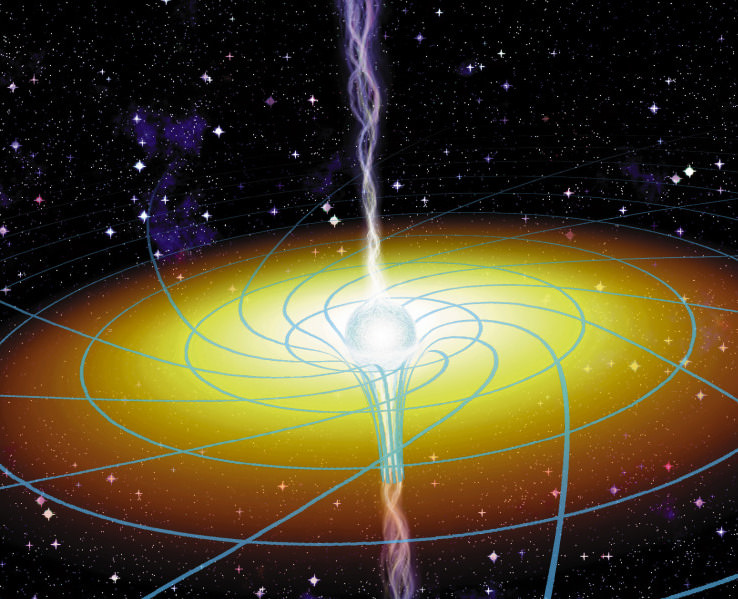
[/caption]
It has been reported that a recent scientific paper delivers the conclusion that our universe resides inside a black hole in another universe. In fact, this isn’t really what the paper concluded – although what the paper did conclude is still a little out of left field.
The Einstein-Cartan-Kibble-Sciama (ECKS) theory of gravity – claimed as an alternative to general relativity theory, although still based on Einstein field equations – seeks to take greater account of the effect of the spin of massive particles. Essentially, while general relativity has it that matter determines how spacetime curves, ECKS also tries to capture the torsion of spacetime, which is a more dynamic idea of curvature – where you have to think in terms of twisting and contortion, rather than just curvature.
Mind you, general relativity is also able to deal with dynamic curvature. ECKS proponents claim that where ECKS departs from general relativity is in situations with very high matter density – such as inside black holes. General relativity suggests that a singularity (with infinite density and zero volume) forms beyond a black hole’s event horizon. This is not a very satisfying result since the contents of black holes do seem to occupy volume – more massive ones have larger diameters than less massive ones – so general relativity may just not be up to the task of dealing with black hole physics.
ECKS theory attempts to step around the singularity problem by proposing that an extreme torsion of spacetime, resulting from the spin of massive particles compressed within a black hole, prevents a singularity from forming. Instead the intense compression increases the intrinsic angular momentum of the matter within (i.e. the spinning skater draws arms in analogy) until a point is reached where spacetime becomes as twisted, or as wound up, as it can get. From that point the tension must be released through an expansion (i.e. an unwinding) of spacetime in a whole new tangential direction – and voila you get a new baby universe.
But the new baby universe can’t be born and expand in the black hole. Remember this is general relativity. From any frame of reference outside the black hole, the events just described cannot sequentially happen. Clocks seem to slow to a standstill as they approach a black hole’s event horizon. It makes no sense for an external observer to imagine that a sequence of events is taking place over time inside a black hole.
Instead, it is proposed that the birth and expansion of new baby universe proceeds along a separate branch of spacetime with the black hole acting as an Einstein-Rosen bridge (i.e. a wormhole).
If correct, it’s a turtles on turtles solution and we are left to ponder the mystery of the first primeval universe which first formed the black holes from which all subsequent universes originate.
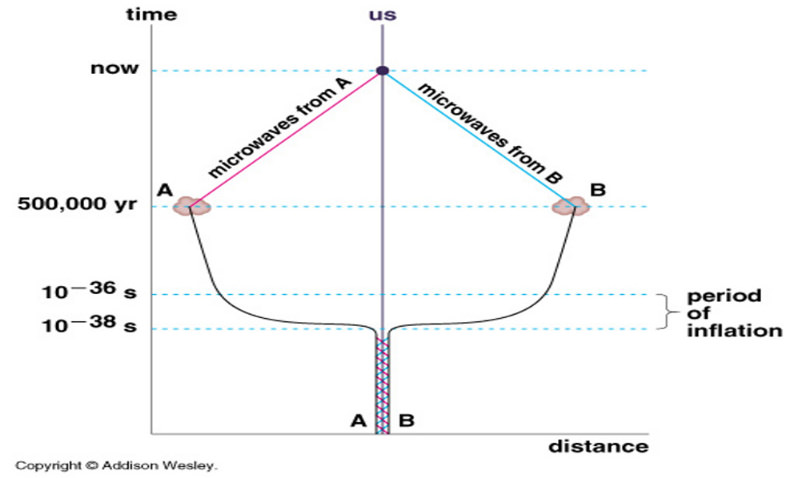
Something the ECKS hypothesis does manage to do is to provide an explanation for cosmic inflation. Matter and energy crunched within a black hole should achieve a state of isotropy and homogeneity (i.e. no wrinkles) – and when it expands into a new universe through a hypothetical wormhole, this is driven by the unwinding of the spacetime torsion that was built up within the black hole. So you have an explanation for why a universe expands – and why it is so isotropic and homogenous.
Despite there not being the slightest bit of evidence to support it, this does rank as an interesting idea.
Further reading: Poplawski, N.J. (2010) Cosmology with torsion – an alternative to cosmic inflation.
i tried to wrap my mind around this. got a bad head ache and could only say “ecks” for about an hour.
“Ecks.”
Standard cosmology is based in general relativity (GR). And similarly, it has allowed GR to be tested at unprecedented distances.
To acknowledge the frame of IVAN3MAN, we hear hoof-beats and should think of horses. This is no different from EU. [Sorry guys, it had to be compared with! :-/]
As regards GR, AFAIU there are serious reasons to believe white holes doesn’t exist (they are too unstable). So no universes in or from black holes.
Btw, note how the non-GR theory relies on GR results: “But the new baby universe can’t be born and expand in the black hole. Remember this is general relativity.” Those results likely remains to be tested in the new theory.
On a positive note, torsion and its analogues is a phenomena of note in other circumstances. Considering quadrature amplitude modulation (QAM) of light gives higher resolution to astronomical observations AFAIU. And there are natural and possibly SETI phenomena that encodes the EM wavefronts with QAM, which unless detection is attempted are left unresolved.
Oops, I forgot: GR is an effective theory, To complain of its singularities is no different from complaining of the many EM singularities. (Say, point-like charge distributions from particles like electrons, which produce singularities in the classical E potential.)
The way forward is to use theories that remove or regulate the singularities, and string theory does that uncontested for all interactions while retaining GR. Modifying GR is is rejected by observation.
Interesting. The populist (interpretation) of this paper is however understandable, partly because its an appealing solution that seems to make sense and it makes for good headlines. 🙂
Its a ‘good’ sign of the times when reasonable alternatives are being proposed to the current paradigm. (General Relativity). Lets think them through, give them some space and consideration.
Engage in some good debate and discourse about their potential.
I personally think Poplawski’s paper and Wun-Yi Shu. “Cosmological Models with No Big Bang.” paper make for the most interesting alternatives I have heard to date. Perhaps when further considered with A. Garrett Lisi’s Theory to explain Physics we could really be onto something here.
Although I’m still trying to comprehend how they all could work together, I must say that the implications are far more pleasing them the current paradim that involve a Big Bang, Singularities, dark (stuff) and a heat death.
At the least, when considered together, the ” turtles on turtles’ 🙂 enigma gets a new perspective. The 3-Sphere model of the universe connected by wormholes (black holes) perhaps? Where the transit of universes is a cyclical transition between geometries. ?
Re the CMBR, well, it remains a lynchpin in the Big Bang theory, but on the face of the observation its (probable) to assume a yet unknown explanation outside of GR if an alternative theory can better explain the universe without the need for Dark stuff.
The universe is a strange place, there should be room in our minds to consider new paradigms to understand it. 🙂 Good times.
Damian
The author confused two ideas, thinking they were the same. The singularity of a black hole is a real Einsteinian object with zero volume. The event horizon of a black hole is an unreal idea. We can point at no physical thing and say, “There! That is the event horizon.” It is instead just an idea. Should anything cross inside this mathematically determined distance, no process except Hawking Radiation would allow it to exit again.
His second misunderstanding involves a frame of reference. While an outside observer would see the time of an infalling traveler slow to zero as he approached the distance defined by the event horizon distance, the infalling traveler would not. His time, for him, would proceed as it always did. For him, his time would no slow as he approached. He would zip inside at the speed of light. Once inside, he would approach the singularity even faster than light speed. The outside observer, while being unable to see this, must conclude that the infalling traveler’s time was now flowing slower than zero, or going backwards. The infalling traveler could still observe the rest of the universe outside the imaginary distance of the event horizon, but would see it as it was before he fell in.
@ Dominion
I think it’s important that everything in cosmology should be able to be explained at a dinner party. So, if it’s helpful – here’s an analogy.
You place a salt shaker on a tablecloth, press down and twist it. The tablecloth twists with it. So, the salt shaker is a massive particle – your pressing down is the gravitational compression of a black hole – and the twisting of the tablecloth is the torsion effect on spacetime. There will come a point at which the tablecloth can’t be twisted anymore. According to the theory, the tablecloth will then undergo a kind of elastic recoil, which will send your salt shaker through a wormhole. 🙂
@ TL OM
Yes, completely agree GR is effective. The singularity issue may indicate GR has its limits, but what it can do well, it does very well.
Steve Nerlich said “Everything in cosmology should be able to be explained at a dinner party”. A noble sentiment, though I suspect this is only possible by choosing your dinner guests carefully (offside!).
There are problems with describing black hole singularities for dinner audiences. Here is a quote from Wikipedia: “‘Even more massive stars, above the Tolman-Oppenheimer-Volkoff limit cannot find a new dynamical equilibrium with any known force opposing gravity. Hence, the collapse continues with nothing to stop it”.
See the problem? The first sentence is not bad if we take “any known force” to include other phenomena. The second sentence should read “The collapse will continue unless it is checked by some other effect yet to be discovered”.
This is not being fussy. If everything went to a dimensionless dot, it would have to have no charge, no angular momentum, and no entropy. Maybe a dimensionless dot could have some of these properties if you can divide infinity by infinity and get one, but it is hard to see how you could get from that state from a finite body. There is good evidence for black holes, which means gravity has overcome the strong force, and the collapse has kept on going. But what happens next happens on the wrong side of an event horizon, and we can’t get a good look at it. As there are all sorts of problems with actually getting to a dimensionless dot, it is sensible to allow that a black hole may never actually get that far, provided it looks the same on the outside.
Dinner-party summary: Outside a black hole, the ECKS theory universe looks much the same as the old theory universe. Things might look different if we were in a black home, but we probably aren’t. Call us when someone finds an Einstein-Rosen bridge. Where’s the port got to?
EU theory has no maths that supports its claims. No predictions that can be verified, no numbers. Only guesswork and combining unrelated events together with a mad up story that appears logical.
This paper has maths, so comparing with EU is very unfair.
Torsion is an odd extension of general relativity. The spin induced curvature of spacetime comes from differences in between connection coefficients. To frame this we can compare this to electromagnetism.
There are three levels of a gauge theory: group elements, gauge potentials and fields (g, A, F), which electromagnetism is an example. These are respectively a scalar and two vectors. These are all related to each other by differential operations. In electromagnetism these differential operations are the “div-grad-curl” operations, and they are constructed from the differential d = dx^i&/&x^I (& = partial derivative symbol) in the language of differential forms. I will leave this idea at this point, for I don’t want to get into lots of mathematics here. However, the theory works that for the three elements dg = A and dA = F. However, d^2 = 0 which means the boundary of a space is such that it has no boundary. Any reader might ponder this bit some, to conclude it is right. A ball has a sphere as a boundary, but the sphere itself has no boundary! So how do we get fields from the group elements? We have to consider differential operators which are covariant in the gauge field, so d is replaced by d + ieA (e = electric charge unit and i = sqrt{-1}). This covariance turns out to be important in quantum mechanics. Now because of differential forms logic (d + ieA)A = dA + ieA^2, but the A^2 is zero due to antisymmetry of differential forms, which implies A*A = -A*A = 0. Why this is so I leave to any reader to seek out Now one important aspect of this is gauge invariance. If I replace A by A + dX, and the field is (d + ieA)A = dA + d^2X. The boundary of a boundary is zero, and so the gauge potentials may be redefined without changing the fields. If you get anything out of this at least try to remember that bit — this is at the heart of gauge theory.
General relativity is similar to a gauge theory. There is a metric, connection coefficients, and curvatures, which are analogous to the group elements, gauge potentials and fields. Connection coefficients (also called Christoffel symbols) are not however vectors, but components of a one-form that have three indices and are a bit more complicated. These are symmetric on two lower indices in general relativity. However, torsion exists if this condition is relaxed and there is an antisymmetric part. The connection terms are written as G^a_{bc}, G = Gamma, and if some piece of G^a_{bc} changes sign, call that piece g^a_{bc}, with the switching of b and c then g^a_{bc} = -g^a_{cb}. This defines the torsion field. The one thing which has to be recognized is that this field is on the level of connection coefficients. This changes the above picture I spelled out with electromagnetism, for now a measurable field effect can come directly from the connection coefficient. This is somewhat uncomfortable, though in a quantum format that discomfort might be ameliorated. Finite differences between these anti-symmetric gauge coefficients in some sort of combinatorial network or “quantum lattice” might then exist as reasonable fields.
Does this torsion field exist at large? The metric terms for spherically symmetric gravity fields have dependencies ~1/r. The connection coefficients are derivatives of these and so are on the order of 1/r^2. For weak gravity fields the geodesic equation with the connection coefficient recovers Newtonian gravity Force ~ 1/r^2, which exists in a frame largely at rest with the central gravity field — for velocities v << c. Curvatures are then derivatives of connection terms and are ~ 1/r^3, and physically manifest themselves in tidal forces. Now for this radial term large the higher the order 1/r^n, n = 1, 2,3 the smaller the physical influence. This means that torsion would have a fairly large physical influence if it were physically manifested on a large or classical level. It clearly does not exist in this way — it would be blatantly apparent if it did.
Does this put the kibosh on the whole torsion idea? Not necessarily, but there are some issues. This paper by N. J. Poplawski is similar in its ideology to a previous paper by him with respect to a cosmology being something connected to a black hole in another cosmology by an Einstein-Rosen bridge or “wormhole.” The derivations in this paper are classical, and I think there might be some deeper issues at work here with respect to spinors, quaternion algebras and quantum mechanics. This physics is inherently quantum mechanical, where I think torsion can only exist as some quantum physics with respect to noncommutative geometry near the Planck length of scale. Another issue is with the Fierz identities on these types of objects. To look into these matters takes one into mathematics somewhat beyond a UT post. So at this point this paper appears to raise some interesting questions and possibilities.
LC
Except the tablecloth doesn’t… recoil… at least, not completely… it might just stay coiled
Where does a black hole go? From the viewpoint of an external observer, what happens when the black hole in the center of our galaxy finishes consuming everything? Does it just turn off? Is there still a “hole”? Does the “hole” closes, leaving dark matter? Is there a vestige of its gravitational pull?
@vuxes
The centre black hole can’t consume everything in our galaxy. In order to make mass fall into a back hole it has to lose energy. It can only lose energy through interaction with other masses so these masses get more energy so they move further from the black hole.
A black hole is just a concentrated mass. It does not close. But it does deflate a bit, so in a few billions of years it might have deflated when no mass fell in it during all those times.
Nothing happens to a black hole. The exterior observer is shielded from any information about the interior by the event horizon. The black hole at the center of any galaxy will persist for 10^{100} years, where in 10^{99} years only about 1% of the mass of these black holes will have quantum evaporated. External observers of these black holes will observe quanta tunneling out, not into any other universe but into the immediate world. Of course an external observer might have to wait an awfully long time to measure much of it.
The quantum tunneling of cosmologies from the interior cores of black holes raises a whole set of questions. For one thing, assume some blob of vacuum energy near the black hole singularity quantum tunnels out into a new cosmology. The interior region is causally disconnected from the exterior. So an exterior observer will not observe the black hole decrease in mass. There is no manner by which a signal could get to the outside. However, some funny issues arise. From the holographic principle perspective the quantum states or strings a distant observer measures on the horizon are quantum mechanically correlated with, or entangled with, quantum states on the singularity. I will not get into the question of how these states “exist” on the singularity, but for now assume they are there. This is a bit of an open question in fact. Now if of those interior states escape to form a new cosmology then as the black hole decays the states on the horizon as observed by a distant observer are not cancelled by the quanta tunneling from the interior. The degrees of freedom frozen on the horizon have to unit by unit be cancelled by the stuff quantum tunneling out from the interior. So your friend who enters a black hole appears frozen on the horizon and is “burned up” by quanta evaporating from the interior. If these quantum bits or degrees of freedom do not match unit by unit then there is some amount of information created by the black hole. So something is wrong here!
What can make this work is if the cosmology which quantum tunnels into existence by a huge vacuum near the singularity is in fact in some entangled state with the black hole interior. In this way nothing actually escapes from the black hole interior, but rather quantum wave entanglements at the center of the black hole can appear “elsewhere,” and elsewhere as a nascent universe or cosmology. It is an abstraction on what happens if you bring two electrons close to each other. If their Compton wavelengths overlap the two electrons can enter into a nonlocal entanglement. So a blob of vacuum energy can similarly become entangled in the superspace outside the black hole and form a quantum cosmology. That quantum cosmology may then inflate and form a big bang. So this process must be some form of quantum cosmology or quantum gravity.
LC
There are likely mini-black holes and flat horizon white holes everywhere as emptiness called the “universe”, which seems to be a deceptive term used by the scientific community and a truth that nobody can adequately describe and hope to reach an agreement upon because of the 2nd law of thermodynamics. Black holes and white holes together are inseperable entangled past and future space time wormholes, without any infinite maximum size or finite smallest size event horizon boundary. Size invariancy ranges are proven by quanta energy being an area equal to the planck constant, but no absolute truth other then it is the smallest KNOWN discovered area. how can there be an absolute 14.5 BY beginning nor end of space time like in the standard model big-bang? Poplawski suggests universes within universes within universes… there is no need to wander into parallel universes nor the grandfather paradox duality. radius Sizes, masses, horizon temperatures, entropies, spins, magnetic fields… all require using constants for equations that will vary upon many conditions including the observer, the acceleration or mass involved, and locations. After studying Poplawski’s theory, I believe that there are universes within universes within universes ad infintum of all sizes. I hate the term “universe” however there are some that are more complex then others, e.g. pee brains though many are entirely self-similar.
Good grief
So … at the ‘core’ of every black hole is a TARDIS?
So … who are those “EU guys”?
Sorry, this post will not add any qualitative or constructive message to this thread, but it needs to be said:
ECKS – someone might call the knights who ’til recently said “Ni!” 😉
@MADDAD
The infalling friend who appears frozen outside the event horizon of an extremely massive black hole will be observing time rapidly briefly speeding up more and more as he approaches the event horizon. He will observe rapid passage of life on earth, and consider it to be the future he is observing. In fact, he will become a living dinosaur if earth survives, and should be considered similar to being alive in suspended animation with extreme slow motion inactivity.
@ stargeezer: The Kerr metric for a rotating black hole has two event horizons. The outer one is the limit of observation from an exterior perspective. These two horizons occur at
r = M +/- sqrt{M – J},
for M the mass in natural units GM/c –> M and J the angular momentum per mass in natural units. The outside horizon conceals a spacelike region from the timelike region in the exterior. The internal horizon covers another timelike region. Inside this region is a ring singularity, and depending on how one orbits this you can travel backwards in time.
That internal region however would prove to be uncomfortable to cross. As you reach it all of the mass-energy which composed the black hole would occur as well, and hugely blue shifted. In fact the blue shift is “infinite.” So the inner horizon might constitute the physical singularity, while the ring singularity is a sort of mathematical construction.
LC
JIMHENSON, That is not quite correct. The exterior observer will observe fields, matter, clocks etc slow down as they approach the horizon. The converse is not exactly true. The infalling observer does not see the future of the universe speed up and pass in a flash just before crossing the horizon. There is a bit of a converse situation though. If an observer remains close to the horizon at a fixed distance, say by using a rocket or by having some superstrong cable holding them they will observe time speed up in the distant universe. Clocks do pass at slower rates at different radii closer to the horizon. In the case of the infalling observer their velocity increases relative to the distant outside world. This means the infalling observer sees clocks sped up by gravity at different radii, but also slowed down by velocity. The two effects largely cancel each other out. For the observer held fixed some distance above the horizon the outside world is observed to speed up in time.
The force required to hold one’s self above the horizon diverges as you approach the horizon. Also locally this is similar to a Rindler wedge for an accelerated frame, and the horizon begins to appear thermal. For larger accelerations required to hold steady closer to the horizon this temperature increases until it becomes enormous just above the horizon.
LC
It would be wild if it turns out the universe is expanding because of a cosmic centripetal force.
@ CRUX,
Then the Universe would be ‘flat’ like a pizza dough base. 😉
The affect of gravity on time doesn’t just occur near black holes, and the horizon of a black hole doesn’t create any different effect than anyplace else. This is often a point where gravity change is extreme, coincidentally at a place where if the object moves any closer to the black hole will not be seen.
The same affect happens with any object of mass. The Earth’s gravity at the surface, and at a point 150 miles above the surface is different enough to cause a noticeable difference. For instance, GPS satellites must have their clocks recalibrated daily to compensate for the 1 billionth of a second per day difference in time that clocks run in orbit compared to how fast they run on the surface of Earth.
Comparitively and with all other things being equal, a clock ( or matter in general) will run slower where there is a large amount of gravity. So if a person looks towards an area of lower gravity, that area will appear to be moving faster relative to him. Conversely, if a person looks towards an area of higher gravity, anything they see there will appear to be moving more slowly. This is why if you were to witness someone falling into a black hole, they would appear to move slower and slower, until the point where they look like they aren’t moving at all by the time they get to the event horizon.
I say all things being equal because there are other things which can affect gravity other than a massive object. For instance, speed. As you increase in speed you also increase in weight; the big reason why we may never travel faster than light.
So as you travel faster and faster, to an outsider your world will appepar to be moving slowly. To you, their world will appear to move faster than yours. Hence the theory, if you spent years travelling faster than the speed of light and then return to Earth, everyone left behind will have aged more than you did.
I am not sure what you mean by the last statement. In flat spacetime the Lorentz boosts are completely symmetric. If one observer (on a frame with coordinates x, t) measures time on a frame (with coordinates t’, x’) moving with velocity v the Lorentz boosts transforms a element of time dt as dt’ = gam(dt – vdx/c), for dx an increment of spatial length and gam = 1/sqrt{1 – (v/c)^2} the Lorentz factor. If there is an observer on that moving frame looking back the transformation of time appears exactly the same. So all observers in the universe will measure time slowed down on all other frames moving with a velocity v. If you input dt = gam(dt’ – vdx’/c), for the increment of time the second observer sees on the first frame, into the dt’ boost equation and use a similar equation for dx’ you can recover dt’ = dt’. This appears tautological, but it illustrates that the slowing down of clocks as observed in special relativity is universal.
The stuff you write about traveling faster than light is wrong. There is no traveling faster than light. The twin paradox comes about because of multiple frame boosts by one observer (twin). The traveling twin leaves on one frame with a velocity v outwards, but to return has to boost to another frame with velocity –v. This is so the two twins can compare their proper time measurements in a single coordinate frame at the end of the whole experiment. In a spacetime diagram the traveling twin moves on a triangle that measures her proper time. The twin who remains on Earth is along a path which in the spacetime diagram is straight. The pseudo-Euclidean structure of spacetime is such that the two legs of the triangle the traveling twin moves on are shorter. For a photon the two triangle legs with pi/4 angle with respect to the stationary observer have zero length. So that is an extreme case of this where the photon has no proper time.
On balance what you same about clocks slowing down is correct. The time metric elements is (1 + 2Phi(r)/c^2) for Phi(r) = -GM/r a Newtonian gravity potential. So the change in coordinate time increments dt’ = (1 + 2Phi(r)/c^2)dt decreases as the potential becomes more negative. So falling into a gravity potential well can be seen as a process whereby your proper clock rate passes through local regions with slower time rates as measured by distant observer.
LC
@CRUX, Kurt Godel proposed a rotating type of universe. This spacetime contains rotating frames, but one result is there are closed timelike curves. The whole universe is a sort of cosmic time machine. This solution also violates the Hawking-Penrose energy conditions, which are sort of “sanity checks” if you will. These are not proven aspects of physics, and lie at the heart of the cosmic censorship or chonology protection hypotheses, but it is likely these do hold for reason which might involve quantum gravity. So the expansion of the universe is not due to any net rotation of the cosmos. Further, there is no observational evidence for any such cosmic rotation. If the universe did rotate as such there would be a huge dipole anisotropy signature we would have already observed.
LC
LBC I work with this sort of stuff nearly every day and I am having difficulties understanding what you are talking about. Perhaps there is some information missing in some of the things you’re saying. Please provide the references where you are getting the information.
I am also interested in the equation: gam = 1/sqrt{1 – (v/c)^2}, please provide a breakdown and a full algebraic proof. I can’t make sense out of it in the context of this article, and do not remember this formula from anything dealing with Lorentz.
There is a Lorentz factor I know of which is used to determine the speed of a clock from an outside observer (Possibly the same you are talking about, and it was typed out wrong).Where the solution is equal to the constant of 1 devided by the square of 1 minus the relative velocity between the observer and the moving clock devided by the speed of light squared:
cal=1/ sqr(1 – v^2 / c^2);
where: v=velocity between observer and moving clock, and “c” is the speed of light. Perhaps you just made a typo. If not, there is a big difference between them.
Of all the information from Lorentz, the one which tends to apply most is the Lorentz Transformation: clocks moving with respect to a frame of reference or observation are measured to be running slower (2 individuals moving different speeds through spacetime). You can dig up all this information and math from any reference covering Relativity. There is a lot of information with this. I can plug in the numbers and get a result in most of them, but there are a few I don’t quite understand fully.
In context of the conversations with Earth, black holes, etc, you would use the Schwarzschild solution to describe the gravitational field outside a spherical mass like a black hole, planet, etc. This you can look up because it can get dry and boring figuring which to use and how.
@Aodhhan: You made an interesting comment that you did not know where gam = 1/sqrt{1 – (v/c)^2} comes from. This is basic stuff — relativity 101. I mean if you really know relativity then in your sleep if your wife kicks you feet and mutters something about time you should respond with, “Yes dear gam = 1/sqrt{1 – (v/c)^2}.” It is that basic! You then wrote down cal=1/ sqr(1 – v^2 / c^2), which is the Lorentz factor gam I wrote above under a different name. So I am not sure what the problem is here. Now if you had commented on my statement:
… Lorentz boosts transforms a element of time dt as dt’ = gam(dt – vdx/c), for dx an increment of spatial length and gam = 1/sqrt{1 – (v/c)^2} the Lorentz factor.
that dt’ = gam(dt – vdx/c^2) — c-squared, then that might have been a bit of something, for I made a typo error.
So as for a reference, I did not use one. This stuff is intrinsic to me. You might look at any source on relativity, such as Rindler’s “Essential Relativity” is a good source for special relativity.
LC
if an infalling observer reaches near light speed velocity as the approach nears ever closer to the event horizon, could he see four different black hole event horizons? and could the area where each event horizon comes into contact with the others be a boundary that causes quantum field effects and dark energy expansion of visible matter? Poplawski says in 10^-46 seconds a black hole rebounds and expands space.
AODHHAN,
I’m completely curious. What is your day job? What do you do?
Lawrence B. Crowell , I think I understand.
A clock steady in a gravitational field slows down, seen from the outside. Internal you see the outside speed up.
A clock in a fast moving spacecraft, is slowing down seen from the outside. Internal you see the outside speed up.
But spacecraft falling into the black hole is seen as slowing down from the outside but from the inside time is pretty normal no speed up of the external universe because your are travelling to more and more denser gravitational fields at a faster and faster rate?
The key if moving fast into an increasing gravitational field?
Sort of, the infalling observer sees clocks in the exterior universe speed up due to gravity if they are stationary, but if they are falling their velocity –> c as they reach the horizon. This velocity then brings in a competing slow down of distant clocks as seen by the infalling observer. As a result a freely falling observer does not detect any speed up of time in the exterior universe.
LC
The event horizon splits upon crossing it. This is a bit abstract to think about. The inwards radial direction still appears black and this is the split part of the horizon. The singularity is now in the time direction of the in falling observer. Some numerical simulations of what it would appear as falling into a black hole can be seen at:
http://jila.colorado.edu/~ajsh/insidebh
LC
LBC…
I love how you act like some expert, and still attempt to belittle someone even when you’re wrong. You can’t even get your explanation correct about time and gravity. It isn’t about being inside a black hole or not. It is about where an observer is and whether or not the observer is watching another object in an area of more gravity or less gravity. No matter where an observer is, to them their own clock is always running correctly.
You only confuse yourself and others by always talking about the event horizon, and then you make things worse by adding things which don’t need to be there and confuse people more.. in some lame poser attempt to make you look like you know what you’re doing.
Understanding Lorentz’s formulas is not Physics101. Knowing it is part of GR is, but not understanding it.
However, since you know this so well you should have no problem proofing your example. Shouldn’t take more than 8 lines for such a simple formula. However, I’m betting you can’t. Heck, I’d be shocked if you understood what proofing an equation is.
Anyone can plug numbers in an equation, not everyone can show why it is one equation versus another.
The funny part, is whether your equation exists or not, I already showed you weren’t using the correct formula. Perhaps you shouldn’t trust your memory so much.
ND…
I teach and also do contract work for a joint service command of the US Military.
Unfortunately there has over the past few months been a tendency for expert to speak to expert and totally exclude the newbie, the curious and the informed layman.The problem is that there are not enough teachers here to translate the exotic, esoteric into relatively simple WORDS with simple analogies. Merely throwing out endless lists of complicated formulae does not impress anyone especially when told it’s special/general relativity/quantum physics 101. For those who are confused by the back and forth arguing and exchange of mathematics there are plenty of sites that can explain these phenomena with graphics and easily-understood explanations. Parts of this site are fast becoming the preserve of the show off and it does their reputations as professionals or aspiring professionals no good whatsoever.
@ AODHHAN
Sorry, dude. But the Lorentz transform is, indeed, Physics101, at least if you have studied it! SR is an important topic in the first semester, it is really not that hard. And as LBC already told you:
the equation he named “gam”, and the equation you named “cal” are obviously EQUAL!
What is your point, apart from just bashing LBC?
@ Paul Eaton-Jones
I agree. The thing ist, LBCs answers have always been quite interesting. Difficult, as well, but most things can be looked up, if one wants to. However, in recent times someone here tries desperately to screw things up, and nobody knows why.
LBC obviously knows a lot about relativity and other things (and if he does not, he clearly and honestly states it!). You can enter his name into (e.g.) NASA ADS and you may find some papers of him, which are all about GR and related stuff.
AODHHAN wrote, “I teach and also do contract work for a joint service command of the US Military.”
Now it is clear why these wars are not going well. 🙂 I just had to do that, because what you are saying makes little sense. You are trying to be combative for its own sake.
@DrFlimmer: I think that it is good to push the envelop of what people think and know. If we don’t do that then we might as well be reading comic books or watching the next Bud-Lite advertisement. Most of what I write is on the cusp of what most people should understand. If people are lacking some mathematical understanding, which when I use math is fairly basic actually, then people should take the trouble to look it up. Being mathematically deprived would seem to me to be as if I were suddenly deaf or blind.
I have been watching reruns of the Ken Burns “Civil War,” and I am struck by the almost gifted eloquence these soldiers had with the English language. These were men often no more educated than the 6th to 8th grades, yet they wrote in a way which by comparison with most modern language use made them almost poets and orators. That we want things distilled into sound bites, twitter feeds, and 10 second jingles is an unfortunate affliction of the modern age.
LC
AODHHAN,
And what exactly is it you teach?
What sort of contract work do you do (without comprising any security).
@ Paul Eaton-Jones, this forum is actually unique since there are people here that are very knowledgeable about astronomy.
But if it gets way too complicated just ask questions, someone else might find a simpler way to explain it. No one expect you to understand everything.
In the case of the black hole it actually exceeds human logical thinking. The formula’s rules apply and there is no simplified human explanation except in math. So far LBC actually manages to give the formulas in a pretty simple way.
LBC if I am orbiting the black hole at near light speed and do not fall pass the event horizon. To I see the external universe at near normal pace?
I agree nothing can move faster than light but space can. So just passed the event horizon, does space move at c or get it higher speeds?
Olaf,
To actually see much of the world from the environment proximal to a black hole the black hole has to be a galactic sized black hole. The tidal forces scale as m/r^3, where these are mild for r > 2m, scaling as 1/m^2. For a stellar sized black hole you would enter it and be ripped to shred within microseconds. A stable orbit can exist for r > 3m. Between 3m and 2m = horizon length, you can escape, but orbits are not stable. The potential energy in the coordinates of the orbiting particle in Newtonian mechanics increases as r – -> 0, but for extreme cases it reaches a maximum at r = 3m and then drops off. So on an orbit fairly close to the black hole the event horizon would “appear,” appear as in being a black void, as a large sheet, which if you had coordinates on it would repeat in a tiling sort of pattern. In looking to the outside universe things would appear more or less normal, though with some complicated Doppler shifting where things would appear blue somewhat in front of you and red behind. Clock rates would be adjusted accordingly, faster for blue and slower for red.
If you plunge into a black hole you are being frame dragged by the “flow of space” into the black hole. Space can flow in almost anyway possible, except for cases that generate closed timelike curves. Any test mass carried along by this flow will reach v = c at the horizon and proceed inwards with the flow. The flow in effect takes the test mass to near infinite velocity before reaching the internal singularity.
LC
To DrFLIMMER. My point is that as this an open, public site there will be many people of all levels of knowledge dropping in to see what is going on. A subject like black holes holds an incredible fascination for many including legions of youngsters who may not be intersted in other aspects of astronomy. Imagine a twelve year old reading the following, “Now because of differential forms logic (d + ieA)A = dA + ieA^2, but the A^2 is zero due to antisymmetry of differential forms, which implies A*A = -A*A = 0. Why this is so I leave to any reader to seek out Now one important aspect of this is gauge invariance. If I replace A by A + dX, and the field is (d + ieA)A = dA + d^2X.” and “… Lorentz boosts transforms a element of time dt as dt’ = gam(dt – vdx/c), for dx an increment of spatial length and gam = 1/sqrt{1 – (v/c)^2} the Lorentz factor.
that dt’ = gam(dt – vdx/c^2) — c-squared,…….”. What do you think their reaction is going to be? Something like, ‘Mummy, I think I’ll become a sociologist’.
Those with the most expertise and understanding of the minutiae of a subject are not necessarily the best suited to expalining to non-specialists. Specialist can talk to specialist in other fora. We have to cater for every level here and certainly the ocassional excursion into the complex is not to be discouraged. But as I said, showing off impresses only the impressionable and is tedious.
@ PAUL EATON-JONES,
I also agree with you. When Prof. Stephen Hawking wrote his book, A Brief History of Time, an editor warned him that for every equation in the book the readership would be halved; hence, it includes only a single equation: E = mc². In addition to Hawking’s abstinence from equations, his book also simplifies matters by means of illustrations throughout the text, depicting complex models and diagrams.
I think that it is essential not to intimidate the curious newbie to the wonders of astronomy by blinding him/her with scientific equations; it will only result in the novice being put off mainstream astronomy as “elitist” and becoming prey to the pseudoscience of “Electric Universe” mad dogs (sorry, but it needed saying!), who say that mathematics is “a priori”, or to the creationist/”Intelligent Design” nutters, who proclaim that “God did it!”, and both of whom will go to any lengths to spread their brand of bull**** propaganda by offering simple ‘answers’ to the mysteries of the Universe to the layperson.
Oh smeg! The HTML/XML code for that equation did not work; it should read: E = mc^2.
I just wanted to note that both of you mentioned very good points.
As I already said, even from my point of view LBC talks about quite complicated things, which is hard even for a PhD-student like me.
What I write is supposed to be understandable for most people here, and I hope that in most cases I achieve this goal. However, it is necessary to ground especially astrophysicists from time to time. They tend to live and think in spheres far away from earth 😉 .
@ PAUL EATON-JONES,
Well in my case when I was 12 and I see those formula’s then I would be more interested in astronomy especially when I am good in maths.
I actually got interested in theory of relativity since a history teacher told our class that we are not smart enough to ever understand the relativity theory.
I actually did not like Hawkins books when I was young. Too basic I was craving for formula’s. Simple formulas how time got dilated for example. I created my own graphs on paper,… I was 15 years old at that time.
You cannot go around the fact that astronomy means formula’s.
Also the blog topics are also way beyond a typical 12 year old. How many 12 year olds are reading this blog?
I doubt that a newbie would be intimidated, but it does do a hell of a job to get rid of the nutjobs.
Am I correct that a rotating black hole has 2 event horizons? And inner and an outer?
@ OLAF,
Actually, a rotating black hole has two physical regions: the inner region is the event horizon; the outer region is visualized as an oblate spheroid known as the ergosphere. This is the result of a process known as frame-dragging; general relativity predicts that any rotating mass will tend to slightly ‘drag’ along the space-time immediately surrounding it.
Oh, one more thing: the plural of formula is formulas or formulae, not “formula’s”. 🙂
To Olaf. I have to say you’re rather off the beam with your reply. Astronomy is not all about formulae. An understanding of the subject can be undertaken without recourse to abstruse maths. E.g. One doesn’t need to understand the fractional charge of quarks to know that protons and neutrons are made up of 3 quarks. To explain the difference between the two all you do is say that the proton has two called up and one a down and the neutron has two down and an up.
Relativity can be explained to even primary school children by simple analogy – the old rubber sheet and ball bearing. This way an interest in sparked. I’ve worked in education for 27 years as a lab technician and taught astronomy in lunch breaks to many inquisitive pupils and never once had to resort to a maths formular except once when a child asked me about Kepler’s Laws. I doubt very much if the overwhelming majority of amateur astronomers ever need maths to appreciate the subject. I do concede that the researchers and professionals here may only be able to get the full explanation of the topic across to each other by way of a string of equations. But most people here are not professions but interested laymen, amateurs and newbies. The blog topics are not in any way beyond a twelve year old. Any youngster interested in astronomy will seize virtually every aspect of the subject and strive to know more whether or not they are good at, or have any interest in maths. That was/is my case. My inability to understand maths beyond secondary school level has certainly NOT hindered or diminished my love of the subject.
All AGN Black holes emit X-ray jets, and a recent discovery fully supports plasma physics to replace fictious dark matter for extra gravity. Jan Zaanen and Antonio Bianconi AUG 12 Nature discovered free roaming OXYGEN atoms ABSORB X-RAYS and form a fractal pattern boosting semiconductors which conduct electricity. The same size pattern at 1 micrometer is at 400 micrometer scale. these oxygen atoms bring electrons to vacancies that contribute in the drop in resistance that accompanies superconductivity. only OXYGEN they recently found astonishingly can work at high temperatures as a superconductor, and THE WHIM OF TAOTAO FANG along the sculpture wall of galaxies DETECTED oxygen atoms of density 6 parts per cubic meter around 1 million degrees kelvin ABSORBING supermassive black hole X-RAYS aligned with the black hole and running for tens of millions of light years across thousands of galaxies, that are of course aligned in a flat plane all having these easily transparent see through plasma filaments that are vacouos tenous difficult to detect but yet discovered unlike fictious dark matter said Fang ! Lets use our heads and get plasma physics the role in stars and galaxies that are made up of 99% hot plasma hydrogen and helium gases, and assume the intergalactic medium of outer space is only about 5 times the distance apart of each galaxy that has a black hole emission jet. The tidal streaming of dark matter gravity and the annihilation particles that are never detected, the cold DM hypothesis, and the WIMPS makeup cover story, a are not better theories then plasma cosmology, which is supported by common sense observations and spectroscopic analysis composition of galaxies.