Universe Today
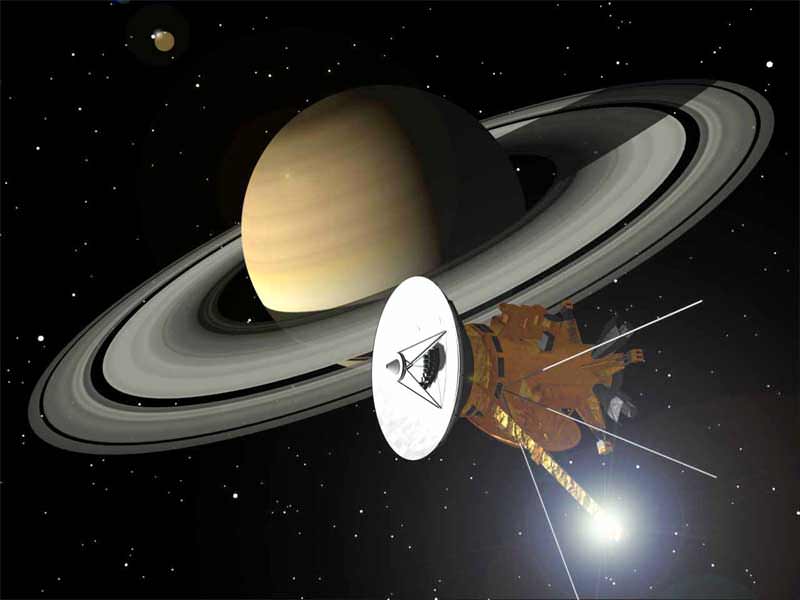
Sometimes people ask what they, as a regular citizen can do to help NASA. Emily Lakdawalla at the Planetary Society Blog posted this today, and this is definitely something to write to members of Congress about. NASA is running out of plutonium-238, which is used to power deep space probes, but it's unclear whether Congress will provide the $30 million that has been requested for the Department of Energy to start new production.
Plutonium-238 has powered dozens of spacecraft, including the Voyager probes, the Galileo mission to Jupiter, and the Cassini spacecraft that is currently sending back such amazing images of Saturn's rings and moons. Because of spacecraft powered by plutonium-238, we now know -- among other things -- that there are volcanoes on Jupiter's moon Io and geysers on Saturn's moon Enceladus.
Plutonium-238 was a by-product of Cold War activities, and the U.S. has not made any new supplies since the 1980s. Since 1993, all of the plutonium-238 the US has used in space probes has been purchased from Russia. It's not the same as plutonium-239, which is used in nuclear weapons; a small marshmallow-sized pellet of plutonium-238 gives off heat, which is used to power spacecraft that can't rely solely on energy from solar panels. Without this energy source, future missions could be canceled.
Emily posted this letter from the chair of the Division of Planetary Sciences of the American Astronomical Society Candy Hansen:
Members of the DPS Federal Relations Subcommittee and the DPS committee carried out our annual "Hill" visits May 13 to key members of Congress. We had two messages – restart domestic production of plutonium-238, and our concerns about R&A carry-over language. With regards to the production of plutonium-238, we are not out of the woods. We still need to convince the members of the Appropriations Subcommittee on Energy and Water that this is a critical need right now – that NASA is already curtailing missions to the outer solar system, and anywhere else plutonium-238 is required (the New Frontiers 3 Announcement of Opportunity ruled out missions which require plutonium-238).
In particular we need constituents of the following states to write letters:
Senate Appropriations Committee Subcommittee on Energy and Water Development: Dorgan (ND) Byrd (WV) Feinstein (CA) Bennett (UT) Hutchison (TX) Murray (WA) Bond (MO) Alexander (TN) Shelby (AL)
Also, Johnson (SD), Cochran (MS), Harkin (IA), Landrieu (LA), Lautenberg (NJ), McConnell (KY), Reed (RI), Tester (MT), Voinovich (OH).
If these are your representatives we need you to write:
House Appropriations Subcommittee on Energy and Water Development: Visclosky (IN) Frelinghuysen (NJ) Edwards (MD) Pastor (AZ) Davis (TN)
Or you live in these districts: IN-01, TX-17, AR-01, PA-02, NY-02, OH-17, MA-01, TN-04, CO-03, NJ-11, TN-03, ID-02, MT, CA-44 and LA-05.
We have a handout that you may wish to send with your letter.
For more background and a letter template, see this page.
Thanks for your efforts!
Candy Hansen