 Universe Today
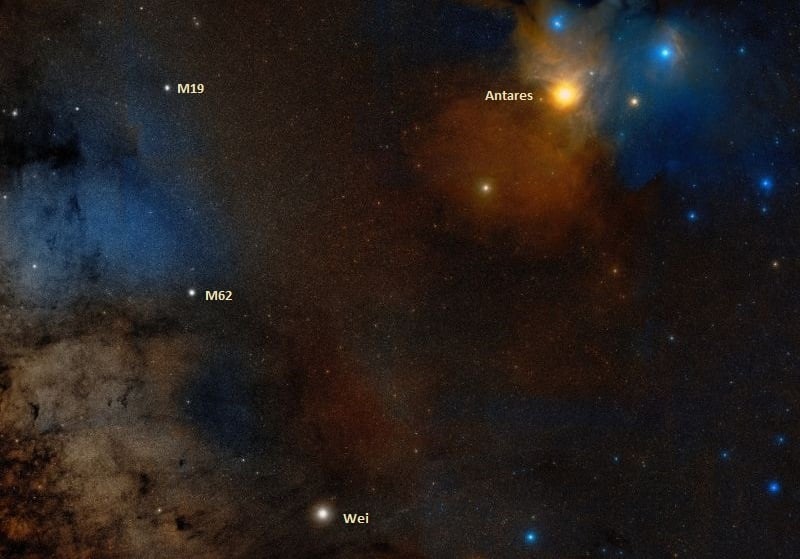
Welcome back to Messier Monday! Today, we continue in our tribute to our dear friend, Tammy Plotner, by looking at the globular cluster known as Messier 62.
In the 18th century, while searching the night sky for comets, French astronomer Charles Messier kept noting the presence of fixed, diffuse objects he initially mistook for comets. In time, he would come to compile a list of approximately 100 of these objects, hoping to prevent other astronomers from making the same mistake. This list – known as the
Messier Catalog
– would go on to become one of the most influential catalogs of Deep Sky Objects.
One of these objects is the globular cluster known as Messier 62, which spans about 100 light-years in diameter and is approximately 22,200 light years from Earth. Located in the southern constellation of
Ophiuchus
, this cluster is easy to find because of its proximity to Antares - the brightest star in
Scorpius constellation
- and is easily viewed suing binoculars and small telescopes.
Description:
Positioned about 22,500 light years away from Earth, this glorious gravitationally bound ball of stars could span as much as 100 light years of space. Captured within its confines are 89 known variable stars - most of them RR Lyrae types. M62 has a very dense core... One which may have experienced core collapse during its long history. An ordinary globular cluster? Not hardly. It's one that holds some optical surprises.
As G. Cocozza (et al) indicated in their
2008 study
:
Is it possible that this is the smoking gun for intermediate mass black holes in globular clusters? Julio Chaname seems to think so. As he explained in his
2009 study
:
History of Observation:
While Charles Messier first discovered this globular cluster on June 7, 1771 - he didn't accurately record its position until June 4, 1779.
Sir William Herschel would resolve it two years after Messier cataloged it, but it was Admiral Smyth who gave it a little more historic significance when he writes in his notes:
Locating Messier 62:
M62 is easily located about 5 degrees (3 finger widths) southeast of Antares - but because it is small, it can easily be overlooked in binoculars. Take your time, because it is only just a little more than an average binocular field away from an easy marker star and bright enough to be seen even with smaller instruments under not so good skies.
In the finderscope of a telescope, begin with Antares in the center and shift southwest. At 5X magnification, it will show as a faint haze. In a small telescope, you may get some resolution - but expect this globular cluster to appear more comet-like. Larger telescopes can expect a wonderful explosion of stars!
Enjoy your observations! And as always, here are the quick facts on this Messier Object to help you get started:
- Object Name
-
Messier 62
- Alternative Designations
-
M62, NGC 6266
- Object Type
-
Class IV Globular Cluster
- Constellation
-
Ophiuchus
- Right Ascension
-
17 : 01.2 (h:m)
- Declination
-
-30 : 07 (deg:m)
- Distance
-
22.5 (kly)
- Visual Brightness
-
6.5 (mag)
- Apparent Dimension
-
15.0 (arc min)
We have written many interesting articles about Messier Objects here at Universe Today. Here's Tammy Plotner's
Introduction to the Messier Objects
,
M1 – The Crab Nebula
, and David Dickison's articles on the
2013
and
2014
Messier Marathons.
Be to sure to check out our complete
Messier Catalog
. And for more information, check out the
SEDS Messier Database
.
Sources:
- Messier Objects - Messier 62
- Wikipedia - Messier 62
- SEDS - Messier 62
