 Universe Today
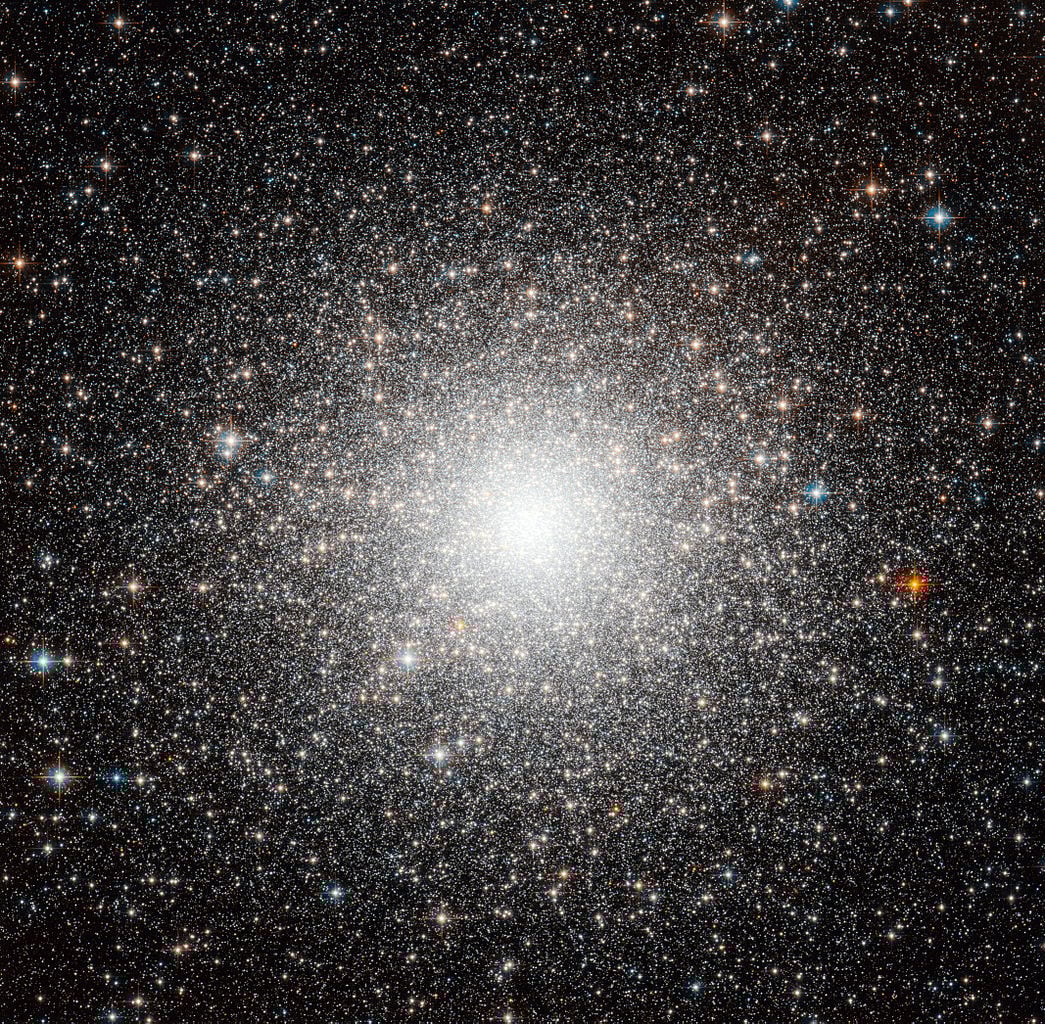
Welcome back to Messier Monday! In our ongoing tribute to the great Tammy Plotner, we take a look at globular cluster known as Messier 54!
During the 18th century, famed French astronomer
Charles Messier
noted the presence of several "nebulous objects" in the night sky. Having originally mistaken them for comets, he began compiling a list of these objects so others would not make the same mistake he did. In time, this list (known as the
Messier Catalog
) would come to include 100 of the most fabulous objects in the night sky.
One of these objects is the globular cluster known as Messier 54. Located in the direction of the Sagittarius constellation, this cluster was once thought to be part of the Milky Way, located about 50,000 light years from Earth, In recent decades, astronomers have come to realize that it is actually part of the Sagittarius Dwarf Galaxy, located some 87,000 light-years away.
What You Are Looking At:
Running away from us at a speed of 142 kilometers per second, this compact globe of stars could be as wide as 150 light years in diameter and as far away as 87,400 light years. Wait... Hold the press... Almost 90 thousand light years? Yeah. Messier 54 isn't part of our own Milky Way Galaxy!
In 1994 astronomers made a rather shocking discovery... this tough to resolve globular was actually part of the Sagittarius Dwarf Elliptical Galaxy. As Michael H. Siegal (et al) said in their study:
Inside its compact depths lurk at least 82 known variable stars - 55 of which are the RR Lyrae type. But astronomers using the Hubble Space telescope have have also discovered there are two semi-regular red variables with periods of 77 and 101 days. Kevin Charles Schlaufman and Kenneth John Mighell of the National Optical Astronomy Observatory explained in their study:
But what other kinds of unusual stars could be discovered inside such distant cosmic stellar evolutionary laboratory? Try a phenomena known as blue hook stars! As Alfred Rosenberg (et al) said in their study:
But with the stars packaged together so tightly, even more has been bound to occur inside of Messier 54. As Tim Adams (et al) indicated in their study:
But the discoveries haven't ended yet.... Because 2009 studies have revealed evidence for an intermediate mass black hole inside Messier 54 - the first known to have ever been discovered in a globular cluster.
History of Observation:
On July 24, 1778 when Charles Messier first laid eyes on this faint fuzzy, he had no clue that he was about to discover the very first extra-galactic globular cluster. In his notes he writes: "Very faint nebula, discovered in Sagittarius; its center is brilliant and it contains no star, seen with an achromatic telescope of 3.5 feet. Its position has been determined from Zeta Sagittarii, of 3rd magnitude."
Years later Sir William Herschel would also study M54, and in his private notes he writes: "A round, resolvable nebula. Very bright in the middle and the brightness diminishing gradually, about 2 1/2' or 3' in diameter. 240 shews too pretty large stars in the faint part of the nebulosity, but I rather suppose them to have no connection with the nebula. I believe it to be no other than a miniature cluster of very compressed stars."
Countless other observations would follow as the M54 became cataloged by other astronomers and each would in turn describe it only as having a much brighter core and some resolution around the edges. Have fun trying to crack this one!
Locating Messier 54:
M54 isn't hard to find... Just skip down to Zeta Sagittarii, the southwestern-most star of Sagittarius "teapot" and hop a half degree south and a finger width (1.5 degrees) west. The problem is seeing it! In small optics, such as binoculars or a finder scope, it will appear almost stellar because of its small size. However, if you just look for what appears like a larger, dim star that won't quite come into perfect focus, then you've found it.
In smaller telescopes, you'll get no resolution on this class III globular cluster because it is so dense. Large aperture doesn't fare much better either, with only some individual stars making their appearance at the outer perimeters. Because of magnitude and size, Messier 54 is better suited to dark sky conditions.
And here are the quick facts on this Messier Object to help you get started:
- Object Name
-
Messier 54
- Alternative Designations
-
M54, NGC 6715
- Object Type
-
Class III Extragalactic Globular Cluster
- Constellation
-
Sagittarius
- Right Ascension
-
18 : 55.1 (h:m)
- Declination
-
-30 : 29 (deg:m)
- Distance
-
87.4 (kly)
- Visual Brightness
-
7.6 (mag)
- Apparent Dimension
-
12.0 (arc min)
We have written many interesting articles about Messier Objects here at Universe Today. Here's Tammy Plotner's
Introduction to the Messier Objects
, ,
M1 – The Crab Nebula
,
M8 – The Lagoon Nebula
, and David Dickison's articles on the
2013
and
2014
Messier Marathons.
Be to sure to check out our complete
Messier Catalog
. And for more information, check out the
SEDS Messier Database
.
Sources: