Universe Today
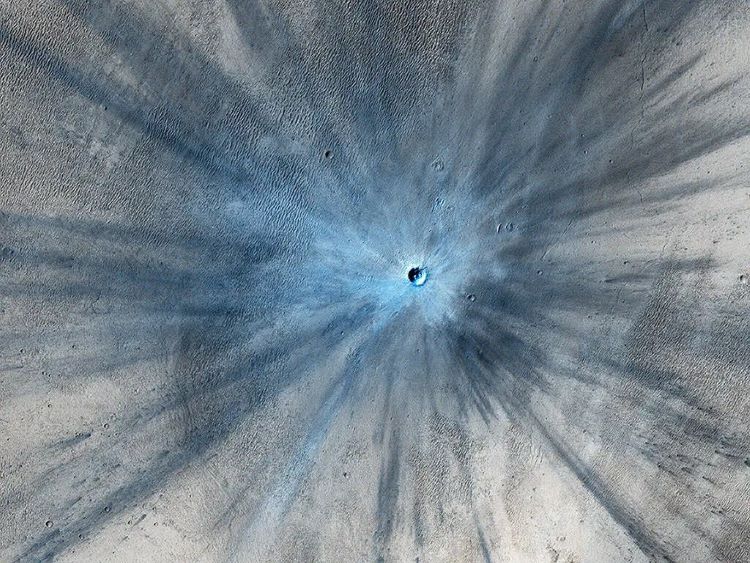
When we look at the Moon, either through a pair of binoculars, a telescope, or past footage from the Apollo missions, we see a landscape that's riddled with what appear to be massive sinkholes. But these "sinkholes" aren't just on the Moon, as they are evident on nearly every planetary body throughout the solar system, from planets, to other moons, to asteroids. They are called impact craters and can range in size from cities to small countries.
Impact craters are caused by rocks ranging in size from dust particles to a few kilometers in diameter that collide with a planetary body's surface at incredible speeds. The result is not only a giant hole in the ground, but the impact also shoots out material from beneath the surface, splattering it in all directions, known as a ray system or ejecta. Some craters are so big that scientists refer to them as giant impacts. But why are impact craters so important to study?
"Collisions are a pervasive physical process during planet formation and evolution," Dr. Sarah T. Stewart, who is a Professor of Earth and Planetary Sciences at UC Davis, tells Universe Today. "While the frequency of collisions is low today compared to the main stages of planet growth, they provide key insights into planetary dynamics, subsurface composition, and internal structure. Collisions also shaped the evolution of life on Earth, which in some cases is well documented such as the Chixculub crater event and its influence on the demise of the dinosaurs. In other cases, such as the roles of collisions in the origin of life, it is less well understood but an active area of research."
Also known as the Chixculub impact event, this event is hypothesized to be a massive impact that occurred on Earth approximately 65 million years ago when an asteroid 10-kilometers (6-miles) in diameter struck just off the northern coast of the Yucatán Peninsula in Mexico. Researchers estimate the resulting blast was equivalent to approximately 100 million megatons while producing a core greater than 5,500 degrees Celsius (10,000 degrees Fahrenheit) and a crater spanning 180 kilometers (110 miles) in diameter and 20 kilometers (12 miles) deep.
Aside from the extreme heat and massive shock waves, the impact also produced sulfuric acid rain from debris raining down onto the planet, loss of ozone, and a massive dust cloud that blocked sunlight, resulting in the extinction of 75 percent of all life on the Earth. But despite the devastating consequences that the Chixculub impact event had for life on Earth, what can studying giant impacts and impact cratering teach us about finding life on other worlds?
"Our views on the relationship between life and impacts have changed dramatically over the past two decades," Dr. Stewart tells Universe Today. "When I was a student, I was taught that impacts would sterilize a planet's surface and inhibit the rise of life. Today, the origin of life community is calling upon impacts to provide chemical and thermal perturbations that would aid pre-biotic chemistry. Since collisions are so common during planet formation, the view has shifted to increase the role of collisions and possible frequency of life as we know it."
The reason why the massive crater from the Chixculub impact event is so well-hidden is due to the planetary surface processes that shape our planet, most notably from erosion, weathering, volcanism, and plate tectonics. These processes have also essentially erased up to millions of other impact craters that have occurred throughout the Earth's approximate 4.6-billion-year history. This is in stark contrast to our Moon and thousands of other planetary bodies throughout the solar system, including planets, moons, and asteroids, which still have craters that could have been produced billions of years ago.
While these processes have erased nearly all impact craters across the globe, one of the most well-preserved impact craters in the world is Meteor Crater, which is located approximately 60 kilometers (37 miles) east of Flagstaff, Arizona. This crater was created approximately 50,000 years ago by an object hypothesized to be 50 meters (150 feet) in diameter, resulting in the crater we see today, which is just under 1.2 kilometers (0.7 miles) in diameter. Therefore, along with all these unique aspects, what are some exciting reasons for both how and why upcoming students should study impact craters?
"Impact craters are always an interesting target for robotic (and human) exploration of other bodies because they provide access to subsurface materials," Dr. Stewart tells Universe Today. "Scientists are still trying to understand how the biggest craters form and how to interpret variations that must be related to the interior properties. Humans are now doing exciting experiments related to planetary defense -- like the DART mission. Planetary protection requires understanding many of the same physical processes as during natural impact events."
Dr. Stewart tells Universe Today, "Impact craters are beautiful, complex, and intriguing planetary features" while encouraging college students to check out Planetary Impacts Community Wiki, which is a science resource for all things impact-related, including online tools, datasets, news, and much more.
What new discoveries will scientists make about impact craters in the coming years and decades? Only time will tell, and this is why we science!
As always, keep doing science & keep looking up!